DropPR.ai Publishes Seven-Signal Framework for AI Source Readiness
Published by: Droppr AI Research Desk
Seven-Signal Framework
Atlanta, Georgia, JUNE 25, 2026 — DropPR.ai today introduced a practical framework for communications teams preparing content for AI-assisted discovery. OpenAI says ChatGPT search can provide links to relevant web sources, while its publisher guidance explains how public sites can be discovered for inclusion.
The framework does not claim to reverse-engineer OpenAI or any other answer engine. It focuses on editorial and technical conditions a brand controls before asking whether a system may retrieve or cite a passage.
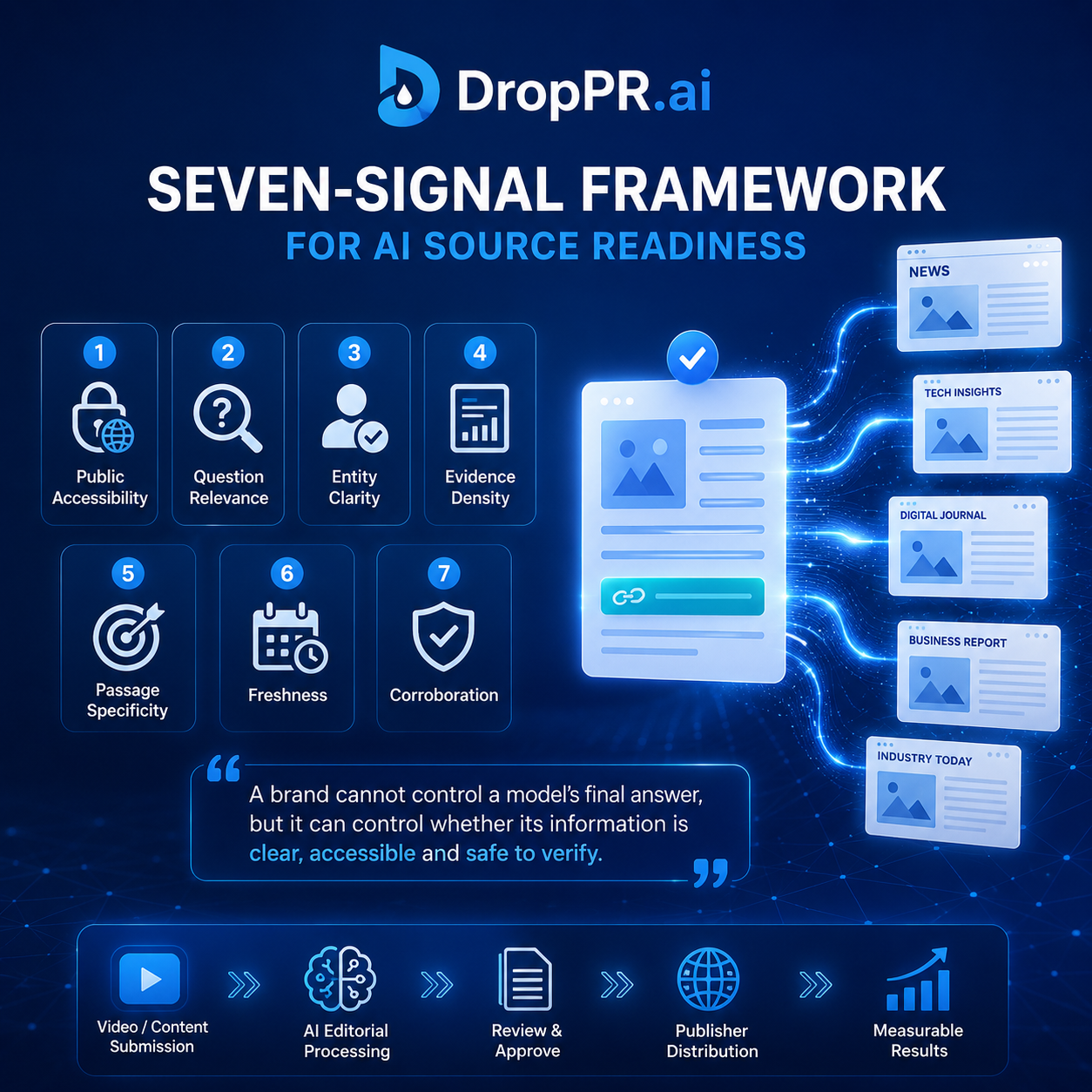
Seven AI Source-Readiness Signals
1.Public accessibility: The page is reachable without accidental crawler blocks or unnecessary friction.
2.Question relevance: The passage directly answers a real audience question.
3.Entity clarity: The organization, product and author are named consistently.
4.Evidence density: Material claims include sources, dates, definitions or methodology.
5.Passage specificity: Statements use concrete facts instead of vague promotion.
6.Freshness: Publication and update dates reflect the current facts.
7.Corroboration: Credible independent sources can confirm important claims.
“A brand cannot control a model’s final answer, but it can control whether its information is clear, accessible and safe to verify,” said Hayden Hollis Head of Growth Marketing.
How to apply it now
Test whether priority pages are public and crawlable. • Rewrite the opening so the primary question receives a direct answer. • Attach primary evidence to every material claim.
Where DropPR.ai fits
DropPR.ai converts user-submitted video and other content into reviewable articles or press releases and distributes approved material through participating publisher networks. The framework improves source quality before distribution; it does not promise a citation, ranking or indexing result.
© 2026 Droppr AI Research Desk