After the Click: What Marketing Looks Like When Discovery Moves to AI
Capstone piece synthesizing the full research cluster. Quotable thesis: marketing built around the click is built for a discovery model already ending — the next decade reorganizes around the citation. Includes an 8-row summary table mapping every major finding from this year's research (trust stacks, owned/earned/AI-distributed, press release format, citable content structure, founder authority, provenance, vertical playbooks) to its core implication, plus a picture of what marketing organizations look like when PR, technical SEO, and content converge around Share of Model as the shared KPI.
By Hayden Hollis
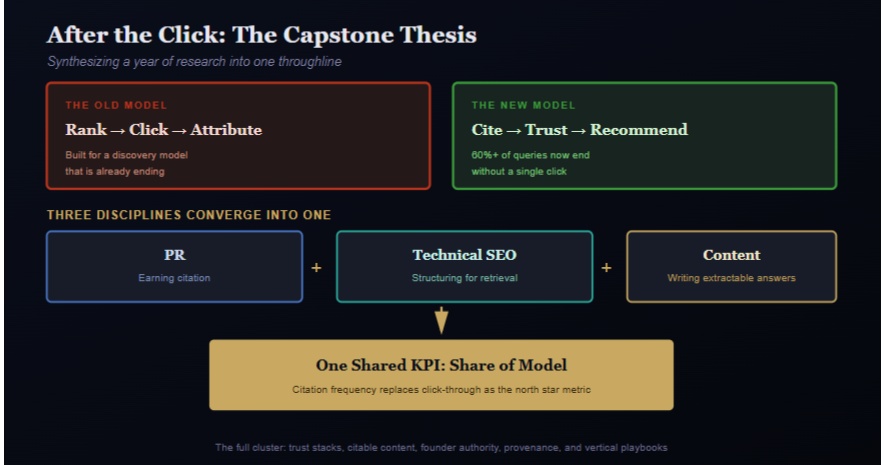
Thesis: Marketing built around the click is marketing built for a discovery model that is already ending. The next decade of marketing will be built around the citation — the moment a brand is named inside an AI-generated answer the buyer never clicks through to verify. Every discipline in the marketing function, from PR to content to paid media to brand strategy, will reorganize around earning and measuring that moment, not around driving traffic to a page.
This is the capstone piece in a cluster that has spent the better part of a year mapping this shift from every angle — the death of the press release as distribution, the rise of Share of Model as a measurement discipline, the specific mechanics of what makes content citable, and the vertical playbooks for creators, agencies, DTC brands, SaaS companies, and local businesses navigating the transition in practice. This article steps back and synthesizes the throughline: what does marketing actually look like when discovery moves from search-and-click to ask-and-cite?
60%+
of search queries in AI-integrated environments now end without a click to any website — the zero-click majority is no longer a minority behavior
3
core disciplines converging into one function: PR (earning citation), technical SEO (structuring for retrieval), and content (writing extractable answers)
0
click-through attribution available for the majority of AI-driven brand discovery — the entire measurement stack marketing has relied on for 20 years does not apply
The Shift in One Sentence
For twenty years, the dominant marketing model has been: create content, optimize it to rank, drive a click, measure the click, attribute the outcome. Every discipline — SEO, content marketing, paid search, even much of PR — has been built to serve this pipeline. AI search breaks the pipeline at its foundation: the click is no longer guaranteed, and increasingly is not even the default outcome of a successful discovery moment. A buyer can now form a complete, confident opinion about your brand, your category position, and your credibility without ever visiting a page you control. The marketing function has to reorganize around a moment that happens entirely outside its traditional measurement instruments.
What This Cluster Has Established, Synthesized
Across this year's research and playbooks, several consistent findings have emerged regardless of vertical, company size, or category. The table below summarizes the core throughlines from this cluster's most load-bearing pieces.
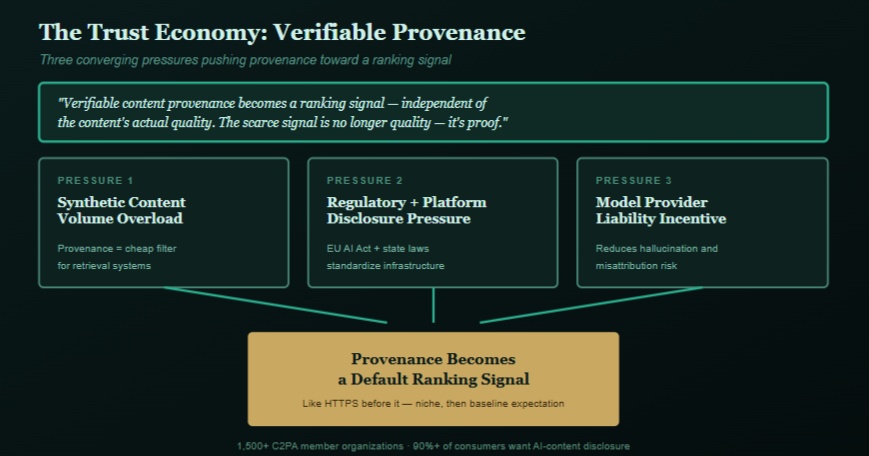
FindingEstablished InCore ImplicationReviews and G2 profiles are foundation, not differentiationThe B2B Trust Stack; Review-Site PlateauEditorial authority is now the deciding layer above table-stakes review presenceSelf-authored positioning claims are discounted by AI modelsOwned vs. Earned vs. AI-DistributedThird-party corroboration is mandatory for any claim of category leadership or superiorityThe wire-service press release model has lost its functionWhy the Press Release Died; The Press Release, RebornDistribution must shift to owned newsroom + direct journalist pitching, not mass syndicationStructural writing determines citation, independent of qualityThe Nine-Step AI-Citable Article FrameworkWell-written content can still be uncitable if structured for human skimming, not model extractionCitation share is measurable, trackable, and improvableShare of Model measurement methodologyA new KPI exists to replace click-based attribution for AI-era visibilityFounder and executive voice outperforms brand-voice contentThe Founder Channel; Creator-Led PRPerson-entity authority is weighted more heavily than Organization-only signalsVertical context changes tactics, not the underlying modelDTC, SaaS, Real Estate, TikTok Shop playbooksThe citation economy applies universally; execution specifics are industry-dependentProvenance and verifiability are the next-generation signalThe Trust Economy: Verifiable ProvenanceNamed, accountable, cryptographically verifiable authorship will matter more as synthetic content scales
What Marketing Organizations Look Like After the Click
PR and content converge into a single discipline. The historical separation between "PR gets us press coverage" and "content marketing writes our blog" made sense when the two disciplines served different funnel stages with different measurement systems. In a citation economy, both disciplines are doing the same underlying job: producing accountable, structured, extractable claims about the brand that third parties or the brand's own owned channels can surface to AI retrieval systems. Organizations that keep these as separate teams with separate KPIs will move slower than organizations that merge the function around a shared goal: citation share.
Technical SEO becomes retrieval engineering. Schema markup, structured data, and site architecture — historically a specialized, somewhat under-resourced technical SEO function — becomes central rather than peripheral. The organizations winning at AI visibility are treating Article, Person, and Organization schema implementation with the same seriousness previously reserved for page speed and Core Web Vitals, because schema accuracy directly determines whether structurally sound content is even eligible for retrieval.
Measurement shifts from attribution to citation tracking. Click-through rate, conversion rate from organic traffic, and backlink count all measured a pipeline that assumed a click occurred. Share of Model — the frequency with which a brand appears, and is cited accurately, across a defined panel of AI-engine queries — measures the thing that actually happens now: a brand being named, described, and recommended inside a generated answer, independent of whether any click follows. Marketing teams that have not built this measurement capability are, in a real sense, flying blind on an increasing share of their buyers' actual discovery experience.
Brand and demand generation stop being sequential. The traditional funnel logic — brand awareness at the top, demand generation converting further down — assumed a multi-touch journey with visible, attributable steps. When a buyer's entire consideration process can happen inside a single AI conversation, brand and demand collapse into the same moment: the brand's citation-worthiness at the instant of the query is simultaneously an awareness event and a consideration event. This does not eliminate the need for both functions, but it eliminates the clean separation between them.
What Does Not Change
It would be a mistake to read this shift as marketing becoming unrecognizable. The underlying disciplines this cluster has repeatedly returned to — genuine expertise, real customer evidence, accurate data, credible third-party validation — are not new requirements invented by AI search. They are the same requirements good marketing and good PR have always had, now enforced more literally and more measurably by a retrieval system that has no patience for unsubstantiated claims, vague positioning, or content optimized purely for algorithms rather than genuine usefulness. AI search has not lowered the bar for what counts as credible. If anything, it has raised it, by making credibility mechanically verifiable rather than a matter of persuasive writing.
The Capstone Argument
The organizations that will win the next decade of marketing are not the ones with the biggest content budgets or the most aggressive SEO tactics. They are the ones that treat citation — being named accurately, favorably, and consistently inside AI-generated answers — as the central object of the entire marketing function, and rebuild their org structure, measurement systems, and content production processes around earning it deliberately rather than hoping it happens as a byproduct of legacy tactics that were built for a discovery model already in decline.
This is not a call to abandon everything that came before. It is a call to recognize that the destination buyers are arriving at has moved, and that marketing, as a function, has to move with it — from the click to the citation, from ranking to retrieval, from attribution to Share of Model. The brands that make this shift deliberately, now, will hold a durable advantage over the ones still optimizing for a click that an increasing share of their buyers will never make.
The Full Cluster · Curated by the DropPR Editorial Desk
Build the Marketing Function for the Citation Economy
Every playbook in this cluster, operationalized for your brand.
DropPR is the execution layer for the shift this article describes — editorial placement, schema implementation, newsroom architecture, and Share of Model measurement, built around citation as the central KPI rather than the click.
Citation Economy Starter Stack
Baseline Share of Model audit across 4 AI engines ($1,500 value)
First editorial placement written to the Nine-Step Framework ($1,200 value)
Full schema implementation across owned properties ($750 value)
30-day post-launch citation share monitoring ($400 value)
Total stack value: $3,850 Charter pricing from $99.
No subscription. No retainer. Pay per placement.
Data Sources Referenced
Semrush (2026) · Zero-click query share in AI-integrated search environments.
Bigeye (2026) · Answer Engine Optimization complete guide; discipline convergence analysis.
LLMrefs (2026) · AI search visibility measurement methodology.
DropPR analysis (2026) · Cluster synthesis and capstone thesis, drawing on the full 2026 research and playbook series.
Hayden Hollis
Head of Growth Marketing · DropPR.ai
Hayden Hollis writes about content distribution, digital PR, SEO, AI search, and creator marketing. His work focuses on how brands and creators can extend the reach of their content beyond social media and improve visibility across search engines, news publishers, and AI-powered discovery platforms. He regularly covers strategies related to earned media, audience growth, authority building, and the evolving role of AI in online discovery.