The Trust Economy: Verifiable Provenance as a Ranking Signal
Forward-looking thesis: within three years, cryptographically verifiable content provenance (C2PA, content credentials, named/disclosed authorship) will function as a ranking and citation signal — independent of content quality — as synthetic content volume, regulatory disclosure pressure, and AI-provider liability incentives converge. Explains what provenance is, why it becomes structurally necessary rather than optional, and three concrete actions to take now, before the tipping point.
By Hayden Hollis
Thesis: Within three years, verifiable content provenance — cryptographic proof of who created a piece of content, when, and with what tools — will function as a ranking and citation signal in its own right, independent of the content's actual quality or accuracy. This is not a prediction about AI detection tools improving. It is a prediction about the incentive structure inverting: as synthetic content becomes cheaper and more abundant, the scarce and valuable signal is no longer "is this well-written" but "can this be verified," and search and AI systems will route around unverifiable content by default rather than as an exception.
This is a forward-looking argument, not a report of an already-implemented system. The infrastructure — the Coalition for Content Provenance and Authenticity (C2PA) standard, cryptographic content credentials, and the beginning of platform-level adoption — already exists. What has not yet happened is the tipping point where AI search and answer engines begin treating provenance as a first-class signal rather than a niche compliance feature for news and image content. This article makes the case for why that tipping point is closer than most marketing and PR teams assume, and what to do about it now, before it becomes a scramble.
1,500+
organizations now participating in the C2PA standard, including major camera manufacturers, publishers, and AI model providers
90%+
of surveyed consumers report wanting to know whether content was AI-generated or human-created, per multiple 2025–2026 trust surveys
0
major AI search engines currently using content provenance as an explicit, documented ranking or citation factor — the gap this article argues will close
What Content Provenance Actually Is
Content provenance, in the C2PA framework, is a cryptographically signed record attached to a piece of content — an image, video, audio file, or increasingly, text — documenting its origin: who or what created it, what tools were used, what edits were made, and when. Think of it as a nutrition label for content authenticity, verifiable independent of the platform hosting the content. A photo with C2PA content credentials can be traced back through its editing history even after it has been reposted, cropped, or re-uploaded across a dozen platforms.
The standard originated primarily to address image and video misinformation — deepfakes, manipulated photos, AI-generated imagery passed off as real. Text-based provenance is a newer and less mature extension of the same idea: verifiable proof that an article was written by a named, identifiable human or organization, using a documented process, rather than generated wholesale by an anonymous AI system and published without disclosure.
Why This Becomes a Ranking Signal, Not Just a Trust Badge
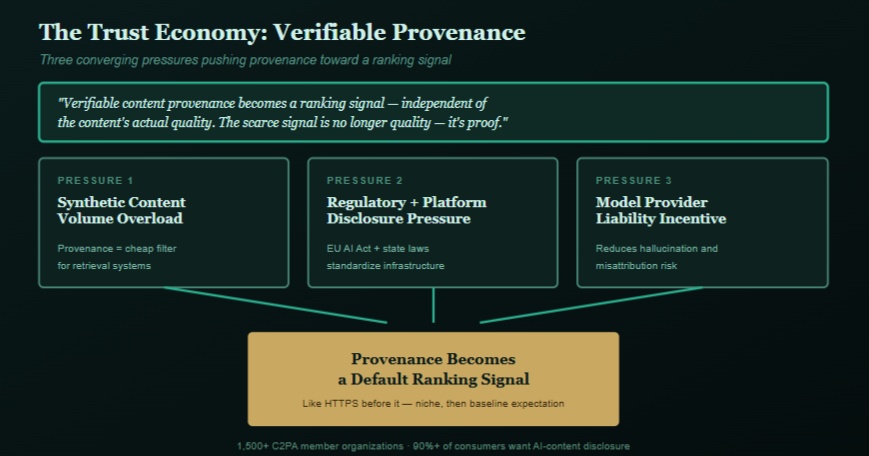
The argument for provenance becoming a ranking signal rests on three converging pressures, each independently pushing in the same direction.
Pressure 1 — Synthetic content volume is overwhelming retrieval systems. AI search engines retrieve and synthesize from a web increasingly populated by AI-generated content, much of it created specifically to game retrieval systems rather than to inform readers. As the volume of low-effort synthetic content grows, the marginal cost to a retrieval system of verifying a source's legitimacy becomes worth paying — provenance becomes a cheap, automatable filter for reducing the candidate pool of sources worth considering for a citation.
Pressure 2 — Regulatory and platform pressure is pushing disclosure requirements. The EU's AI Act and various U.S. state-level AI disclosure laws are beginning to require labeling of AI-generated content in specific contexts (political advertising, deepfakes, certain commercial contexts). As disclosure becomes a legal requirement in more jurisdictions and content categories, the infrastructure for verifying and displaying that disclosure becomes standardized — and once standardized, it becomes trivially available for retrieval systems to consume as a signal, not just a compliance checkbox.
Pressure 3 — Model providers themselves have a strong incentive to prioritize verified sources. AI companies face direct reputational and legal risk when their models cite fabricated, manipulated, or synthetic content as fact. A retrieval system that can verify "this article was written by a named journalist at a publication with an established editorial process, cryptographically confirmed" versus "this article's origin cannot be verified" has a clear, low-cost way to reduce hallucination and misattribution risk. This is not a hypothetical incentive — it is the same incentive that already drives AI companies to weight established publishers over anonymous content farms; provenance simply formalizes and automates a judgment currently made through blunter proxies like domain authority.
What This Looks Like in Practice
The practical mechanism will likely resemble how HTTPS became a ranking factor in traditional search: initially a niche technical signal relevant mainly to security-conscious sites, eventually a baseline expectation that unencrypted sites were penalized for lacking. Content provenance will likely follow a similar arc — initially relevant mainly to news, research, and high-stakes commercial content, eventually a baseline signal that unverified content is discounted against by default, not through an explicit penalty but through the retrieval system preferring verified alternatives whenever one exists.
For brands and publishers, this means: articles with verifiable, disclosed authorship (a named human author, an editorial process, ideally cryptographic content credentials once text-based C2PA tooling matures) will be preferentially retrieved and cited over anonymous or undisclosed-authorship content addressing the same topic with similar quality. The differentiator will not be "is this well-written" — AI-assisted writing tools have made baseline quality nearly universal — but "can this be verified as coming from an accountable, identifiable source."
What to Do Now, Before the Tipping Point
Action 1 — Standardize named, verifiable authorship on all published content. Every article your organization publishes should have a named author with a linked Person schema entity, not an anonymous "Team" or "Staff" byline. This is the baseline infrastructure provenance verification will build on, and it costs nothing to implement now.
Action 2 — Monitor C2PA tooling as it extends to text content. The standard is most mature for image and video; text-based content credentials are an active area of development. Organizations that adopt text provenance tooling early, as it becomes available, will have an established track record by the time retrieval systems begin weighting it — a first-mover advantage similar to early HTTPS adopters.
Action 3 — Build an internal editorial process worth disclosing. If your content is genuinely written, reviewed, and fact-checked by identifiable humans, document that process in a way that can eventually be verified and disclosed. If your content pipeline is entirely AI-generated with no human review, this is a genuine strategic risk under the thesis of this article — not because AI-assisted writing is inherently low-quality, but because undisclosed, unverifiable authorship is precisely the category retrieval systems will learn to discount.
Further Reading · Curated by the DropPR Editorial Desk
Build Verifiable Authorship Before It's a Requirement
Named authorship, Person schema, and editorial process — the foundation provenance will be built on.
DropPR ensures every placement carries named, verifiable authorship with proper Person and Organization schema linkage — the baseline infrastructure your content needs in place before content provenance becomes a formal citation signal.
Verifiable Authorship Stack
Named author assignment + Person schema implementation ($300 value)
Editorial article placement with verified, disclosed authorship ($1,200 value)
Organization + Person schema audit across your existing content ($400 value)
Total stack value: $1,900 Charter pricing from $99.
No subscription. No retainer. Pay per placement.
Data Sources Referenced
C2PA (2026) · Coalition membership figures; content credentials standard specification.
Multiple consumer trust surveys (2025–2026) · Over 90% of respondents want AI-generated content disclosed.
European Union AI Act · Disclosure requirements for synthetic and AI-generated content in specified contexts.
DropPR analysis (2026) · Forward-looking thesis on provenance as an emerging ranking and citation signal.
Hayden Hollis
Head of Growth Marketing · DropPR.ai
Hayden Hollis writes about content distribution, digital PR, SEO, AI search, and creator marketing. His work focuses on how brands and creators can extend the reach of their content beyond social media and improve visibility across search engines, news publishers, and AI-powered discovery platforms. He regularly covers strategies related to earned media, audience growth, authority building, and the evolving role of AI in online discovery.