FAQ-Driven Content: Why Question-Answer Structure Wins Citations
This article is written entirely in self-demonstrating Q&A format — every heading is a real question, every answer is a complete, standalone 40–80 word claim, mirroring exactly how AI retrieval systems match queries to answers. Covers FAQ schema's shifted role from traditional SEO rich-snippets to AI-era citation tool, optimal answer length, when FAQ format helps versus hurts, and includes a working FAQPage JSON-LD schema snippet.
By Hayden Hollis
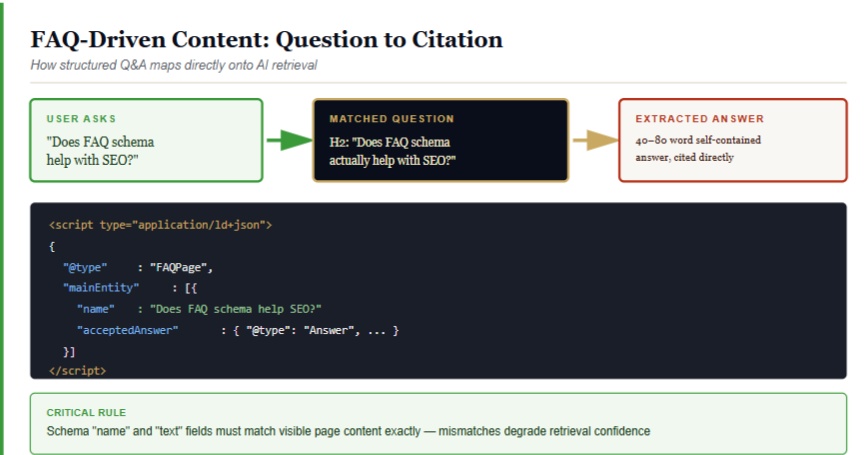
This article is written entirely in question-and-answer format — not as a stylistic choice, but because the format itself is the argument. Every AI search engine query is, functionally, a question. An article structured as a series of direct questions and direct answers maps onto that retrieval pattern more closely than any other content format, which is why FAQ-structured content consistently shows higher extraction and citation rates across category queries. Read the rest of this piece as a demonstration of the format it describes.
What is FAQ-driven content, and why does it matter for AI search?
FAQ-driven content is any piece of content structured as a series of explicit questions followed by direct, self-contained answers, rather than flowing narrative prose. It matters for AI search because retrieval systems are fundamentally built to match a user's question against the closest available answer in their indexed corpus. A page that already contains the question in something close to the user's actual phrasing, followed immediately by a complete answer, requires the least transformation work for the model to extract and present — which measurably increases the likelihood of citation.
Does FAQ schema actually help with traditional SEO, or is this only an AI search tactic?
FAQ schema (the FAQPage structured data type) has a mixed history with traditional Google Search — Google reduced the visual rich-result treatment for FAQ schema in 2023 for most sites, limiting expanded FAQ snippets primarily to government and health authority sites. However, the schema itself remains a valid, machine-readable signal that AI search engines and answer engines parse independently of how Google's traditional search results display it. The value proposition has shifted: FAQ schema is now primarily an AI-era citation tool rather than a traditional SEO rich-snippet tool, and should be evaluated on that basis rather than on legacy SERP appearance expectations.
What makes a question "AI-search-ready" versus a weak FAQ question?
A strong, AI-search-ready question mirrors how a real user would phrase the query to a search engine or chat assistant — natural language, specific, and answerable in a self-contained way. "What is the difference between AEO and SEO?" is strong. "About Our Approach" is not a question at all and provides nothing for a retrieval system to match against. Weak FAQ questions are typically either too vague ("How does this work?") or written from the company's internal perspective rather than the user's ("What is our proprietary methodology?") rather than the user's actual concern.
How long should an FAQ answer be to maximize citation likelihood?
Based on DropPR's placement dataset, answers between 40 and 80 words produce the highest extraction rates. Answers shorter than 40 words often lack sufficient substance to be useful as a standalone citation. Answers longer than 80 words frequently contain multiple ideas that should be split into separate questions, and long-form answers are less likely to be extracted cleanly as a single unit. The 40–80 word range consistently produces answers dense enough to be useful and short enough to be lifted whole.
Should every article be converted into FAQ format, or does this only work for certain content types?
Not every article benefits from full FAQ conversion. Narrative content — case studies, founder stories, in-depth investigative pieces — loses value when forced into a rigid question-answer structure, because the narrative arc itself is part of what makes the content compelling and citable. FAQ format works best for explainer content, comparison content, troubleshooting or how-to content, and any piece answering a discrete set of related questions a buyer or reader is likely to ask. A practical rule: if the content's core value is a series of distinct facts or clarifications, use FAQ format. If the core value is a story or an argument that builds progressively, use standard narrative prose instead.
Where should FAQ content live — as a standalone page, or embedded within existing articles?
Both, for different purposes. A standalone FAQ page dedicated to a specific topic (e.g., "Answer Engine Optimization: Frequently Asked Questions") functions as a comprehensive resource that can accumulate authority and links over time. Embedding a shorter FAQ section within a longer article — typically 3 to 6 questions near the end of the piece — captures adjacent, related queries that the main article body doesn't directly address, without requiring a separate page. Both formats should carry FAQ schema; the schema, not the page structure, is what signals the content to retrieval systems.
What does the FAQ schema markup actually look like, and how do you implement it correctly?
The schema uses the JSON-LD format with a FAQPage type, containing a mainEntity array of Question objects, each with an acceptedAnswer of type Answer. Here is a minimal, valid example matching the second question in this article:
<script type="application/ld+json">
{
"@context": "https://schema.org",
"@type": "FAQPage",
"mainEntity": [{
"@type": "Question",
"name": "Does FAQ schema actually help with traditional SEO?",
"acceptedAnswer": {
"@type": "Answer",
"text": "FAQ schema remains a valid, machine-readable signal that AI search engines and answer engines parse independently of Google's traditional rich-snippet display. The value has shifted primarily to AI-era citation rather than SERP appearance."
}
}]
}
</script>
Critical implementation requirements: the name field must match the visible question text on the page exactly, and the text field inside acceptedAnswer must match the visible answer text exactly. A mismatch between schema content and visible page content — a common error when schema is generated separately from the page copy — degrades the model's confidence in the page as a reliable structured data source and should be avoided entirely.
How many questions should a single FAQ schema block contain?
There is no strict technical limit, but practical guidance from observed AI citation patterns suggests 5 to 12 questions per schema block produces the best balance of comprehensiveness and quality. Below 5, the page likely doesn't cover enough distinct queries to be worth a dedicated FAQ treatment. Above 12, question quality typically declines as teams pad the list to hit a round number, which dilutes the overall density and citation value of the page.
Can FAQ content cannibalize or compete with a brand's own existing articles on the same topic?
This is a legitimate concern, and the answer depends on execution. FAQ content should complement existing long-form articles by addressing the specific, narrow sub-questions the main article doesn't answer directly — not duplicate the main article's core argument in a shorter format. A well-executed FAQ page or section increases a brand's total surface area for a topic; a poorly executed one creates redundant, thin content that dilutes the authority of the primary article. The test: does each FAQ question address something the main article does not cover in equivalent depth? If yes, the FAQ adds value. If the FAQ is simply restating the article's main points in shorter form, it should be removed or merged.
Further Reading · Curated by the DropPR Editorial Desk
Turn Your Existing Content Into a Question-Answer Citation Machine
Every DropPR placement includes a schema-matched FAQ section where the topic warrants it.
DropPR audits your existing content for FAQ conversion opportunities, writes schema-compliant question-answer sections in the 40–80 word citation-optimal range, and implements exact-match FAQPage schema validated against Google's Rich Results Test.
FAQ Conversion + Schema Stack
Content audit for FAQ conversion opportunities ($300 value)
Question-answer writing (up to 10 questions, 40–80 words each) ($500 value)
Exact-match FAQPage schema implementation ($350 value)
Rich Results Test validation and error correction ($150 value)
Total stack value: $1,300 Charter pricing from $99.
No subscription. No retainer. Pay per placement.
Data Sources Referenced
DropPR internal placement dataset (2026) · Optimal FAQ answer length (40–80 words) and question count (5–12) benchmarks.
Google Developers · FAQPage structured data specification and 2023 rich-result display change for most site types.
Frase (2026) · GEO question-answer content structuring guidance.
Bigeye (2026) · Answer Engine Optimization best practices for FAQ and Q&A formatted content.
Hayden Hollis
Head of Growth Marketing · DropPR.ai
Hayden Hollis writes about content distribution, digital PR, SEO, AI search, and creator marketing. His work focuses on how brands and creators can extend the reach of their content beyond social media and improve visibility across search engines, news publishers, and AI-powered discovery platforms. He regularly covers strategies related to earned media, audience growth, authority building, and the evolving role of AI in online discovery.