From Transcript to Trusted Source: Converting Talks Into Articles
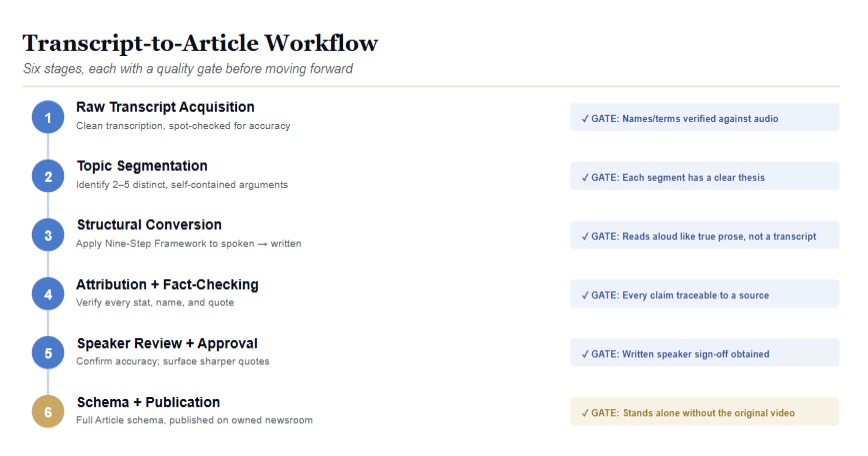
A six-stage workflow for converting recorded talks, webinars, and interviews into citable, schema-marked articles — raw transcript acquisition, topic segmentation, structural conversion using the Nine-Step Framework, attribution and fact-checking, speaker review, and schema publication. Each stage has a quality gate that must pass before proceeding. Includes a worked example showing how one 45-minute talk becomes three distinct standalone articles.
By Hayden Hollis
A 45-minute conference talk, podcast interview, or webinar contains more original expertise than most brands publish in a quarter of blog content. It also almost never gets converted into anything AI engines can retrieve. The talk lives as a video file or an audio recording — formats that current-generation AI search engines do not parse, index, or cite directly. The insight is real. The distribution is zero. This is one of the largest untapped content sources most PR and content teams have sitting in their own archive.
This is a workflow for converting a spoken talk into a citable, AI-retrievable article — with a quality-gate checklist at each stage to make sure the output is genuinely citable, not just a dumped transcript with paragraph breaks added. The process mirrors the production chain used across this journal's other conversion work: raw source, structural pass, editorial pass, schema and publication.
0%
of raw video or audio content is directly indexed or cited by current AI search engines — conversion to text is mandatory for retrieval
6–8
hours typical turnaround from a 45-minute talk to a fully published, schema-marked article using this workflow
3–5
standalone articles that can typically be extracted from a single substantive 45-minute talk, if segmented by distinct topic rather than published as one long piece
Stage 1: Raw Transcript Acquisition
Action: Obtain a clean transcript of the talk. Most conference platforms, webinar tools (Zoom, Riverside, Descript), and podcast hosting tools now offer automated transcription. If none is available, use a dedicated transcription tool rather than attempting manual transcription — accuracy on technical terms and named entities matters for the steps that follow.
Quality gate 1: Verify speaker names are correctly attributed throughout, especially in multi-speaker talks (panels, interviews, fireside chats). Verify technical terms, product names, and company names are transcribed correctly — automated transcription frequently mangles proper nouns and industry jargon. Do not proceed to Stage 2 until the transcript has been spot-checked against the audio for the first two minutes and any section containing specific data, statistics, or named entities.
Stage 2: Topic Segmentation
Action: Read through the full transcript and identify distinct, self-contained topics or arguments the speaker makes. A single 45-minute talk covering multiple subtopics should almost never become a single article — it should be segmented into 2–5 separate articles, each built around one coherent argument or insight. Mark timestamp ranges for each identified segment.
Quality gate 2: Each identified segment must contain a complete, standalone argument — not just a topic label. "The speaker talks about pricing strategy" is not sufficient; the segment must have an identifiable thesis, such as "usage-based pricing outperforms seat-based pricing for developer tools because it aligns cost with realized value." If a segment does not have a clear thesis, either combine it with an adjacent segment or discard it — thin segments produce thin, uncitable articles.
Stage 3: Structural Conversion
Action: For each segment, convert the spoken language into structured written prose. This is not a light edit — spoken language and written language have fundamentally different structures. Speakers use filler words, restate points multiple times for a listening audience, use incomplete sentences that work when heard but not when read, and rely on vocal emphasis that does not translate to text. The conversion should preserve the speaker's actual ideas, examples, and voice while restructuring the delivery entirely for the written medium.
Apply the Nine-Step AI-Citable Article Framework during this conversion: lead each article with a direct answer to the implicit question the segment addresses; make paragraphs self-contained; anchor any statistics the speaker cited with their original source (ask the speaker or check their slides if the source wasn't stated verbally); use descriptive headers; maintain consistent entity naming; preserve or add a clearly quotable version of the speaker's most substantive point; and structure any comparisons explicitly rather than leaving them embedded in conversational flow.
Quality gate 3: Read the converted article aloud. If it still sounds like a transcript with punctuation added — repetitive phrasing, false starts, verbal tics ("you know," "right," "so basically") — it has not been sufficiently converted. A properly converted article should read as though it were written directly for publication, with no trace of its spoken origin, while remaining completely faithful to the speaker's actual argument and examples.
Stage 4: Attribution and Fact-Checking
Action: Confirm every statistic, company name, product claim, and quote attributed to the speaker in the converted article. If the speaker cited a source verbally ("according to a study I read"), track down the actual source and cite it properly in the article — a vague verbal citation is not sufficient for a written, schema-marked piece. If a source cannot be verified, either remove the claim or clearly frame it as the speaker's personal observation rather than a sourced fact.
Quality gate 4: Every specific number, named entity, and attributed claim in the article must be traceable to either the original talk (with timestamp reference for internal verification) or an external source cited in-text. No claim should exist in the published article that cannot be defended if a reader or journalist asks "where did that come from?"
Stage 5: Speaker Review and Approval
Action: Send the converted article to the original speaker (if they are internal to your organization, or an external speaker you have a relationship with) for review before publication. This step serves two purposes: it confirms the conversion accurately represents their argument, and it often surfaces an opportunity for the speaker to add a sharper quote or clarify a point that came across ambiguously in speech.
Quality gate 5: The speaker should confirm, in writing, that the article accurately represents what they intended to communicate — not necessarily word-for-word what they said, but the substance of their argument. If the speaker requests substantial changes, treat this as new source material requiring a return to Stage 3, not a quick patch.
Stage 6: Schema and Publication
Action: Publish the finished article on your owned newsroom (or pitch it as a byline to a relevant publication, depending on the strategic goal). Implement full Article schema: headline, author (linked to the speaker's Person schema entity if they have one), datePublished, and about fields matching the visible content. If the original talk is publicly available (a recorded webinar, a conference video posted on YouTube), link to it from the article as supplementary context — but ensure the article itself is fully readable and citable independent of the video.
Quality gate 6: Validate the published URL through Google's Rich Results Test. Confirm the article stands alone as a complete, citable piece without requiring the reader to watch the original talk for context — if it does not, return to Stage 3.
Worked Example: One Talk, Three Articles
A 45-minute conference talk titled "The Future of B2B Marketing" by a marketing executive might cover: (1) a specific argument about why traditional lead scoring is broken, with data the speaker cited from their own company's pipeline; (2) an unrelated but substantive point about how their team restructured content production around AI search visibility; and (3) a closing anecdote about a specific campaign that failed and what they learned. Rather than one long "notes from my talk" article, this becomes three distinct pieces: "Why Traditional Lead Scoring Models Are Failing B2B Teams in 2026," "How We Restructured Content Production for AI Search Visibility," and a shorter piece built around the campaign failure and lesson. Each stands alone, each is citable independently, and each can be pitched or published on a different timeline and to a different audience.
Further Reading · Curated by the DropPR Editorial Desk
Turn Your Recorded Talks Into Citable Articles
Your best expertise is probably sitting in a video file nobody can cite.
DropPR runs the full transcript-to-article workflow: transcription cleanup, topic segmentation, structural conversion against the Nine-Step Framework, fact-checking, speaker review coordination, and schema-marked publication. Send us the recording — we handle every stage through to a citable, published article.
Talk-to-Article Conversion Stack
Transcript cleanup + topic segmentation (up to 3 articles) ($600 value)
Structural conversion to Nine-Step Framework compliance ($900 value)
Fact-checking and source verification ($300 value)
Article schema implementation and Rich Results validation ($350 value)
Total stack value: $2,150 Charter pricing from $99.
No subscription. No retainer. Pay per placement.
Data Sources Referenced
DropPR internal workflow analysis (2026) · Turnaround benchmarks and segment-per-talk yield.
Bigeye (2026) · Content format retrieval limitations; video/audio invisibility to text-based AI search.
Google Developers · Article structured data specification for converted content.
Hayden Hollis
Head of Growth Marketing · DropPR.ai
Hayden Hollis writes about content distribution, digital PR, SEO, AI search, and creator marketing. His work focuses on how brands and creators can extend the reach of their content beyond social media and improve visibility across search engines, news publishers, and AI-powered discovery platforms. He regularly covers strategies related to earned media, audience growth, authority building, and the evolving role of AI in online discovery.