Agencies and AI Visibility: Productizing Citation as a Client Deliverable
Marketing agencies are fielding client requests for "AI search visibility" without a standardized way to scope, deliver, or price it. A three-tier service-packaging framework (Audit → Foundation Program → Growth Program) with defined scope, deliverables, and KPIs for each tier, pricing and positioning guidance, and a monthly report
By Hayden Hollis
Marketing agencies have spent two years watching AI search visibility become a client priority without having a clean way to sell it. The typical agency conversation goes: a client asks "can you help us show up when people ask ChatGPT about our category?" and the agency account lead improvises a scope built from SEO habits, PR habits, and guesswork. There is no standard package, no standard deliverable, no standard way to price it. This is a solvable problem, and the agencies that solve it first will own a new revenue line before the category commoditizes.
This is a service-packaging framework: how to productize AI visibility (also called AEO, GEO, or citation optimization) as a resellable client deliverable with defined scope, concrete outputs, and measurable KPIs. The goal is not to reinvent PR or SEO — it's to package the specific tactics that drive AI citation into something a client can buy, understand, and see results from within a quarter.
58%
of marketing agencies report client requests for "AI search" or "ChatGPT visibility" services in the past 12 months, up from near-zero in 2024
$3K–$15K
typical monthly retainer range agencies are charging for structured AI visibility programs, depending on scope and reporting depth
73%
of agencies currently offering AI visibility services report doing so without a standardized package — ad hoc scoping per client
Why Agencies Are Struggling to Package This
AI visibility sits at the intersection of three disciplines agencies already sell separately: SEO (technical structure, schema, content optimization), PR (earned media, third-party validation, press placement), and content marketing (thought leadership, original research). No single existing service line owns the full picture, so agencies default to selling it as an add-on to whichever discipline they're strongest in. An SEO agency sells "AI search optimization" as schema markup and content restructuring. A PR agency sells it as press placement with an AI angle bolted on. Both are incomplete, because AI citation depends on signals from all three disciplines working together — a company with perfect schema and zero press coverage is just as invisible to AI engines as a company with great press and no structured data.
The fix is not choosing one discipline. It's packaging a cross-disciplinary service with clear scope boundaries, specific deliverables, and KPIs that map to what's actually being measured: citation frequency, not rankings; Share of Model, not traffic; retrieval eligibility, not backlinks.
The Service Package: Three Tiers
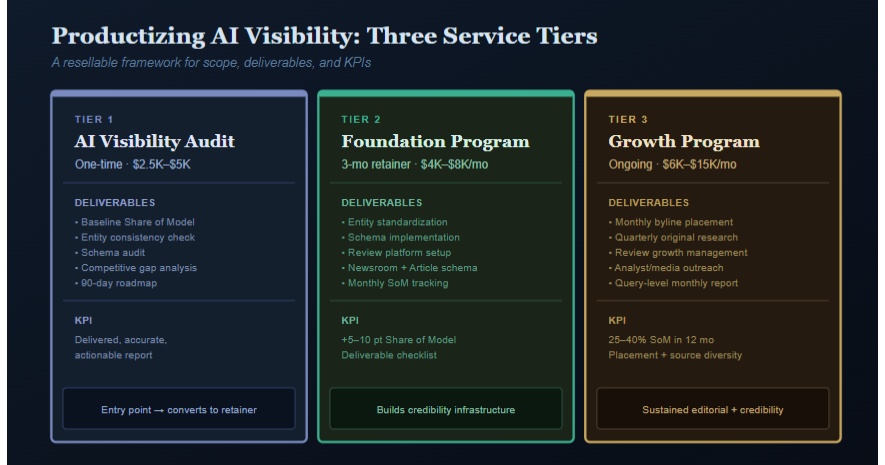
Tier 1 — AI Visibility Audit (One-Time, $2,500–$5,000)
Scope: A diagnostic engagement, not an ongoing program. Deliverable-focused, sold as a standalone entry point that can convert into a retainer.
Deliverables: (1) Baseline Share of Model report — a 20–30 query panel run across ChatGPT, Perplexity, Google AI Overviews, and Claude, measuring current citation frequency for the client's brand versus named competitors; (2) Entity consistency audit — checking brand descriptor alignment across Wikipedia, Crunchbase, LinkedIn, G2, and the client's own site; (3) Technical schema audit — Organization, Person, and Article schema presence and validation status; (4) Competitive gap analysis — which competitors are being cited, and via which sources (press, reviews, analyst mentions); (5) A prioritized 90-day action roadmap with recommended next-tier engagement.
KPI: Delivery of the report itself. This tier is diagnostic, not results-based — the KPI is a completed, accurate, actionable audit document delivered on schedule.
Tier 2 — AI Visibility Foundation Program (3-Month Retainer, $4,000–$8,000/month)
Scope: Implementation of the audit's priority recommendations. This tier builds the entity and technical foundation required before editorial tactics can be effective.
Deliverables: (1) Entity standardization — rewriting and aligning brand descriptors across all major platforms; (2) Schema implementation — Organization and Person schema deployed and validated on client's website; (3) Review platform optimization — G2/Capterra/Trustpilot profile completion and initial review campaign setup (client-side execution, agency-managed strategy); (4) One structured newsroom or press page setup on the client's own domain with Article schema; (5) Monthly Share of Model tracking against the Tier 1 baseline.
KPI: Percentage improvement in Share of Model from baseline (target: 5–10 percentage point improvement over 3 months for foundation-stage clients), plus completion checklist of technical deliverables (schema validated, profiles standardized, newsroom live).
Tier 3 — AI Visibility Growth Program (Ongoing Retainer, $6,000–$15,000/month)
Scope: Sustained editorial and credibility-building program. This tier is where PR expertise becomes central — it requires actual media placement, not just technical setup.
Deliverables: (1) Monthly founder/executive byline placement on relevant publications (minimum one per month); (2) Quarterly original research or data-driven content piece published to the client's newsroom; (3) Ongoing review platform management (review volume growth targets); (4) Analyst outreach and relationship-building (for B2B clients) or roundup/media list targeting (for consumer clients); (5) Monthly Share of Model report with query-level detail — which specific queries show the client, which don't, and recommended content or placement to close gaps; (6) Quarterly competitive benchmarking against 3–5 named competitors.
KPI: Share of Model growth (target: reaching 25–40% citation share on a defined query panel within 12 months, depending on category competitiveness), number of placements secured, and qualitative tracking of citation source diversity (are citations coming from press, reviews, or analyst mentions — diversification is a health signal).
Pricing and Positioning Guidance
Do not price this as a discount add-on to existing SEO or PR retainers. AI visibility requires distinct measurement (Share of Model tooling or manual query panels), distinct expertise (understanding retrieval and citation mechanics, not just ranking factors), and distinct client education (most clients do not yet understand why this differs from traditional SEO). Price it as its own line item, even if delivered by the same team members handling other services.
Position the audit (Tier 1) as the low-commitment entry point for skeptical or budget-conscious clients. Most agencies find the audit converts to a retainer at a 60–70% rate when the audit surfaces a clear, embarrassing gap (e.g., "your top three competitors are cited in 80% of category queries and you appear in zero"). The audit does the selling; the agency does not need to oversell in the initial pitch.
For existing SEO or PR clients, position AI visibility as a natural extension rather than a new vendor relationship: "the tactics we're already running (content, press placement, schema) feed directly into this — we're adding a measurement layer and a few specific tactics your current program doesn't cover." This reduces friction for clients who are already paying for adjacent services.
What to Avoid Selling
Do not sell guaranteed citation outcomes. AI engines are non-deterministic and citation behavior shifts as models update — an agency that promises "we will get you cited in ChatGPT's top answer for X query" is setting up a client conflict when model behavior changes for reasons outside the agency's control. Frame KPIs around Share of Model improvement and specific deliverable completion, not guaranteed placement in specific answers.
Do not sell "AI SEO tricks" or techniques aimed at manipulating model outputs rather than building genuine credibility signals (schema stuffing, fake reviews, content designed purely for scraping rather than human readability). These tactics produce short-term citation gains that collapse when platforms update detection methods, and they expose the agency to reputational risk if a client's manipulation attempt is publicly identified.
Reporting Template for Client Retention
Monthly reporting should include: (1) Current Share of Model score versus prior month and versus the original baseline; (2) query-level breakdown showing which specific queries include the client and which don't; (3) citation source analysis (what's driving current citations — press, reviews, schema, or a mix); (4) competitor comparison on the same query panel; (5) completed deliverables for the month (bylines placed, reviews added, schema updates); (6) next month's priority actions. This report format doubles as a retention tool — clients renew retainers when they can see concrete monthly progress against a clear baseline, which is exactly what generic "we did some PR this month" reporting fails to provide.
Further Reading · Curated by the DropPR Editorial Desk
Resell AI Visibility Without Building It From Scratch
DropPR powers the placement layer behind your agency's AI visibility packages.
Agencies use DropPR as the execution layer for Tier 2 and Tier 3 deliverables — founder byline placement, newsroom setup with schema, and monthly Share of Model reporting — white-labeled under your agency brand. You keep the client relationship and the strategy; we handle placement execution and measurement infrastructure.
Agency Partner Stack
White-labeled AI Visibility Audit template + delivery support ($1,500 value)
Founder/executive byline placement execution for your clients ($1,000/placement value)
Client newsroom setup with Article schema implementation ($2,000 value)
Monthly Share of Model reporting, white-labeled for your clients ($400/month value)
Total stack value: $4,900+ per client engagement Partner pricing from $99 per placement.
For marketing agencies, PR agencies, and SEO agencies reselling AI visibility services. Pay per placement.
Data Sources Referenced
Semrush (2026) · 58% of agencies report client requests for AI search visibility services in the past 12 months.
Bigeye (2026) · Agency pricing benchmarks for structured AI visibility retainers.
LLMrefs (2026) · Agency service standardization gap; 73% offering ad hoc scoping.
Omnia (2026) · Share of Model measurement methodology for client reporting.
DropPR analysis (2026) · Three-tier service packaging framework; audit-to-retainer conversion benchmarks.
Hayden Hollis
Head of Growth Marketing · DropPR.ai
Hayden Hollis writes about content distribution, digital PR, SEO, AI search, and creator marketing. His work focuses on how brands and creators can extend the reach of their content beyond social media and improve visibility across search engines, news publishers, and AI-powered discovery platforms. He regularly covers strategies related to earned media, audience growth, authority building, and the evolving role of AI in online discovery.