AI Search Visibility for DTC Brands: A Field Guide
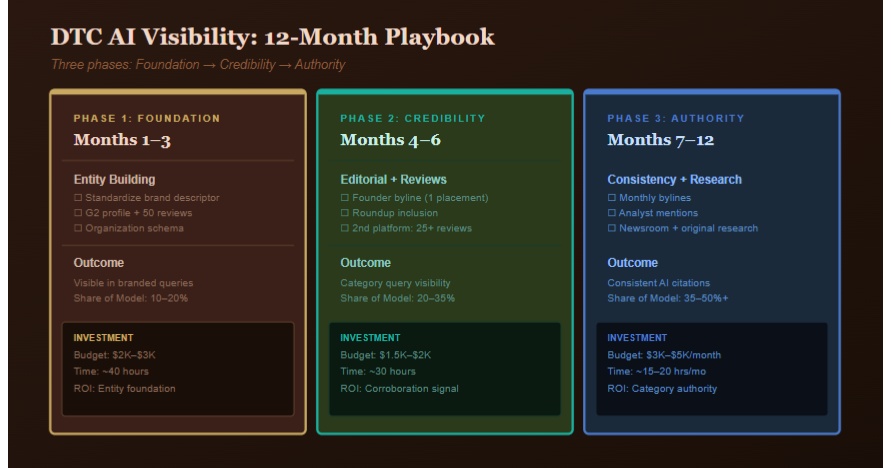
A prioritized 12-month action plan for DTC brands entering AI-driven product discovery, sequenced by impact and resource requirement. Months 1–3: entity building + G2 density. Months 4–6: editorial placement + roundup inclusion. Months 7–12: founder byline program + analyst mentions + newsroom. Track Share of Model monthly. For mid-market DTC brands ($1M–$10M revenue) with existing press relationships and review platform presence.
By Hayden Hollis
The DTC playbook of the last five years — owned audience, email list, paid social, influencer partnerships — optimized for a retail environment where discovery happened on Instagram, TikTok, and Google Shopping. AI search has not destroyed this playbook. It has created a parallel discovery surface that most DTC brands are not optimizing for at all, and that is beginning to determine which products get recommended when a buyer asks ChatGPT, Perplexity, or Google AI "what product should I use for X?"
This is a field guide: a prioritized action plan for DTC brands trying to establish visibility in AI-driven product discovery. The recommendations are sequenced by impact and resource requirement — start with the actions that move the needle most, then expand as team capacity increases. The guide assumes a mid-market DTC brand (7-figure annual revenue, existing press relationships, established review platform presence) and builds from there.
63%
of DTC product buyers ask AI engines for recommendations before purchasing — the emerging primary discovery surface for direct-to-consumer
34.5%
of commercial AI Overviews cite review platforms — G2, Capterra, and category-specific review sites drive AI product citation
2–4
brands typically named per product category query in AI answers — tighter competitive set than organic search
Months 1–3: Foundation (Entity Building + Review Density)
Priority 1 — Get your Wikipedia page (if you don't have one). Wikipedia is cited in roughly 15% of AI-synthesized answers for brand/product queries. A Wikipedia page is not mandatory, but brands with Wikipedia presence see a corroboration signal that brands without do not. If you have $10,000 in budget, allocate $2,000 to a Wikipedia consultant to research whether your brand qualifies for a page and to build one if it does. If you do not have budget, skip this and move to Priority 2.
Priority 2 — Standardize your brand descriptor everywhere. Pull your current brand description from Wikipedia (if you have a page), Crunchbase, LinkedIn, G2, and your website homepage. They should be identical, word-for-word, across all surfaces. If they are not, rewrite each one to match the canonical version. AI engines build entity disambiguation through repeated consistent descriptors. Inconsistency forces averaging toward vagueness. This step takes four hours and zero budget.
Priority 3 — Audit and improve your G2 presence. G2 is cited in 34.5% of commercial AI Overviews for product category queries. This is the single highest-leverage review platform for DTC. Required actions: claim your G2 profile if not already claimed, update all profile fields (company description, logo, pricing, product features), add at least three team members as verified employees, and begin a systematic review campaign targeting customers who have recently purchased and deployed. Target 50 substantive reviews (reviews longer than 100 words) within 90 days. Allocate $1,500–$2,000 for review platform management software (Trustpilot, G2 partner tools, or in-house) to systematize the process.
Priority 4 — Build Organization and Person schema on your website. Your homepage and founder/executive bio pages need proper Organization and Person schema markup. This is technical but not complex — you can implement it in two to four hours using JSON-LD and your CMS. Validate both pages with Google's Rich Results Test. This step is the highest-ROI technical fix available to DTC brands and costs nothing beyond the time investment.
Months 1–3 outcomes: Your brand entity is standardized, verified on G2, discoverable via schema, and has the foundation for AI citation. You have not yet earned editorial corroboration, but the entity-building layer is solid. Expect to see your brand appear in AI answers for branded queries (searches specifically for your product name) during this period.
Months 4–6: Credibility (Editorial Placement + Analyst Mentions)
Priority 5 — Place one founder byline on a consumer or business media property. DTC founder brands are more believable to buyers than corporate brand voices. Place your founder on a relevant consumer publication, business media, or vertical publication. The article should address a problem your product solves or a trend your product represents. Example: a sustainable coffee brand founder writes a piece on "Why Coffee Subscriptions Are Finally Solving the Stale Beans Problem" on a food or lifestyle publication. Cost: $800–$1,200 if outsourced; free if in-house. This placement serves two functions: it builds the founder's person entity, and it creates a third-party editorial mention of the brand and product in a trusted source that AI engines retrieve from.
Priority 6 — Target inclusion in a vertical roundup or "best products" article. Identify three to five publications, influencer sites, or specialist reviewers that cover your product category and that are cited by AI engines. Pitch for inclusion in their "best X for Y" roundup or product review. Goal: land in two roundups within 90 days. These roundups are often cited directly by AI engines and serve as the canonical list for a category. Being named in the list puts you in the consideration set automatically.
Priority 7 — Build a legitimate review campaign on at least one additional platform. G2 is Priority 3. For months 4–6, add either Trustpilot (for consumer brands), Capterra (for SaaS-adjacent products), or the category-specific review site most-cited for your category. Target 25–30 reviews on the new platform. Continue building G2 to 75 reviews total.
Months 4–6 outcomes: Your brand is mentioned in third-party editorial sources (roundups, founder byline) and has substantive review presence on multiple platforms. You have moved from entity-building-only to corroboration-building. Expect to see your brand appear in AI answers for category-level queries ("best coffee subscription services") during this period, not just branded queries.
Months 7–12: Authority (Consistent Placement + Category Thought Leadership)
Priority 8 — Establish a monthly founder or exec byline program. One byline per quarter is not enough for authority compounding. Shift to one byline per month on relevant publications. The articles should be strategically spaced across different publication types: consumer media, business media, vertical publications, and founder-focused platforms. Each byline builds both the founder's person entity and the brand's category associations. Cost: $1,000–$1,500 per byline if outsourced; $300–$500 if in-house.
Priority 9 — Pursue analyst or industry expert mentions. Identify analysts covering your category (Gartner, Forrester, IDC for enterprise; niche analysts for consumer categories). Pursue placement in their annual reports or research on your category. This step requires longer lead times (3–6 months) but produces high-weight corroboration signals. Even a mention in an analyst report carries more citation weight than five consumer media placements.
Priority 10 — Launch a structured newsroom on your website. Implement the newsroom architecture described in "The Owned Newsroom" — a dedicated hub on your domain where you publish announcements, research, and founder perspectives. Implement full Article schema on every newsroom page. Link all external editorial coverage back to the corresponding newsroom announcement. This creates the anchor structure that third-party coverage points to and that AI engines cite. Cost: $2,000–$3,000 for initial setup and schema implementation.
Priority 11 — Build original research or data relevant to your category. If you have access to proprietary customer data, usage data, or market research relevant to your category, package it as original research and publish it on your newsroom. Examples: "2026 Consumer Coffee Subscription Usage Report" or "Survey: How Home Office Product Choices Have Changed Since 2024." Original research is one of the few owned content formats that AI engines retrieve and cite directly. Cost: $3,000–$8,000 depending on research scope.
Months 7–12 outcomes: Your brand has consistent editorial presence (one byline per month), has been mentioned in analyst reports or roundups, and has owned research available on your newsroom. You have moved from corroboration-building to authority-building. By the end of month 12, your brand should appear in AI answers for most category-relevant queries with reasonable frequency.
Ongoing: Maintenance and Expansion
After month 12, shift to a maintenance cadence: one founder byline per month, quarterly analyst outreach, continuous review platform management (aim for 100+ reviews on your primary platform, 50+ on secondary platforms), and monthly newsroom updates with announcements, customer stories, or new research. Track your Share of Model monthly on a 30-query panel across ChatGPT, Perplexity, Google AI Overviews, and Claude. Use the Share of Model measurement to identify query category gaps where your brand is absent and prioritize editorial placements targeting those gaps.
Further Reading · Curated by the DropPR Editorial Desk
Get Your DTC Brand Into AI Product Recommendations
A sequenced 12-month playbook that takes your brand from invisible to recommended.
DropPR runs the full DTC AI visibility playbook: entity standardization, review platform management, editorial placement, founder byline program, and newsroom setup with schema. We measure your Share of Model monthly and adjust the strategy based on what's working.
DTC AI Visibility 12-Month Stack
Brand descriptor standardization audit across all surfaces ($300 value)
G2 profile optimization + 50-review campaign (Months 1–3) ($1,200 value)
Founder editorial byline placement (Month 4) ($1,200 value)
Newsroom setup with Article schema implementation ($2,000 value)
Monthly Share of Model measurement + strategic adjustments ($400/month value)
Total stack value: $6,500+ Charter pricing from $99 per placement.
For DTC brands, ecommerce, and direct-to-consumer product companies. Pay per placement.
Data Sources Referenced
Semrush (2026) · 63% of DTC product buyers query AI engines for recommendations before purchasing.
BrightEdge (Q1 2026) · 34.5% of commercial AI Overviews cite review platforms.
Bigeye (2026) · 2–4 brands named per product category query in AI answers.
LLMrefs (2026) · Wikipedia citation frequency; AI product discovery trends.
Omnia / Profound (2026) · DTC brand visibility benchmarks and Share of Model ranges.
DropPR analysis (2026) · 12-month DTC AI visibility playbook sequencing and prioritization.
Hayden Hollis
Head of Growth Marketing · DropPR.ai
Hayden Hollis writes about content distribution, digital PR, SEO, AI search, and creator marketing. His work focuses on how brands and creators can extend the reach of their content beyond social media and improve visibility across search engines, news publishers, and AI-powered discovery platforms. He regularly covers strategies related to earned media, audience growth, authority building, and the evolving role of AI in online discovery.