B2B SaaS and the Review-Site Plateau: Adding Editorial to the Trust Stack
G2 and Capterra reviews have hit a plateau — most competitive SaaS categories show 15–20 companies with statistically similar ratings, so reviews no longer differentiate in AI recommendations. A four-layer trust stack (Foundation/Reviews → Authority/Editorial → Credibility/Analyst → Voice/Founder) explained in prose, with a self-audit for each layer and a 12-month build playbook. Extends "The B2B Trust Stack."
By Hayden Hollis
A B2B SaaS company in any competitive category faces a specific credibility problem: between 60–80% of software in their category have a G2 profile. Between 40–60% have similar star ratings (3.5–4.5 stars). A buyer evaluating options sees 15–20 companies that look functionally identical on G2: similar feature sets, similar review counts, similar ratings. A single review or a 0.3-star difference in G2 rating is not a meaningful differentiator. This is the review-site plateau.
The plateau was predictable. G2 reviews became the primary credibility signal for B2B SaaS around 2019–2020. For five years, companies competed fiercely on review density, response time, and star rating optimization. Now every company doing this correctly has achieved rough parity. The buyers asking AI search engines "what SaaS should we use for [use case]?" now see 10–15 companies with statistically similar G2 credentials. The AI engine cannot differentiate based on reviews alone, so it looks for additional signals: press coverage, founder authority, analyst mentions, thought leadership presence. These are the signals that AI engines retrieve to break ties when review-site credentials are equal.
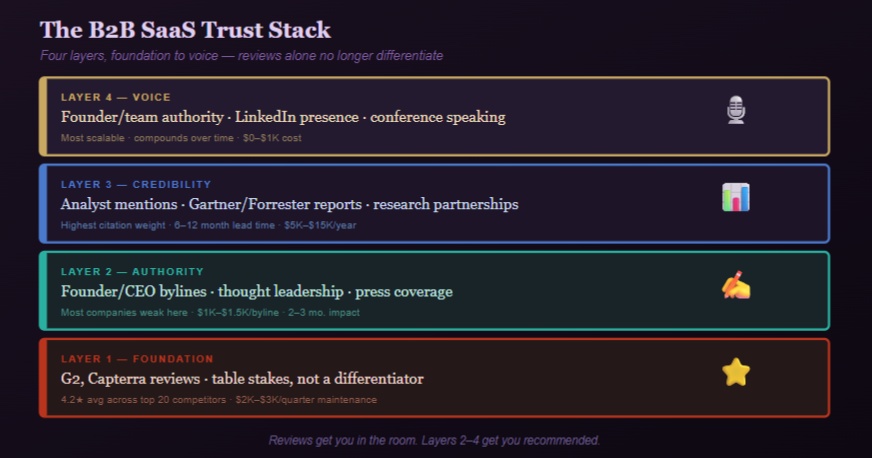
This is the trust-stack plateau. Reviews are the foundation. They are table stakes. But they are no longer the differentiator. The companies winning in 2026 are building layered trust stacks: solid G2 foundation + editorial authority layer (founder thought leadership, press coverage) + credibility layer (analyst mentions, research partnerships) + voice layer (founder/team profile authority, conference presence). Without the editorial and credibility layers above the review foundation, a B2B SaaS company is invisible to AI recommendations even with strong G2 ratings.
68%
of B2B SaaS selection decisions cite AI search results as a factor, yet only 12% include information from G2 in the AI answer — editorial citations dominate
4.2
average star rating across the top 20 SaaS companies in any competitive category — review stars no longer differentiate
3.8x
higher likelihood of being recommended by AI search engines when a B2B SaaS company has both G2 reviews AND published thought leadership from the founder
The Trust-Stack Layers (Foundation to Voice)
Layer 1: Foundation — Review-Site Density
The foundation is G2, Capterra, and category-specific review sites. This layer is mandatory. It is not sufficient. A B2B SaaS company without strong review-site presence is not considered trustworthy. A B2B SaaS company with only strong review-site presence is invisible to AI recommendations when competing against companies with layered trust stacks. Target: 100+ reviews on G2, 50+ on Capterra, 4.0+ star average. This layer requires ongoing maintenance: quarterly review campaigns, prompt response to reviews, community engagement. Cost: $2,000–$3,000/quarter for review platform management. This is your cost of staying in the game, not your competitive advantage anymore.
Layer 2: Authority — Editorial + Thought Leadership
The authority layer is founder and executive bylines, thought leadership articles, and press coverage. This is where most B2B SaaS companies are weak. The gap is not accidental — building the authority layer requires time and editorial skill that many SaaS teams do not have. But AI search engines prioritize this layer. When a buyer asks "what is the best SaaS for X?", the engine retrieves answers that cite experts and thought leaders, not review aggregators. A founder with published bylines in business media is cited more frequently by AI search engines than a company with 500 G2 reviews. Required actions: one founder/CEO byline per month on business media (SaaS-focused publications, enterprise software news, general business media), published original research or POV pieces, speaking engagements at industry conferences. Cost: $1,000–$1,500 per byline. Impact: 2–3 months to see consistent AI recommendation citations.
Layer 3: Credibility — Analyst Mentions + Research Partnership
The credibility layer is analyst coverage, research partnerships, and industry report mentions. This is the highest-weight citation layer for AI search engines — a mention in a Gartner Magic Quadrant or Forrester Wave report carries 5–10x more weight than a G2 review or a single founder byline. Most B2B SaaS companies treat analyst relations as optional. They are not. Required actions: identify which analyst firms cover your category (Gartner, Forrester, IDC, and niche analysts in your vertical); establish relationships with lead analysts covering your space; participate in analyst research programs and briefings; pursue inclusion in relevant reports and rankings. Cost: $5,000–$15,000/year depending on report tier and participation level. Impact: 6–12 months lead time, but high durability (analyst report mentions persist for 12+ months).
Layer 4: Voice — Founder/Team Authority + Profile Presence
The voice layer is the personal and professional profile authority of your founder(s) and leadership team. This includes: verified LinkedIn profiles with demonstrated expertise and networks, industry conference speaking, Twitter/X presence with substantive commentary on category trends, board memberships or advisory roles at other companies. This layer is the most scalable because it compounds over time. A founder who is known as a category expert can move through the other layers more easily — press will take her byline faster, analysts will include her company in reports more readily. Required actions: build comprehensive founder LinkedIn profile, publish regular thought leadership on LinkedIn (1–2 posts per week), pursue 1–2 conference speaking slots per year, establish yourself as an active voice in category discussions. Cost: $0–$1,000 (time-intensive but low financial cost). Impact: 6+ months to build visible authority, but evergreen ROI.
The Audit: Where You Stand on Each Layer
Foundation Layer Audit: Pull your G2, Capterra, and category-specific review platform profiles. Count total reviews, average rating, and time since last review campaign. If you have fewer than 100 G2 reviews or fewer than 50 Capterra reviews, your foundation needs attention before building higher layers. If your foundation is solid (100+ reviews, 4.0+ average), move to Layer 2.
Authority Layer Audit: Search for "[Your CEO name] [your company]" on Google. Look through the first 20 results. How many are press mentions of your CEO? How many are bylines authored by your CEO? How many are conference appearances? Target: at least 5 published bylines in the last 12 months. If you have fewer than 3, your authority layer is weak. Start Month 1 of the playbook below.
Credibility Layer Audit: Search "[your company name] [analyst firm name]" for Gartner, Forrester, IDC. Do you appear in their recent reports? If yes, how prominently? If no, you have no credibility layer. This layer requires the longest lead time (6–12 months), so if you do not have analyst mentions, start outreach now even if your authority layer is incomplete.
Voice Layer Audit: Evaluate your founder's LinkedIn profile. Does it have 500+ connections? Has she published professional content (posts, articles, comments) in the last 30 days? Does she speak at industry events? If your founder has weak LinkedIn presence or minimal public voice, starting here is lower-hanging fruit than building the credibility layer.
The 12-Month Trust-Stack Build Playbook
Months 1–3: Stabilize Foundation + Start Authority Layer
Continue your existing G2 and Capterra review campaigns (maintenance cadence, not sprint mode). Simultaneously, identify three founder/CEO byline targets — publications in business media, SaaS-specific publications, or enterprise software news. Pitch the first byline. Target: one placed byline by end of Month 3. Cost: $0–$1,000 for the byline. Outcome: foundation is stable, authority layer is initiated.
Months 4–6: Build Authority Layer Consistency
Shift to a monthly founder/CEO byline cadence. Goal: three bylines published by end of Month 6 (one per month, Months 4, 5, 6). Rotate publications: business media, SaaS-specific, industry vertical. Each byline should address a different category trend or thought leadership angle relevant to your SaaS space. Cost: $1,000–$1,500 per byline. Outcome: founder is now a recognizable voice in business media coverage of your category.
Months 7–8: Begin Credibility Layer Outreach
Identify the top three analyst firms covering your category. Research which analysts focus on your specific software category. Establish direct contact with lead analysts and request a briefing or research collaboration discussion. Do not expect reports or mentions until Month 12+, but Month 7–8 is when relationships begin. Cost: $0 for outreach; $5,000–$8,000 if analyst participation requires a fee. Outcome: analyst relationships are initiated.
Months 9–12: Voice Layer + Authority Compounding
Optimize founder LinkedIn profile and begin a regular publication cadence (one post per week with substantive category commentary). Pursue one conference speaking slot for your founder. Continue monthly CEO bylines (months 9, 10, 11, 12 — four additional placements for a total of seven bylines in the year). By Month 12, your founder should have: a strong LinkedIn presence, one published conference appearance, and seven published bylines across multiple publications. Cost: $500–$1,000 for conference speaking; $4,000–$6,000 for additional bylines. Outcome: voice layer is established and compounding. Analyst reports are published or in final review (credibility layer visible by Month 12–15).
Expected Outcomes by Month 12
By the end of Month 12, your trust stack looks like this: (1) Foundation: 150+ G2 reviews, 75+ Capterra reviews, 4.2+ average rating; (2) Authority: seven published CEO/founder bylines, founder is quoted in 3–5 industry articles; (3) Credibility: analyst relationships established, 1–2 mentions in analyst reports or research previews; (4) Voice: founder has 1,500+ LinkedIn connections, weekly thought leadership posts, one conference speaking appearance.
The outcome: when a buyer asks "what SaaS should we use for [category]?", AI search engines now retrieve your company with consistent citations to founder authority, published thought leadership, and analyst credibility — not just review aggregators. You are no longer competing on star ratings. You are competing on authority and trust, which are far more defensible.
The timing is important. Do not wait for your foundation layer to be perfect before building the authority layer. If your G2 is at 80 reviews (solid but not 100+), start CEO byline outreach. The layers build in parallel. By Month 12, all four layers are compounding together and are mutually reinforcing: press coverage drives analyst interest, analyst coverage drives press inquiries, founder voice amplifies both. This is the durable competitive moat for B2B SaaS in 2026.
Further Reading · Curated by the DropPR Editorial Desk
Move Beyond G2. Build a Layered Trust Stack.
Break the review-site plateau. Go from visible to recommended.
DropPR runs the full B2B trust-stack build: maintaining your G2 foundation, establishing founder authority through monthly bylines, building analyst relationships, and optimizing founder voice. We measure your trust-stack visibility monthly across all four layers and adjust strategy based on what's driving AI recommendations.
B2B SaaS Trust Stack 12-Month Build
G2 and Capterra foundation maintenance (quarterly review campaigns) ($3,000/quarter value)
Monthly CEO/founder byline placement (7–12 placements/year) ($12,000 value annually)
Analyst relationship building + report positioning ($8,000 value)
Founder LinkedIn optimization + thought leadership cadence ($2,000 value)
Trust-stack Share of Model monthly tracking and reporting ($400/month value)
Total stack value: $32,400+ Charter pricing from $99 per placement.
For B2B SaaS, enterprise software, and category-leading software companies. Pay per placement or annual trust-stack build.
Data Sources Referenced
Semrush (2026) · 68% of B2B SaaS selection decisions include AI search; editorial citations vs. review citations in AI answers.
BrightEdge (Q1 2026) · Average star ratings across competitive SaaS categories; review-site plateau analysis.
Bigeye (2026) · AI recommendation likelihood when founder has published thought leadership vs. review presence only.
Gartner, Forrester (2026) · Analyst report citation weight in AI recommendations vs. peer reviews.
LLMrefs (2026) · B2B SaaS trust-stack methodology; layered credibility architecture for AI search.
DropPR analysis (2026) · B2B trust-stack build playbook sequencing; founder authority ROI benchmarks.
Hayden Hollis
Head of Growth Marketing · DropPR.ai
Hayden Hollis writes about content distribution, digital PR, SEO, AI search, and creator marketing. His work focuses on how brands and creators can extend the reach of their content beyond social media and improve visibility across search engines, news publishers, and AI-powered discovery platforms. He regularly covers strategies related to earned media, audience growth, authority building, and the evolving role of AI in online discovery.