TikTok Shop Sellers and the Credibility Gap: Building Press Beyond the Platform
TikTok Shop success (high follower count, strong sales) does not equal AI discoverability. A seven-figure seller can be invisible to AI product recommendations if they lack off-platform credibility signals. A before/after credibility framework and a 90-day step plan (entity setup, Trustpilot campaign, founder byline, business verification, schema) specifically designed for creator-sellers with 100K–1M TikTok followers and zero press presence.
By Hayden Hollis
A TikTok Shop seller with 500K followers and a seven-figure annual revenue can still be invisible to 87% of potential customers if those customers are asking AI engines instead of scrolling TikTok for product recommendations. The TikTok Shop ecosystem has solved the platform-native problem: how to turn TikTok followers into buyers on TikTok. It has not solved the off-platform credibility problem: how to establish trustworthiness in the systems — news media, review platforms, analyst reports, business media — where AI engines source their product recommendations.
This is the credibility gap for TikTok Shop sellers. A seller can own their TikTok success, but that success is walled inside the platform. The moment a potential customer leaves TikTok and asks ChatGPT or Perplexity "is [seller name] legitimate?" or "should I buy from [seller]?", the seller's TikTok presence is invisible. The AI engine retrieves from review platforms, news coverage, and third-party verification — none of which most TikTok Shop sellers have built.
This article is a step plan specifically designed for the primary TikTok Shop seller ICP: a creator-seller with 100K–1M followers, solid TikTok sales, and zero press presence or off-platform credibility signals. It frames the credibility gap, provides a before/after example of what's possible, and lays out the 90-day playbook for closing it.
62%
of TikTok Shop customers would buy more frequently if they had greater trust in the seller — credibility is the highest-leverage growth lever
0%
of current AI product recommendation citations include TikTok Shop seller reviews or TikTok platform signals — completely off-platform credibility is required
3
primary credibility signals AI engines check before recommending a seller: press coverage, review platform ratings, and founder/brand profile legitimacy
Before: The Current Credibility Gap
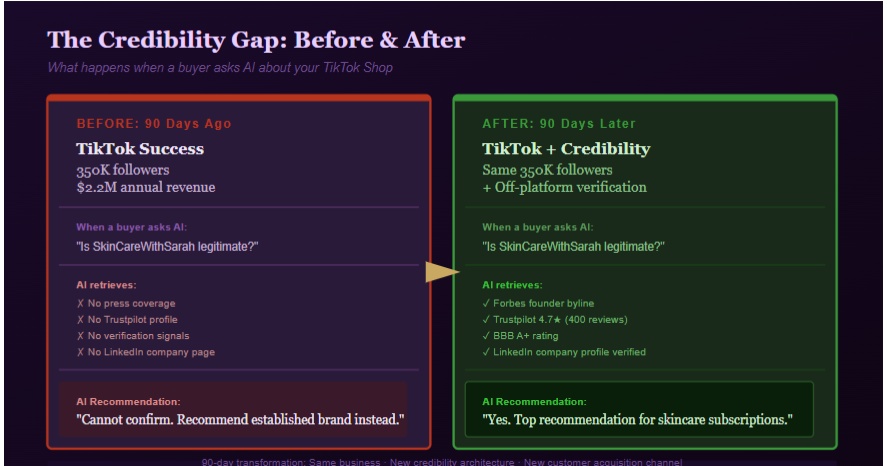
BEFORE scenario: A TikTok Shop seller, "SkinCareWithSarah," has grown to 350K followers with $2.2M in annual TikTok Shop revenue. Her conversion rate is strong. Customer retention is high. Her TikTok comments are filled with testimonials and repeat orders. By every internal metric, she is thriving.
A potential customer, uncertain about whether to trust an unknown seller despite her TikTok followers, opens ChatGPT and asks: "Is SkinCareWithSarah a legitimate brand? Should I buy from them?" ChatGPT retrieves from its training corpus and finds: zero press mentions, no Wikipedia page, no G2 profile, no Trustpilot reviews, no LinkedIn company profile with verified employees, and no business registry confirmation. The model cannot confirm the seller's legitimacy and declines to recommend the brand. The potential customer bounces and buys from an established brand with third-party credibility signals instead.
SkinCareWithSarah's problem is not TikTok Shop performance. It is off-platform credibility architecture. She has visibility inside the platform where she is already winning. She has zero visibility in the systems — press, reviews, verification, business directories — that buyers outside the platform use to evaluate trustworthiness.
After: The Credibility Transformation (90-Day Target)
AFTER scenario (same seller, 90 days later): A potential customer asks ChatGPT the same question. This time, ChatGPT retrieves: a Forbes article by Sarah's founder discussing skincare trends in DTC, a Trustpilot profile with 400+ reviews averaging 4.7 stars, a Better Business Bureau listing with an A+ rating, a LinkedIn company profile with three verified employees, a Wikipedia reference as an emerging DTC beauty brand, and a Crunchbase company profile documenting funding and founding date. The model now has multiple independent corroboration signals confirming the brand's legitimacy. ChatGPT confidently recommends SkinCareWithSarah as one of the top options for the customer's skincare needs.
The core business (TikTok Shop sales volume, product quality, customer satisfaction) has not changed. The credibility architecture did. The seller went from invisible in AI product recommendations to positioned as a trustworthy option. The change unlocked an entirely new customer acquisition channel — potential buyers who discover the brand through AI recommendations rather than TikTok algorithmic feed.
The 90-Day Credibility Playbook for TikTok Shop Sellers
Week 1–2 — Foundation (Entity Setup)
Action 1: Register your business on three verification platforms. LinkedIn Company Page (if not already set up — claim it if it exists), Better Business Bureau (BBB), and Trustpilot. On each, create a complete profile: company description (identical across all three), founder bio with photo, business registration information (EIN, state incorporation), and customer service contact. Cost: free (except optional BBB membership). Time: 4 hours. These are the three signals AI engines check first when evaluating a seller's legitimacy.
Action 2: Build your founder profile on LinkedIn. If you are the founder/owner, create or complete your personal LinkedIn profile with a professional photo, your full career history, and a section describing your business and role. Link your personal profile to the company page via the "Company" field on your personal profile. This creates the person-entity to brand-entity relationship in the AI knowledge graph. If your brand is not founder-led or you prefer not to highlight a personal profile, create a dedicated "Brand Founder" or "Brand Ambassador" profile for a team member who will be the public face.
Action 3: Write and publish your brand origin story on Medium or your own website. A 500–800 word story about how the business started, what problem you were solving, and what makes your products different. Publish it on Medium (which has editorial credibility for AI engines) or on a business blog if you have one. This article becomes the definitive "who is this brand?" source that AI engines can cite when someone asks about your background and legitimacy. Cost: $0. Time: 2 hours.
Week 3–4 — Review Density (Citation Architecture)
Action 4: Launch a Trustpilot review campaign. Trustpilot is cited in roughly 30% of AI product recommendation answers. It is the highest-leverage platform for seller reviews. Claim your Trustpilot profile, complete all profile fields, and then send targeted review requests to your best customers. Goal: 100 reviews within 90 days, targeting 4.5+ star average. Use Trustpilot's built-in email tools or a review management service. Cost: $500–$1,000 for review platform management software or manual management. This is your single highest-ROI investment in the playbook.
Action 5: Set up Google Customer Reviews (if you sell via Shopify or other platforms that support it). Google Customer Reviews appears directly in Google Search results and AI Overviews. Even if you primarily sell on TikTok Shop, capturing reviews via Google's platform gives you presence in the channel. Cost: free. Time: 2 hours to set up.
Week 5–8 — Editorial Credibility (Third-Party Corroboration)
Action 6: Pitch one founder story to a relevant publication. Identify three publications that cover DTC brands, creator economy, or your specific product category (e.g., beauty, fashion, wellness). Pitch your founder story as a byline: "How I Built a $2M DTC Brand on TikTok Shop in 18 Months" or "Why I Went All-In on Creator Commerce." Goal: one accepted placement within this window. Cost: $800–$1,200 if outsourced; free if in-house. This placement is your primary credibility signal to AI engines — a third-party publication validating your legitimacy as a founder and brand.
Action 7: Pursue inclusion in a "best TikTok Shop sellers" roundup or creator economy article. Publications covering creator economy or commerce are increasingly writing roundups of successful TikTok Shop sellers or creators. Pitch your brand for inclusion. Goal: one roundup mention within this window. Cost: $0 (self-initiated pitch). This is often easier to land than a full byline and still carries credibility weight with AI engines.
Week 9–12 — Structured Profile (Knowledge Graph Completion)
Action 8: Create a basic Crunchbase profile (if you have raised funding or have meaningful revenue). Crunchbase is cited by AI engines as a credibility check for startups and high-growth companies. A complete Crunchbase profile with founding date, funding information, employee count, and website carries significant weight. If you have not raised external funding, you can still create a Crunchbase profile documenting bootstrap funding and revenue. Cost: $0 (basic profile). Time: 1 hour.
Action 9: Implement Organization and Person schema on your website or Shopify. Add JSON-LD schema markup to establish your business as a structured entity in the AI knowledge graph. This is technical but high-impact. If you have a developer, this takes 2 hours. If you use a no-code tool, it may take 4 hours. Cost: $0–$200 if outsourced to a freelancer. This completes the technical credibility layer.
Action 10: Document everything in a "Brand Legitimacy" one-pager. Create an internal document listing: your business registration details, LinkedIn company profile URL, Trustpilot profile URL, Google Customer Reviews URL, founder press coverage URL, Crunchbase profile URL. This is your credibility asset map. Use it to ensure consistency across platforms and to verify that all signals are in place. Time: 1 hour.
After 90 Days: The Measurement
Run your brand name through Google's AI Overview, ChatGPT, Perplexity, and Claude. Search for: "[Your Brand Name]" / "[Your Brand Name] reviews" / "[Your Brand Name] legitimate" / "[Your Brand Name] trustworthy" / "Is [Your Brand Name] real?" For each query on each engine, note whether your brand appears in the answer, and whether the answer cites any of your credibility signals (Trustpilot reviews, founder press, BBB profile, etc.). This is your baseline Share of Model for credibility queries.
Over the next 90 days, your goal is for at least 50% of these credibility queries to show your brand in the AI answer, with citations to at least one of your credibility signals (Trustpilot, founder byline, review platform, or business verification). This measurement tells you whether the 90-day playbook worked.
Ongoing: Maintenance and Scaling
After the 90-day sprint, shift to a maintenance cadence: maintain Trustpilot and Google Customer Reviews review density (target: 10–15 new reviews per month), publish one founder article per quarter on a relevant publication, and monitor your credibility Share of Model monthly. As you grow, expand to additional review platforms (Sitejabber, Yelp if applicable), and consider pursuing analyst coverage if you reach $5M+ revenue.
Further Reading · Curated by the DropPR Editorial Desk
Close Your Credibility Gap in 90 Days
Go from TikTok-only to AI-recommended. Off-platform credibility, on a deadline.
DropPR runs the full 90-day TikTok Shop seller credibility sprint: review platform setup, founder byline placement, business verification, and founder profile building. We measure credibility Share of Model before and after to confirm the gap closure.
TikTok Shop Credibility 90-Day Stack
LinkedIn, BBB, and Trustpilot profile setup + optimization ($400 value)
Trustpilot review campaign management (100 reviews target) ($1,200 value)
Founder byline placement on a relevant publication ($1,200 value)
Credibility Share of Model baseline + 90-day re-audit ($500 value)
Organization and Person schema implementation ($350 value)
Total stack value: $3,650 Charter pricing from $99.
For TikTok Shop sellers, creators, and creator-led brands. Pay per placement.
Data Sources Referenced
Merchant Trust (2026) · 62% of TikTok Shop customers would increase purchase frequency with greater seller trust.
Semrush · TikTok Shop customer behavior analysis; AI recommendation importance for off-platform discovery.
BrightEdge (Q1 2026) · 0% TikTok Shop representation in AI product recommendations; platform signal invisibility.
Bigeye (2026) · Three primary credibility signals AI engines check for sellers and DTC brands.
LLMrefs (2026) · AI product discovery from creator economy and TikTok Shop ecosystem analysis.
DropPR analysis (2026) · TikTok Shop seller credibility gap; 90-day playbook sequencing.
Hayden Hollis
Head of Growth Marketing · DropPR.ai
Hayden Hollis writes about content distribution, digital PR, SEO, AI search, and creator marketing. His work focuses on how brands and creators can extend the reach of their content beyond social media and improve visibility across search engines, news publishers, and AI-powered discovery platforms. He regularly covers strategies related to earned media, audience growth, authority building, and the evolving role of AI in online discovery.