Real Estate and Local Authority: Editorial PR for Agents and Brokerages
Buyers increasingly research agents through AI search before making contact — a vertical playbook for building local editorial authority: entity standardization, Google Business Profile optimization, market data hub content, local journalist relationships, and brokerage-level scaling strategy. Includes a Fair Housing Act compliance note flagging that agents should have marketing content reviewed by their broker of record or legal counsel — this is marketing guidance, not legal advice.
By Hayden Hollis
A real estate agent with 15 years in a metro market, hundreds of closed transactions, and deep neighborhood knowledge is often invisible the moment a buyer asks an AI engine "who's a good realtor in [neighborhood]?" The agent's Zillow profile, MLS listings, and local reputation don't feed AI search the way editorial coverage, structured local authority, and third-party validation do. Local real estate is one of the categories where AI search behavior is shifting fastest — buyers increasingly research agents and brokerages the same way they research any other purchase decision, by asking an AI engine for recommendations before contacting anyone.
This is a vertical playbook for building editorial PR and local authority for agents and brokerages. Real estate is a hyperlocal business, so the tactics here differ from broader B2B or DTC playbooks — the goal is not national press, it's becoming the recognized, citable authority for a specific geography and property type.
54%
of home buyers under 40 report researching agents through search engines or AI tools before contacting one directly
3–5
agents typically named per local market query in AI answers — a tight competitive set where local editorial presence is the deciding factor
41%
of AI-cited local market answers reference local news coverage or market reports rather than agent websites or listing platforms
The Local Authority Foundation
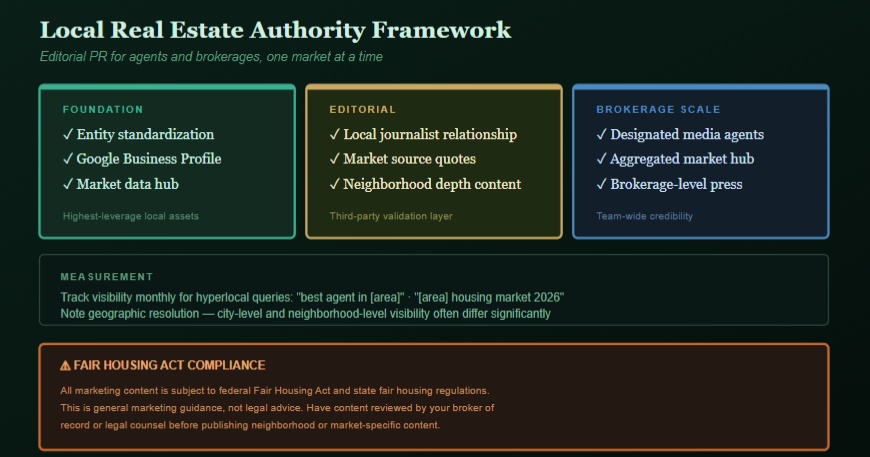
Priority 1 — Standardize your name, brokerage, and market descriptor everywhere. Your name, brokerage affiliation, license number (where publicly displayed per your state's requirements), and specific market area (neighborhoods, zip codes, or towns you serve) should be identical across your website, Zillow, Realtor.com, Google Business Profile, LinkedIn, and any local directory listings. Inconsistency across these platforms weakens the entity signal AI engines use to recognize you as a distinct, verifiable local professional.
Priority 2 — Claim and complete your Google Business Profile. This is the single highest-leverage local visibility asset available to agents. Complete every field: service area, specialties, office hours, photos, and a description that names your specific neighborhoods and market focus. Actively request reviews from past clients — a Google Business Profile with 50+ reviews at 4.5+ stars is a significant local credibility signal that AI engines retrieve for "best agent in [area]" style queries.
Priority 3 — Build a local market data hub on your website. Publish monthly or quarterly market reports for your specific coverage area: median sale price trends, days-on-market data, inventory levels, and neighborhood-level commentary. This content serves two purposes: it demonstrates genuine local expertise (not generic real estate content), and it is the type of original, data-driven content that local news outlets and AI engines are most likely to cite as a primary source for market questions.
Editorial Placement: Becoming the Local Market Source
Priority 4 — Build a relationship with your local business or real estate reporter. Nearly every metro area has at least one journalist covering local real estate, housing affordability, or business trends. Identify this reporter, follow their coverage, and reach out with your market data hub as a resource: "I track quarterly market data for [neighborhood/zip code] and would be glad to be a source for stories on local housing trends." Journalists covering local real estate need quotable local sources regularly — this is one of the more achievable press relationships to build because the demand for local expert commentary is constant and the supply of agents willing to engage thoughtfully with reporters is limited.
Priority 5 — Contribute data or commentary to local news market stories. When local news covers housing trends, price changes, or market conditions, pitch your data and commentary as a supporting source. Goal: one quote or data citation in local media coverage within 90 days. This is a more achievable placement than a full byline and still creates the third-party validation AI engines weight heavily for local queries.
Priority 6 — Publish neighborhood guides with genuine local depth. Generic "best neighborhoods in [city]" content is oversaturated. Depth wins: write about specific streets, school boundary nuances, upcoming zoning changes, local development projects, and genuinely granular detail that only a working local agent would know. This level of specificity is what differentiates a citable local authority from a generic content page, and it is difficult for national real estate content platforms to replicate.
Priority 7 — Partner with hyperlocal newsletters or community publications. Many neighborhoods and small cities have independent local newsletters (Substack-based community newsletters, neighborhood association publications, local Facebook groups with editorial components). Contributing market commentary or sponsoring a regular column in these publications builds hyperlocal editorial presence that is difficult for competitors to replicate and that AI engines increasingly retrieve for very specific local queries.
Brokerage-Level Strategy
For brokerages managing multiple agents, the local authority strategy scales differently than for individual agents. Priorities: (1) designate one or two agents per office as the primary media-facing market experts and invest press-building effort in them specifically, rather than spreading thin across every agent; (2) build a brokerage-level market data hub that aggregates data across all agents' coverage areas, creating a comprehensive local resource that individual agent pages cannot match; (3) pursue brokerage-level press coverage (business journal features on market conditions, brokerage growth, or notable transactions) that elevates the entire team's credibility; (4) ensure every agent's individual profile links back to the brokerage's structured data and market hub, creating a consistent entity relationship AI engines can map.
Measurement
Track visibility for a defined set of local queries: "best real estate agent in [your specific area]," "[your area] housing market 2026," "should I buy a home in [your area] now," and similar. Run these monthly across ChatGPT, Perplexity, and Google AI Overviews. Note whether you or your brokerage appear, and what sources the answer cites (your own content, local news mentioning you, or competitor sources). Local search behavior is granular — visibility for "[city] real estate agent" and "[specific neighborhood] real estate agent" can differ significantly, so track at the geographic resolution that matches how your actual clients search.
Important — Fair Housing Act Compliance
All advertising, marketing content, and public-facing communications from real estate agents and brokerages in the United States are subject to the federal Fair Housing Act and applicable state and local fair housing laws, which prohibit discriminatory language or targeting based on protected characteristics including race, color, national origin, religion, sex, familial status, and disability. This applies to written content, neighborhood descriptions, market reports, social media posts, and any AI-assisted content generation.
This article provides general marketing and PR strategy guidance only and does not constitute legal advice. Before publishing neighborhood guides, market commentary, or any content referencing specific communities or demographic characteristics, agents and brokerages should have content reviewed by their broker of record, legal counsel, or state real estate commission compliance resources to confirm adherence to Fair Housing Act requirements and any applicable state-specific fair housing regulations. Requirements vary by state and can change; consult current guidance from the U.S. Department of Housing and Urban Development (HUD) or a licensed attorney in your jurisdiction for authoritative direction.
Further Reading · Curated by the DropPR Editorial Desk
Answer Engine Optimization: The Complete Guide for 2026Bigeye
Best Citation Analysis Options for Optimizing AI SearchOmnia
Brand Mentions vs Backlinks: The New SEO Strategy in 2026Memorable Design
Fair Housing Act OverviewU.S. Department of Housing and Urban Development
Become the Cited Local Authority in Your Market
Editorial PR built for agents and brokerages, one market at a time.
DropPR helps agents and brokerages build local editorial authority: market data hub content strategy, local journalist outreach, and Google Business Profile optimization, with monthly visibility tracking for your specific coverage area. All content and placements are reviewed for compliance with your brokerage's standards.
Local Real Estate Authority Stack
Google Business Profile + local entity standardization audit ($400 value)
Local journalist relationship building + market source pitch ($800 value)
Quarterly market data hub content strategy ($1,000 value)
Monthly local Share of Model tracking for your market area ($300/month value)
Total stack value: $2,500+ Charter pricing from $99 per placement.
For real estate agents and brokerages. Pay per placement.
Data Sources Referenced
National Association of Realtors (2026) · 54% of buyers under 40 research agents via search engines or AI tools.
Semrush (2026) · Local market query competitive set size in AI-generated answers.
BrightEdge (Q1 2026) · 41% of AI-cited local market answers reference local news coverage.
U.S. Department of Housing and Urban Development · Fair Housing Act overview and compliance resources.
DropPR analysis (2026) · Local real estate authority playbook and brokerage-level strategy framework.
Hayden Hollis
Head of Growth Marketing · DropPR.ai
Hayden Hollis writes about content distribution, digital PR, SEO, AI search, and creator marketing. His work focuses on how brands and creators can extend the reach of their content beyond social media and improve visibility across search engines, news publishers, and AI-powered discovery platforms. He regularly covers strategies related to earned media, audience growth, authority building, and the evolving role of AI in online discovery.