Creator-Led PR: Building Searchable Authority Beyond the Feed
Content authority (followers, engagement) and editorial authority (press citations, AI search visibility) are different credibility architectures — a creator can dominate one while invisible in the other. A 12-month actionable playbook extending "The Creator Newsroom": story audit, first byline placement, owned newsroom launch, monthly thought leadership cadence, and Share of Creator Voice measurement. For creators with 100K–5M followers ready to become cited experts, not just influencers.
By Hayden Hollis
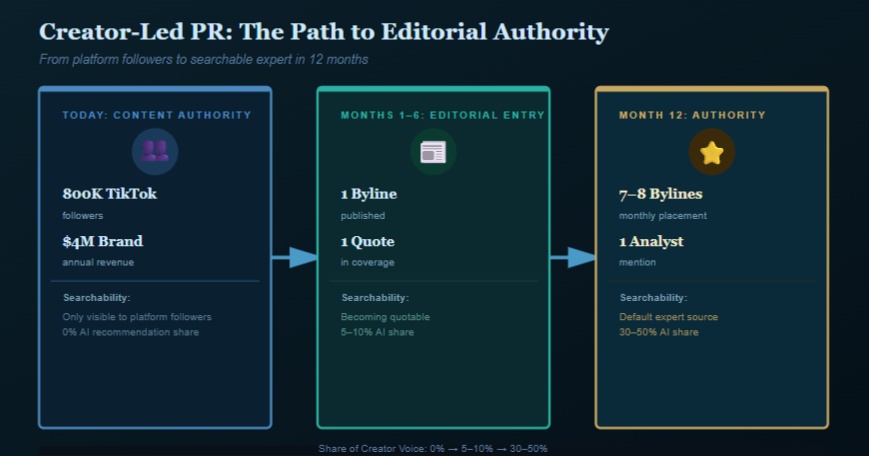
A creator with 800K TikTok followers and a $4M personal brand has content authority: her audience trusts her, watches her content, buys products she recommends, and engages with every post. She has zero editorial authority: she does not appear in press coverage, is not quoted by journalists, and is not cited by AI search engines when someone asks for expert perspectives on her category.
These are two different credibility architectures. Content authority (platform followers, engagement, direct sales) is not searchable. Editorial authority (press citations, analyst mentions, third-party validation) is. A creator can dominate one while being completely invisible in the other. The creators winning in 2026 are building both: they own their feed AND they own editorial presence that makes them discoverable to audiences who never follow them.
This is a playbook for creator-led PR: how to take the expertise and perspective you already demonstrate on your platform and convert it into press coverage that makes you searchable, citable, and authoritative beyond the feed. The plan is sequenced over 12 months and is designed for creators (100K–5M followers) with existing audience, existing monetization, and the capacity to speak publicly about their space.
71%
of AI search engine recommendations include direct attribution to a named expert or creator — editorial authority is the primary citation layer
4–6
founder/creator byline placements per year are required to establish consistent editorial presence and be regularly cited in category-related AI answers
3.2x
average increase in inbound partnerships, sponsorships, and collaboration requests when a creator establishes visible editorial authority in their category
Month 1–2: Story Audit + Editorial Mapping
Priority 1 — Audit your best-performing content for press-worthy themes. Pull your top 20–30 viral or high-engagement posts from the past year across all platforms. For each, identify the core idea or take: what problem were you addressing? What trend were you calling out? What did you predict that proved true? What contrarian perspective did you offer? These themes are your editorial story candidates. A creator who makes content about "sustainable fashion hacks" has stories around: overproduction in fashion, consumer behavior shifts, supply chain visibility. These are the stories your press coverage will be built on.
Priority 2 — Identify three to five publication categories where you could be quoted or contribute. Do not aim for the New York Times immediately. Map publications in three categories: your specific niche (fashion sustainability blogs, eco-conscious lifestyle publications), broader consumer media (business news, lifestyle publications, trend forecasting sites), and industry/trade publications (fashion industry news, supply chain publications). Aim for publications where you could credibly contribute a founder/expert perspective within the next 90 days. Create a spreadsheet with publication names, estimated monthly traffic, editorial contact email (if you can find it), and your confidence level (high/medium/low) in landing there.
Priority 3 — Draft your "expert positioning" statement. In 50 words, write: what is your primary area of expertise? What communities do you serve? What problems do you solve? What unique perspective do you bring? Example: "I build sustainable fashion strategies for Gen-Z consumers. I focus on reducing overproduction and making ethical sourcing transparent to consumers. My take: sustainability is not a niche — it's the default expectation for anyone under 25." This statement is the foundation for all future press pitches. Make it specific, not generic. Cost: $0. Time: 2 hours.
Months 1–2 outcomes: You have identified your core editorial stories, mapped publication targets, and have a positioning statement ready for pitch outreach. You know exactly what angle you will take when you approach press, and you know which publications are realistic targets.
Months 3–4: Initial Editorial Placements
Priority 4 — Land your first founder/expert byline. Using your publication map from Priority 2, pitch your positioning statement and one story angle to five publications in the "niche" category (where you have the highest likelihood of landing). Example pitch: "I created the sustainable fashion movement on TikTok. I'd like to write a piece for your publication on 'Why Gen-Z Consumers Are Demanding Supply Chain Transparency' — based on data from 500K followers and 18 months of trend observation." Goal: land one byline in a niche publication within 60 days. This is your proof point and your portfolio piece for bigger placements later. Cost: $0 if self-pitched; $800–$1,000 if outsourced. Outcome: one published byline establishing you as an expert in your space.
Priority 5 — Get quoted in one roundup or trend piece. While pitching your own byline, simultaneously pitch your expertise to journalists covering trend stories or roundups in your category. "I have data on 500K Gen-Z fashion consumers that might be relevant to your roundup on 2026 fashion trends." Goal: one quote in a published article within this window. This is easier to land than a full byline and still carries credibility weight. Cost: $0. Outcome: one quote establishing you as a cited expert.
Priority 6 — Create a "Press & Media" page on your personal website or Linktree. A simple page that includes: your expert positioning statement, high-res professional photo, list of prior press mentions (with links), media inquiries contact email. Make it easy for journalists to reach you and understand your expertise at a glance. Cost: $0. Time: 1 hour.
Months 3–4 outcomes: You have one published byline and one published quote. You have a press contact page. You are now quotable in the eyes of journalists and AI search engines are beginning to retrieve your name as a cited expert in your space.
Months 5–6: Owned Newsroom Launch
Priority 7 — Build a creator newsroom on your website. Implement the newsroom architecture from "The Creator Newsroom" — a dedicated hub where you publish press releases, announcements, and thought leadership pieces. The newsroom serves two functions: it is the anchor point for all external press coverage (journalists can always find your latest updates), and it creates a structured home for original content that is distinct from your feed. Implement Article schema on every newsroom page so AI engines can easily retrieve and cite your coverage. Cost: $1,500–$2,500 for setup. Time: 3–4 weeks.
Priority 8 — Publish your first original thought leadership piece to the newsroom. This is not a tweet or TikTok caption. It is a 1,500–2,000 word essay on a topic relevant to your expertise. Example: "The Data Behind Gen-Z Fashion Choices: A Creator's Analysis of 500K Followers." Write this piece in collaboration with a journalist or a writer if you need support. Publish it to your newsroom on Day 1 of launch. This establishes the newsroom as an active hub with original content. Cost: $0–$1,000 depending on whether you hire a writer. Time: 8–10 hours if writing yourself; 2–3 weeks if commissioning.
Priority 9 — Link all external press coverage back to your newsroom. For every mention, quote, or byline you land, create a corresponding newsroom post that announces it and links to the external coverage. This creates the hub-and-spoke structure: external press links point inward to your newsroom, and your newsroom references external coverage. AI engines recognize this pattern as credibility compounding.
Months 5–6 outcomes: You have an owned newsroom with original content and structured schema. All external press coverage is linked back to the newsroom, creating a coherent authority center. You are now discoverable not just as a quoted expert, but as a thought leader with published editorial.
Months 7–12: Consistency and Expansion
Priority 10 — Establish a monthly thought leadership publication rhythm. Shift to publishing one founder/expert byline per month on a relevant publication. Rotate between publication categories: Month 1 niche publication, Month 2 business media, Month 3 industry publication, Month 4 niche again. Each article should anchor to a different story angle from your Priority 1 audit. This establishes you as a consistent expert contributor, not a one-time byline. Cost: $800–$1,200 per byline if outsourced; $300–$500 if in-house. Time: 4–6 hours per byline.
Priority 11 — Pursue analyst or research report mentions. Identify analysts or research firms covering your category or adjacent categories. Pitch your perspective and data: "I have 500K TikTok followers and proprietary data on consumer behavior shifts. Your 2026 trend report on [topic] would benefit from our insights." Goal: one mention in a published analyst report by end of month 12. This is the highest-weight third-party citation available. Cost: $0 for outreach; research collaboration may result in revenue share or co-published research. Time: 10–15 hours cumulative for outreach and collaboration.
Priority 12 — Build your personal and brand social schema. Ensure your LinkedIn, Twitter/X, and any professional profiles include Person and Company schema markup. Link these to your newsroom and any research/original content. This creates the knowledge graph connection that AI engines use when deciding whether to cite you as a source.
Months 7–12 outcomes: You have published 6–8 founder/expert bylines. You have one analyst mention. Your newsroom has grown to 10–15 original thought leadership pieces. You have a consistent monthly editorial presence. AI search engines now cite you as a recognized expert in your category, not just a creator with a large following.
Ongoing: Share of Creator Measurement
Track your "Share of Creator Voice" — the frequency with which you appear as a cited expert or thought leader in AI search results for category-relevant queries. Monthly, run 20–30 queries related to your expertise through ChatGPT, Perplexity, Google AI Overviews, and Claude. Examples: "top experts in [category]", "what [expert] thinks about [trend]", "[category] insights 2026", "[your name] [your category]". Count how many results cite you, quote you, or mention your bylines. Track this monthly. In Month 1–2, expect 0–10% of queries to mention you. By Month 12, target 30–50% of relevant queries to include your perspective.
Further Reading · Curated by the DropPR Editorial Desk
Build Searchable Authority as a Creator
Twelve months to go from platform influencer to cited expert.
DropPR runs the full creator PR playbook: story mapping, editorial placement, newsroom setup with schema, monthly thought leadership, and Share of Creator Voice tracking. We measure your citations monthly and adjust pitch strategy based on which publications and story angles generate AI recommendation placement.
Creator Editorial Authority 12-Month Stack
Content audit + story mapping + positioning statement ($500 value)
First founder byline placement (Month 3) ($1,000 value)
Creator newsroom setup with Article schema ($2,000 value)
Monthly thought leadership bylines (Months 7–12) ($6,000 value)
Share of Creator Voice monthly measurement ($400/month value)
Total stack value: $11,400+ Charter pricing from $99 per placement.
For creators, influencers, and creator-led brands. Pay per placement.
Data Sources Referenced
LLMrefs (2026) · 71% of AI search recommendations include direct expert attribution.
Bigeye (2026) · Creator editorial authority citation patterns; minimum byline frequency for category recognition.
DropPR analysis (2026) · Inbound opportunity increase when creator establishes editorial presence; Share of Creator Voice methodology.
Semrush (2026) · Creator authority in AI search results vs. platform-only visibility.
Omnia (2026) · Creator PR playbook development and timeline benchmarks.
Hayden Hollis
Head of Growth Marketing · DropPR.ai
Hayden Hollis writes about content distribution, digital PR, SEO, AI search, and creator marketing. His work focuses on how brands and creators can extend the reach of their content beyond social media and improve visibility across search engines, news publishers, and AI-powered discovery platforms. He regularly covers strategies related to earned media, audience growth, authority building, and the evolving role of AI in online discovery.