Answer Engine Optimization vs. SEO: What Actually Changed in 2026
SEO ranks pages. AEO earns citation inside AI-synthesized answers. They are not the same discipline, they do not use the same signals, and they do not measure the same outcomes. A full side-by-side comparison of every dimension — from content format to measurement tools to budget implication — and the 2026 recommendation for running both as complements.
By Hayden Hollis
For the better part of three decades, search engine optimization meant one thing in practice: rank higher on Google. The entire discipline — keyword research, on-page optimization, link acquisition, technical architecture — was built around a single output: a position on a page of ten blue links. The higher the position, the more clicks. The more clicks, the more pipeline. The logic was linear, and for a long time, it worked.
In 2026, that logic describes a shrinking share of how buyers actually discover and evaluate vendors. AI Overviews appear on 48% of search result pages and answer the query before the user reaches the links. ChatGPT processes more than a billion queries per week without surfacing a ranked list at all. Perplexity, Claude, and Gemini synthesize answers from multiple sources and cite a small number of them — typically three to five — regardless of how any individual source ranks on Google.
Answer Engine Optimization (AEO) is the discipline that has emerged to address this shift. It is not a replacement for SEO. It is a parallel discipline with a different optimization target, a different set of signals, and a different measurement framework. Understanding precisely what changed — and what did not — is the most important strategic clarification available to any marketing team writing a 2026 budget.
48%
of Google SERPs now feature an AI Overview that answers the query above the organic links
344%
surge in search interest for "EEAT" over five years — the bridge concept between SEO and AEO
<20%
overlap between top-ranked organic pages and AI-cited sources — ranking and citation are different outcomes
What SEO Was Built to Do
Traditional SEO optimizes for a specific output: a high position on a search engine results page. The mechanism is well understood. Google's algorithm evaluates pages against a query using hundreds of signals — keyword relevance, domain authority, page experience, backlink quality, content depth — and ranks them accordingly. The user sees a ranked list and chooses which result to click.
The SEO optimization loop runs accordingly. Identify the queries your buyers use. Publish content that addresses those queries comprehensively. Earn backlinks from authoritative domains. Ensure technical correctness. Monitor rankings. Adjust. The loop is well-established, and the investment compounds over time as domain authority accumulates.
SEO is not dead. Pages still rank. Users still click — for a declining share of queries. The discipline still produces real returns on the queries and categories where organic links remain the primary result. But for an increasing share of high-intent commercial queries, the primary result is no longer a ranked list of links. It is a synthesized answer. And SEO does not optimize for that outcome.
What AEO Is Built to Do
Answer Engine Optimization optimizes for a different output: citation share inside AI-synthesized answers. The mechanism operates through five signals — entity recognition, corroboration, source authority, structural extractability, and recency — that determine whether a brand or source is named in a synthesized response.
The AEO optimization loop runs differently from SEO. Identify the queries your buyers use inside AI engines. Audit which sources are currently cited in answers to those queries. Build editorial presence on those sources. Ensure your brand entity is consistently defined across the web. Structure your owned content for passage-level extraction. Monitor citation share. Adjust.
The inputs overlap with SEO in some areas — content quality, domain authority, and technical structure matter in both disciplines — but the targets diverge significantly. A page can rank on page one of Google and never appear in an AI citation. A brand can appear consistently in AI citations without ranking on page one for any query. Citation share and ranking position are related but distinct outcomes, requiring distinct optimization strategies.
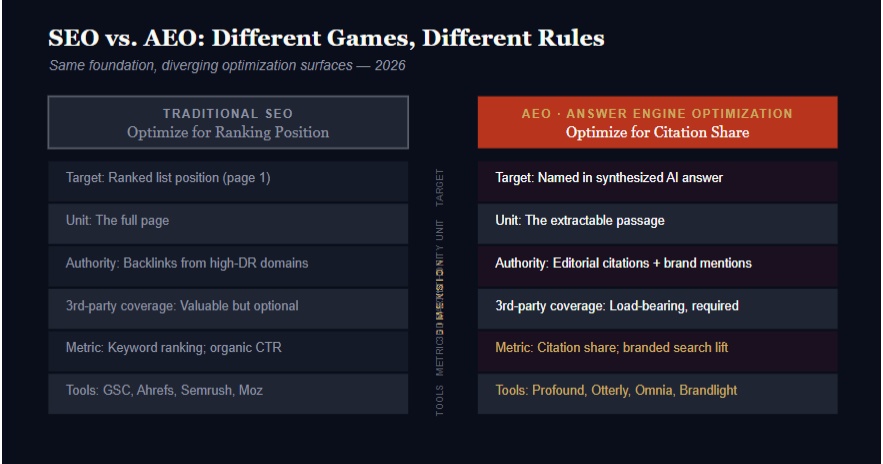
AEO vs. SEO: Side-by-Side Comparison
DimensionSEO (Search Engine Optimization)AEO (Answer Engine Optimization)Primary TargetHigh position on a ranked results pageCitation inside a synthesized AI answerSuccess MetricKeyword ranking position; organic click-through rateCitation share across target queries; branded search liftUnit of OptimizationThe page — optimized for the full queryThe passage — optimized for extraction and synthesisContent FormatComprehensive long-form content covering all subtopicsStructured, extractable content with definitional leads and discrete blocksAuthority SignalBacklinks from high-DR domainsBrand mentions and editorial citations from trusted sourcesEntity ImportanceSecondary — keywords matter more than brand entitiesPrimary — entity recognition is the entry condition for citationSchema MarkupUseful for rich snippets; enhances click-throughEssential for entity disambiguation and passage type identificationRecency WeightingModerate — freshness matters for news and volatile queriesHigh — AI retrieval systems weight recent, dated content heavilyThird-Party CoverageValuable for backlinks; secondary signalEssential — corroboration from multiple trusted sources is load-bearingOwned Content ValueHigh — ranks directly, drives organic trafficModerate — must be structured for extraction; third-party coverage compounds itMeasurement ToolsGoogle Search Console, Ahrefs, Semrush, MozProfound, Otterly, Omnia, Brandlight; manual samplingTime to Result3–12 months for new content to compoundWeeks for initial citation lift; 3–6 months for consistent shareBudget ImplicationContent production, technical optimization, link buildingEditorial placement, entity standardization, structured content audit
Where SEO and AEO Overlap
The two disciplines share a foundation that neither can neglect. Technical correctness matters in both — a site that cannot be crawled cannot be ranked or retrieved. Content quality matters in both — thin, inaccurate, or poorly-written content is penalized in organic rankings and deprioritized in AI retrieval. Domain authority matters in both — high-DR domains rank better and their content is retrieved with higher trust weights.
E-E-A-T (Experience, Expertise, Authoritativeness, Trustworthiness) is the concept that most directly bridges the two disciplines. Google's quality rater guidance has emphasized E-E-A-T for years as a quality signal for organic ranking. AI engines apply the same framework — essentially — to source selection in retrieval. Content authored by credentialed experts, published on authoritative platforms, and substantiated by third-party corroboration scores well on both the SEO and AEO dimensions of E-E-A-T.
The practical consequence is that a well-executed SEO strategy built on E-E-A-T principles produces a strong foundation for AEO. The investment is not wasted — it is complementary. The additional layer that AEO requires is the deliberate optimization of content structure for passage extraction and the deliberate investment in editorial placements on sources AI engines already trust.
Where AEO Requires Different Investment
Third-party coverage is now load-bearing, not optional. SEO can be executed almost entirely through owned content — publish enough high-quality pages, earn enough backlinks, and rankings will follow. AEO cannot. The corroboration signal requires multiple independent sources making consistent claims about your brand. Owned content cannot corroborate itself. The editorial investment that SEO treats as valuable-but-optional is the primary mechanism of AEO.
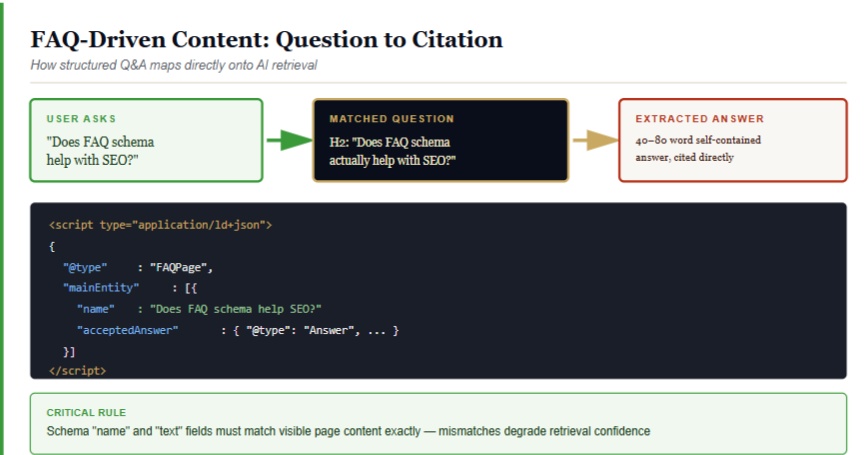
The content unit is a passage, not a page. SEO optimization produces comprehensive pages that rank for many related queries. AEO optimization produces extractable passages that answer specific questions. A single well-structured article with five clearly-labeled sections, each leading with a definitional sentence, produces five extractable passages — five citation opportunities — from a single piece of content. The same article written as continuous prose produces far fewer extraction opportunities regardless of its ranking position.
Citation share requires a different measurement stack. SEO measurement is mature — Google Search Console, ranking trackers, and traffic analytics give a reliable picture of organic performance. AEO measurement is newer and requires different tools. Citation share across ChatGPT, Perplexity, Google AI Mode, Claude, and Gemini requires a dedicated monitoring cadence. Branded search lift requires baseline tracking and timestamp correlation. The measurement investment is modest but it must be built before the optimization effort scales.
The 2026 Recommendation: Run Both, in Sequence
The brands that are winning discovery in 2026 are not choosing between SEO and AEO. They are running SEO as the foundation and AEO as the layer that captures the demand that now bypasses organic links entirely. The sequence matters: SEO builds the technical and content foundation; AEO extends that foundation into the surfaces where the buyer is now spending research time.
The specific additions AEO requires — editorial placements on trusted sources, entity standardization, structured extractable content, citation share monitoring — are not large in budget terms relative to a mature SEO program. They are large in strategic terms, because they address the discovery surface that is growing fastest and that most competitors have not yet systematically addressed.
The window for early-mover advantage in AEO mirrors the window that existed for SEO in 2010: the brands that build citation share now are establishing entity associations and corroboration patterns that will compound for years. Brands that delay will find the citation landscape significantly more competitive when they arrive.
Further Reading · Curated by the DropPR Editorial Desk
Add AEO to Your SEO Foundation
Citation share in the answers your buyers read — built on the editorial authority AI engines already trust.
DropPR extends your existing SEO foundation into AEO — placing your brand on the publishers AI engines cite, structuring content for passage extraction, and measuring the citation share that SEO dashboards cannot track.
SEO + AEO Integration Stack
Editorial placement on an AI-cited, high-DR publisher ($1,200 value)
Owned content extractability audit (top 5 pages restructured) ($400 value)
Entity schema and brand descriptor standardization ($350 value)
Citation share baseline measurement across 5 AI engines ($400 value)
Branded search lift tracking with 30-day reporting ($250 value)
Total stack value: $2,600 Charter pricing from $99.
No subscription. No retainer. Pay per placement.
Data Sources Referenced
BrightEdge · AI Overviews on 48% of SERPs as of Q1 2026.
Casey's SEO (2026) · 344% surge in search interest for "EEAT" over five years.
LLMrefs (2026) · <20% overlap between top-ranked organic pages and AI-cited sources.
Bigeye (2026) · AEO complete guide; five citation signals; corroboration as load-bearing requirement.
Frase (2026) · GEO Playbook; passage-level extraction; structured content for retrieval.
Google · EEAT quality rater guidelines and E-E-A-T framework updates.
Hayden Hollis
Head of Growth Marketing · DropPR.ai
Hayden Hollis writes about content distribution, digital PR, SEO, AI search, and creator marketing. His work focuses on how brands and creators can extend the reach of their content beyond social media and improve visibility across search engines, news publishers, and AI-powered discovery platforms. He regularly covers strategies related to earned media, audience growth, authority building, and the evolving role of AI in online discovery.