The Owned Newsroom: Architecting the AI-Trusted Brand Hub
The brand newsroom stopped being a press-release archive when AI engines started using it as a canonical source. The properties that earn that trust are knowable, replicable, and almost entirely missing from how most brands have built theirs.
By Hayden Hollis
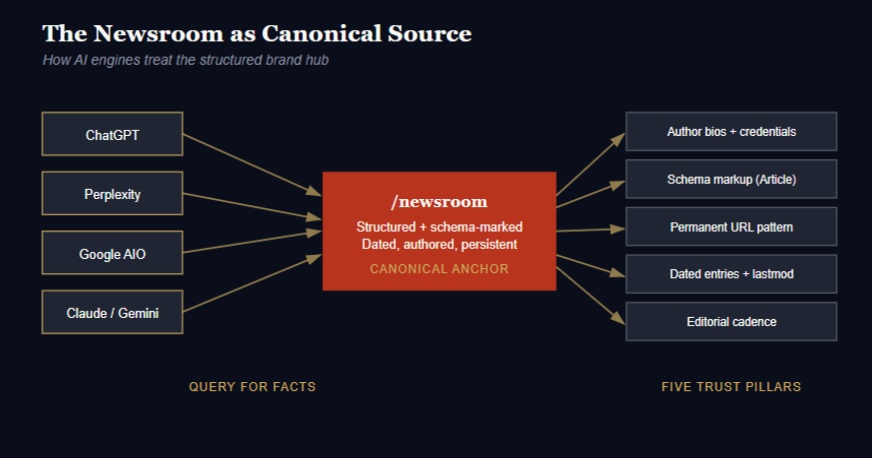
The most consequential discovery channel a brand controls in 2026 is the one it has historically treated as the least strategic. The "newsroom" or "press" section of a corporate website was, for most of the past two decades, an archive — a place where press releases went to die. In a generative search environment, that archive is the canonical reference that AI engines query when they need to verify a fact about your company. The architectural decisions made in that section of your website now substantially determine whether the model has a confident claim to make about you.
The brands moving on this opportunity in 2026 are not building bigger newsrooms. They are building structurally different ones. The differences are not aesthetic; they are systems-level — author bios that establish E-E-A-T, schema markup that LLMs can parse cleanly, URL structures that survive site migrations, dated entries with last-modified timestamps, and editorial cadences that keep the property fresh enough to remain a primary citation candidate.
This is an architecture problem. Here is the architecture.
5×
approximate citation lift observed when a newsroom adds proper Article schema markup
~25%
share of AI citations coming from owned brand properties — when properly structured
Q1 '26
Google core update emphasizing fresh, dated, authored content as ranking input
What "Canonical Source" Actually Means
When ChatGPT, Perplexity, Google AI Overviews, or Claude need to answer a question about your brand, they perform retrieval against a corpus of candidate sources. Your owned newsroom is the only source in that corpus where you fully control the content. Every other candidate — Wikipedia, third-party reviews, news coverage, competitor comparison content — represents your brand as someone else describes you. If your newsroom is well-structured and trustworthy, the model anchors its answer to it. If it is not, the model anchors its answer to whatever third party best fills the gap.
The strategic implication is simple. A brand that wants control over how it is described in synthesized answers must build a newsroom the model considers authoritative enough to use as anchor. There is no shortcut. There is, however, a checklist.
The Five Pillars of a Trust-Earning Newsroom
Pillar 01 — Named, Credentialed Authors with Persistent Bios. Every article has a named author. Every author has a bio page at a persistent URL. Every bio page identifies credentials, experience, and a verifiable identity (LinkedIn, professional profile, or equivalent). AI engines now treat author entities as ranking inputs — anonymous corporate-authored content is structurally discounted versus the same content attributed to a credentialed expert.
Pillar 02 — Article Schema and Structured Data. Every newsroom entry implements Article or NewsArticle schema with required fields: headline, datePublished, dateModified, author (linked to a Person schema), publisher (linked to Organization schema), and image. The schema tells AI engines exactly what they are reading and gives them the entity associations the Knowledge Graph uses. The cost is one engineering ticket. The lift is consequential.
Pillar 03 — Permanent URL Patterns. Newsroom URLs should follow a stable, semantic pattern — typically /newsroom/[year]/[slug] — and never change after publication. Site migrations that break newsroom URLs destroy AI citation history, lose the inbound editorial links that earned the citations in the first place, and reset the entity-graph reinforcement to zero. The cost of a clean URL migration is small; the cost of a broken one is multi-year.
Pillar 04 — Visible Dates and Last-Modified Timestamps. Both visible to readers and present in the schema. Freshness is one of the strongest AI citation signals — and one of the easiest for brands to underrate, because most corporate newsrooms hide dates to avoid looking stale. The right move is the opposite: surface dates prominently, update articles when facts change, and use dateModified to signal freshness to the algorithm.
Pillar 05 — Editorial Cadence and Topical Density. A newsroom with five entries from 2022 is not a newsroom; it is a sign that the brand has stopped publishing. The cadence floor for AI citation eligibility is approximately weekly — though monthly substantive entries also work if each is genuinely substantive. Topical density matters more than volume: the newsroom should cover your category's central concepts repeatedly and authoritatively, not chase every news cycle.
What the Best Brand Newsrooms Look Like in 2026
The properties getting this right share a small set of characteristics that distinguish them from the corporate-archive default. They look more like trade publications than press-release dumps. They have named authors with their own profile pages. They publish substantive editorial content — analysis, frameworks, data — alongside corporate announcements. The corporate announcements themselves are written in journalistic register, with quotes, context, and named sources.
This last point is worth highlighting. Most brand newsrooms still write their own announcements in the format of a press release — third-person, formal, distribution-oriented. AI engines parse this format and discount it, because it is structurally indistinguishable from the corporate communication the algorithm has learned to weight less. The same announcement, rewritten as an editorial article with named quotes from named executives and explanatory context for non-expert readers, gets weighted very differently.
The Anchor-Hub-Spoke Model
The most operationally effective architecture treats the owned newsroom as the canonical hub for brand facts and uses third-party editorial placements as the spokes that drive authority back to it. Each external placement contains a link or canonical reference to the relevant newsroom page. Each newsroom page becomes the most cited and most updated version of that topic on the open web. The flywheel is mechanical: external placements earn authority that the newsroom inherits; the newsroom updates with new information that external placements then reference.
What to Audit This Quarter
Run a structured-data validator on your newsroom. Google's Rich Results Test and Schema.org validator will tell you in seconds whether your articles are emitting the data AI engines need. The most common failure mode is articles published without Article schema, or with schema missing the author entity. Both are trivial to fix.
Inventory your author pages. Every name that appears as a byline should have a persistent URL, a bio, credentials, and external verification (a LinkedIn link, usually). Most newsrooms have either no author pages or generic placeholder pages. Building real ones is one engineering sprint of work.
Check your last-modified hygiene. Articles published before 2023 that still describe your product, pricing, or positioning should be either updated and re-dated or formally archived. Old content with outdated facts is the most reliable source of AI hallucinations about your brand.
Further Reading · Curated by the DropPR Editorial Desk
Build the Newsroom AI Engines Trust
A canonical brand hub. Properly architected. AI-ready in 30 days.
DropPR works with brands and their developers to architect newsroom infrastructure that AI engines treat as primary source. Schema, author profiles, URL hygiene, editorial cadence — and the steady stream of publisher placements that drive authority back to it.
Owned Newsroom Architecture Stack
Newsroom architecture audit and recommendations ($800 value)
Schema markup specification and validator-tested templates ($600 value)
Author profile system design with E-E-A-T compliance ($500 value)
First editorial placement linked back to your newsroom ($1,200 value)
30-day citation share monitoring across AI engines ($250 value)
Stack value: $3,350 Charter pricing from $99.
Newsroom-as-anchor + external placement = compounding AI citation.
Data Sources Referenced
PR.co (Dec 2025) · Owned newsroom as AI anchor; Muck Rack analysis of journalistic citation share.
Google Developers · Article structured data specification and validation tools.
Schema.org · Article and Person type references for entity disambiguation.
Aumcore (2026) · EEAT, brand authority, and trust signals as 2026 ranking drivers.
Frase (2026) · Complete GEO Playbook including schema and structural recommendations.
Gini Dietrich, Spin Sucks · PESO® Model and newsroom-as-anchor framework.
Hayden Hollis
Head of Growth Marketing · DropPR.ai
Hayden Hollis writes about content distribution, digital PR, SEO, AI search, and creator marketing. His work focuses on how brands and creators can extend the reach of their content beyond social media and improve visibility across search engines, news publishers, and AI-powered discovery platforms. He regularly covers strategies related to earned media, audience growth, authority building, and the evolving role of AI in online discovery.