Unlocking AI Performance: DropPR.ai's AEO Headline Pattern Library
A catalog of eight headline structures correlated with AI citation performance — Direct Definition, Numbered Framework, Comparison Resolution, Named Mechanism, Diagnostic Question, Data-Anchored Claim, Practical Playbook, and Category Redefinition — each with a worked example, plus four common headline conventions to avoid for AI retrieval purposes. Internal data shows a 2.9x extraction rate lift over curiosity-gap headlines.
By Hayden Hollis
SAN FRANCISCO, July 20, 2026 — DropPR, a performance PR platform that places editorial content on AI-cited publishers, today released the AEO Headline Pattern Library, a catalog of headline structures analyzed for their likelihood of being extracted and surfaced by AI search engines as a direct answer to a user's query.
The library was built from an analysis of headline structures across DropPR's editorial placement dataset, cross-referenced against which headlines were subsequently extracted, quoted, or paraphrased in AI-generated answers for related queries. The result is a set of eight recurring headline patterns that correlate strongly with citation performance, contrasted against common headline conventions that consistently underperform for AI retrieval despite working well for traditional SEO or social engagement.
"Headlines written to get a human to click and headlines written to get a model to extract are not the same headline," said Lou Schwartz, Founder of DropPR. "A curiosity-gap headline like 'You Won't Believe What Happened Next' is designed to withhold the answer. AI engines are designed to extract the answer. Those two goals are directly opposed, and most content teams are still optimizing for the wrong one."
8
recurring headline patterns identified across DropPR's highest-citation-rate editorial placements
2.9x
higher extraction rate for headlines following a high-performing pattern versus curiosity-gap or clickbait-style headlines on the same topic
12
words or fewer — the length ceiling above which headline extraction rates drop sharply across the analyzed dataset
The Eight High-Performing Headline Patterns
Pattern 1 — Direct Definition. "[Term] Is [Definition]." Example: "Answer Engine Optimization Is the Discipline of Getting Cited, Not Ranked." This pattern works because it answers "what is X?" queries directly in the headline itself, giving the model a complete extractable claim before the article even begins.
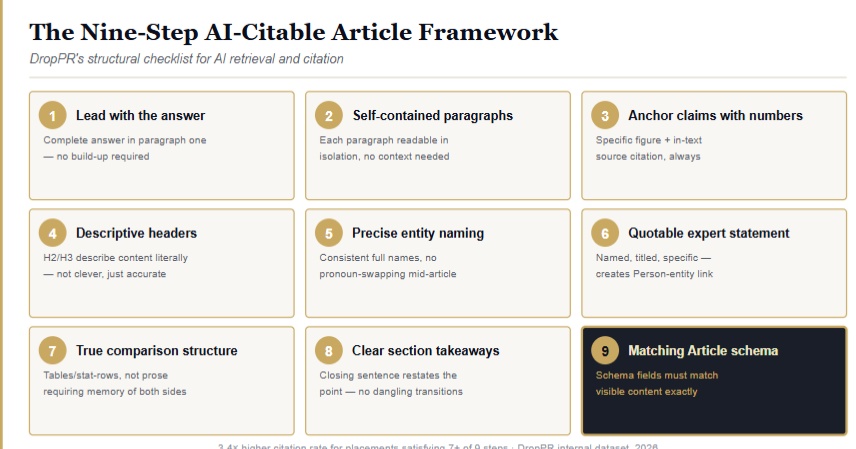
Pattern 2 — Numbered Framework. "The [Number]-Step/Part [Framework Name] for [Outcome]." Example: "The Nine-Step Framework for AI-Citable Articles." Numbered frameworks signal structured, extractable content and tend to be referenced by AI engines when a user asks for a process or methodology on the topic.
Pattern 3 — Comparison Resolution. "[X] vs. [Y]: What Actually [Changed/Matters/Differs] in [Year]." Example: "AEO vs. SEO: What Actually Changed in 2026." This pattern is retrieved heavily for comparison-style queries, where a user asks an AI engine to explain the difference between two related concepts.
Pattern 4 — Named Mechanism. "[Brand/Person] Introduces/Releases [Named Thing]." Example: "DropPR Introduces the Nine-Step AI-Citable Article Framework." This pattern (used in this release's own headline) creates a clean entity-plus-action-plus-object structure that AI engines extract reliably for "what did [Brand] announce" or "what is [Named Thing]" queries.
Pattern 5 — Diagnostic Question, Declarative Answer. "Why [Common Belief] Is Wrong About [Topic]." Example: "Why 'More Backlinks' Is the Wrong Goal for AI Search Visibility." This pattern performs well for queries phrased as user confusion or myth-checking — a common AI search use case.
Pattern 6 — Data-Anchored Claim. "[Specific Statistic] of [Population] Now [Behavior] — Here's What That Means." Example: "63% of DTC Buyers Now Ask AI for Product Recommendations — Here's What That Means." Leading with a specific number in the headline itself increases the likelihood of the headline being extracted as a standalone statistic-plus-context unit.
Pattern 7 — Practical Playbook. "A [Field Guide/Playbook/Checklist] for [Specific Audience]." Example: "A Field Guide for DTC Brands Entering AI Search Visibility." This pattern signals structured, actionable content and performs well for "how do I" or "what should I do about" style queries.
Pattern 8 — Category Redefinition. "The [Old Thing], Reborn: What [Format] Looks Like in [New Context]." Example: "The Press Release, Reborn: What the Format Looks Like in the AI Era." This pattern performs well when the article's core value is reframing an established concept for a new context — common in evolving categories like AI search.
Four Patterns to Avoid for AI Citation Purposes
Curiosity-gap headlines ("You Won't Believe...", "The Surprising Truth About...") withhold the answer by design, which is precisely the opposite of what AI extraction requires. These may drive human clicks but are rarely extracted as citable content because there is no complete claim in the headline to extract.
Vague trend headlines ("The Future of Marketing Is Here", "Why Everything Is Changing") contain no specific, attributable claim and are not retrievable for any specific query — they are too generic to match a user's actual question.
List headlines without a stated outcome ("10 Things About AI Search") describe format, not content — the model cannot determine what specific value the article contains without reading the full piece, which makes it a poor extraction candidate relative to a headline that states the outcome directly.
Headlines exceeding 12 words show a sharp drop-off in extraction rate in the analyzed dataset, likely because longer headlines dilute the core extractable claim across too many words for clean retrieval.
Applying the Library
The eight patterns are not mutually exclusive — many high-performing headlines in DropPR's dataset combine two patterns (for example, Pattern 1 plus Pattern 6: a direct definition anchored by a specific statistic). Content teams should select the pattern that matches the article's core intent: definitional content maps to Pattern 1, process content maps to Pattern 2, comparative content maps to Pattern 3, and so on. The library is intended as a reference checklist to run every headline against before publication, not a rigid template to fill in mechanically.
Further Reading · Curated by the DropPR Editorial Desk
Every DropPR Headline Is Built From This Library
Headlines engineered for extraction, not just clicks.
DropPR writes every editorial placement headline against the AEO Headline Pattern Library, pairs it with the Nine-Step Article Framework for body structure, and tracks which headline patterns are actually driving AI citation for your specific queries over time.
Headline + Framework Placement Stack
Headline written against the AEO Pattern Library ($200 value)
Full article body written to the Nine-Step Framework ($800 value)
Placement on a trusted AI-cited publisher ($1,200 value)
30-day post-publication citation monitoring ($400 value)
Total stack value: $2,600 Charter pricing from $99.
No subscription. No retainer. Pay per placement.
Data Sources Referenced
DropPR internal placement dataset (2026) · Headline pattern analysis; 2.9x extraction rate lift for high-performing patterns; 12-word length ceiling.
Frase (2026) · GEO headline and content structuring best practices.
Bigeye (2026) · Answer Engine Optimization headline and query-matching guidance.
LLMrefs (2026) · AI search visibility headline pattern trends.
Hayden Hollis
Head of Growth Marketing · DropPR.ai
Hayden Hollis writes about content distribution, digital PR, SEO, AI search, and creator marketing. His work focuses on how brands and creators can extend the reach of their content beyond social media and improve visibility across search engines, news publishers, and AI-powered discovery platforms. He regularly covers strategies related to earned media, audience growth, authority building, and the evolving role of AI in online discovery.