DropPR.ai Introduces the Nine-Step AI-Citable Article Framework
DropPR releases a structural writing methodology for maximizing AI citation likelihood — nine steps covering lead-with-the-answer openings, self-contained paragraphs, sourced numeric claims, descriptive headers, consistent entity naming, quotable expert statements, genuine comparison structure, clear section takeaways, and matching Article schema. Includes a before/after rewrite example and internal data showing a 3.4x citation lift for high-compliance articles.
By Hayden Hollis
SAN FRANCISCO, July 19, 2026 — DropPR, a performance PR platform that places editorial content on AI-cited publishers, today introduced the Nine-Step AI-Citable Article Framework, a structured writing methodology designed to maximize the likelihood that a published article is retrieved, extracted, and cited by AI search engines including ChatGPT, Perplexity, Google AI Overviews, and Claude.
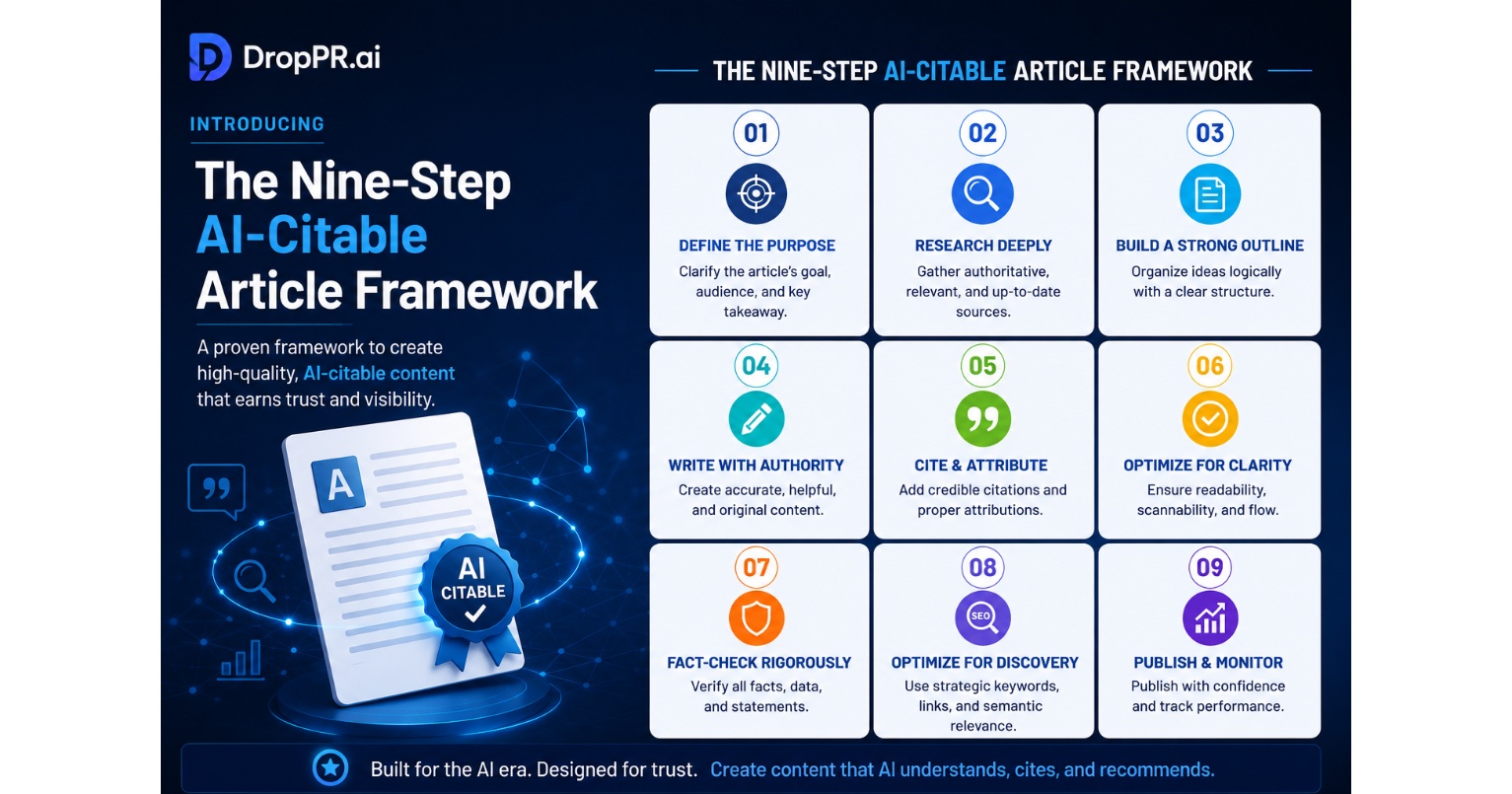
The framework codifies a pattern DropPR has observed across hundreds of editorial placements: articles that are citable by AI engines share nine structural characteristics, regardless of topic, industry, or publication. Articles missing several of these characteristics — even when well-written and factually accurate — are retrieved and cited far less frequently. The framework is being released publicly so that PR teams, content marketers, and agencies can apply it to their own editorial production.
"Most content teams are still writing for human skimmers and search engine crawlers from 2019," said Lou Schwartz, Founder of DropPR. "AI engines extract passages, not pages. If your article isn't structured so a model can lift a self-contained, accurate answer out of paragraph four without needing paragraphs one through three for context, it's invisible no matter how good the writing is. This framework is the checklist we run every placement against before it goes live."
9
structural steps that determine whether AI engines can extract and cite a given passage of an article
3.4x
higher citation rate observed in DropPR placements that satisfy at least 7 of the 9 framework steps versus placements satisfying fewer than 5
55
average word count of the most-cited standalone passages across DropPR's placement dataset — short, dense, self-contained
The Nine-Step Framework
Step 1 — Lead with the answer, not the setup. The first paragraph must contain a complete, extractable answer to the question the article's headline implies. Do not build up to the point across three paragraphs of context. If the headline asks "what is answer engine optimization?", the first paragraph must define it clearly enough that a model could quote it as a standalone answer. Save nuance, caveats, and background for paragraph two onward.
Step 2 — Make every paragraph self-contained. Each paragraph should be readable and meaningful in isolation, without requiring the paragraph before or after it for context. AI retrieval systems extract passages, not full articles — a paragraph that opens with "This is also true because..." or "As mentioned above..." fails when lifted out of sequence. Write each paragraph as if it might be the only one a reader (or a model) ever sees.
Step 3 — Anchor every claim with a specific, sourced number. "AI search is growing fast" is not extractable in any useful way. "AI Overviews now appear on 48% of search engine result pages (BrightEdge, Q1 2026)" is a complete, citable fact. Every substantive claim in the article should be attached to a number and a source, cited in-text immediately adjacent to the figure — not in a footnote or endnote the model may not associate with the claim.
Step 4 — Use descriptive, keyword-complete headers. H2 and H3 headers should describe exactly what the following section contains, using the terms a reader would actually search or ask about. "The Three Types of Schema You Need" is retrievable; "Getting Technical" is not. Headers function as a table of contents for the retrieval system — treat them as literal, not clever.
Step 5 — Name entities precisely and consistently. Use full, correct names for companies, products, and people on first reference, and do not vary the naming convention within the article. "DropPR" should not become "the company" or "we" in ways that break the entity chain for a model trying to track who is being discussed. Consistent entity naming is what allows AI systems to build accurate knowledge graph associations from the article.
Step 6 — Include at least one directly quotable expert statement. A named, titled individual saying something specific and substantive — not a generic platitude — gives AI engines a Person-entity association and a citable authority statement. "This shift is important" is not quotable in a useful way. "The wire model assumed sending a release to 270,000 journalist email addresses would produce coverage — that assumption is no longer operative," attributed to a named executive, is.
Step 7 — Structure comparative content as genuine comparison, not narrative. When an article compares two or more things (tools, strategies, categories), use an actual table, a stat-row, or clearly parallel paragraph structure — not a flowing narrative that requires the reader to hold both sides in memory. AI engines retrieve structured comparative data far more reliably than prose-embedded comparisons.
Step 8 — End sections with a clear takeaway sentence, not a transition. The last sentence of a major section should restate the section's core point in a complete, standalone form — not lead into the next section with "but there's more to consider." This gives the retrieval system a clean closing statement to extract as a summary of that section's content.
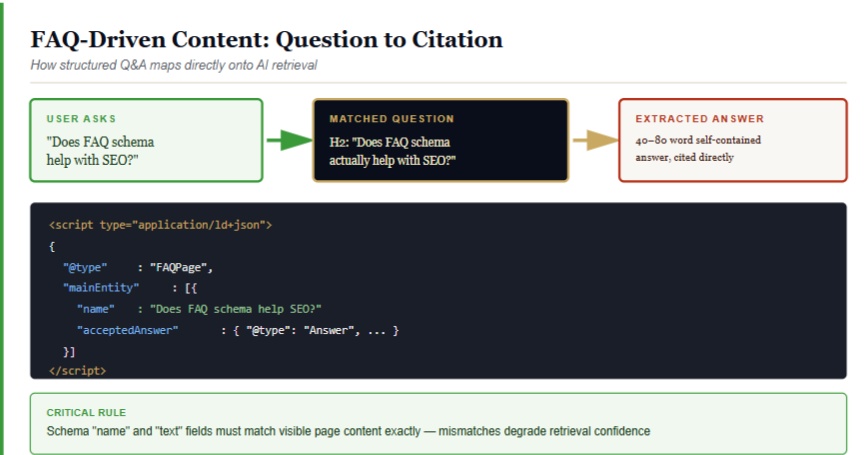
Step 9 — Implement Article schema matching the visible content exactly. The headline, author, datePublished, and about fields in the article's JSON-LD schema must match the visible page content precisely. A mismatch between schema and visible text (a common error when schema is templated separately from content) actively degrades the model's confidence in the article as a reliable structured data source.
Applying the Framework: A Before/After Example
Before (fails Steps 1, 2, 3, 6): "In today's rapidly evolving digital landscape, businesses are increasingly turning their attention to new ways of thinking about search visibility. This has led many marketing teams to reconsider their strategies. As we'll explore in this article, there are several important factors to keep in mind when thinking about how AI is changing things."
After (satisfies Steps 1, 2, 3, 6): "Answer Engine Optimization (AEO) is the practice of structuring content so AI search engines like ChatGPT and Perplexity can extract and cite it directly in generated answers, rather than optimizing for traditional ranked search results. 'The ranking game and the citation game are now two separate disciplines requiring two separate strategies,' said Lou Schwartz, Founder of DropPR. AI Overviews now appear on 48% of search engine result pages (BrightEdge, Q1 2026), meaning a growing share of buyer research never reaches a traditional results page at all."
Availability
The Nine-Step AI-Citable Article Framework is available immediately as a free reference for content teams, PR professionals, and agencies. DropPR applies the full framework to every editorial placement it produces for clients, alongside Article schema implementation and post-publication citation monitoring.
Further Reading · Curated by the DropPR Editorial Desk
Apply the Nine-Step Framework to Your Content
Every DropPR placement is written and validated against this exact checklist.
DropPR writes editorial content structured against the full Nine-Step Framework, implements matching Article schema, and monitors post-publication citation performance so you can see which structural elements are actually driving AI retrieval for your brand.
Framework-Compliant Placement Stack
Editorial article written to the full Nine-Step Framework ($800 value)
Article schema implementation and Rich Results validation ($350 value)
Placement on a trusted AI-cited publisher ($1,200 value)
30-day post-publication citation monitoring ($400 value)
Total stack value: $2,750 Charter pricing from $99.
No subscription. No retainer. Pay per placement.
Data Sources Referenced
BrightEdge (Q1 2026) · AI Overviews appear on 48% of search engine result pages.
DropPR internal placement dataset (2026) · 3.4x citation rate lift for high-framework-compliance articles; 55-word average length of most-cited passages.
Bigeye (2026) · Answer Engine Optimization structural best practices.
Google Developers · Article structured data specification and schema-content consistency requirements.
Hayden Hollis
Head of Growth Marketing · DropPR.ai
Hayden Hollis writes about content distribution, digital PR, SEO, AI search, and creator marketing. His work focuses on how brands and creators can extend the reach of their content beyond social media and improve visibility across search engines, news publishers, and AI-powered discovery platforms. He regularly covers strategies related to earned media, audience growth, authority building, and the evolving role of AI in online discovery.