Entity SEO for AI: How to Make Your Brand a Recognized Entity Inside LLMs
Entity recognition is the entry condition for AI citation — if the model doesn't know your brand as a distinct, well-defined entity, no amount of content or backlinks will get you cited. A six-step framework for building your brand into a recognized entity: Organization schema with sameAs, canonical brand descriptors, person entities for executives, third-party corroboration, Wikipedia/Wikidata, and freshness cadence.
By Hayden Hollis
Entity SEO is the practice of making your brand a recognized, well-defined entity inside the knowledge graphs that AI systems use to understand the world. It is distinct from traditional keyword-based SEO in one fundamental way: keyword SEO optimizes for the relationship between your content and a query. Entity SEO optimizes for the relationship between your brand and everything the model knows about your category, your competitors, your customers, and your claims.
The distinction matters because AI engines do not retrieve content the way search engines rank pages. They retrieve from a structured understanding of entities and their relationships. A brand that is not a recognized entity — with consistent attributes, corroborated claims, and structured data connecting it to its category — is not a candidate for citation regardless of how well its content ranks. The entity is the entry condition. Everything else is secondary.
This article defines what an entity is in the context of AI systems, explains why entity recognition is now the entry condition for AI citation, and provides a concrete step-by-step framework for building your brand into a recognized, citable entity inside the models your buyers use.
344%
surge in search interest for "EEAT" over five years — the quality signal most directly tied to entity authority
5×
citation lift when a brand adds proper Organization and Article schema — entity signals made machine-readable
Feb '26
Google core update that shifted ranking authority from the link graph to the entity knowledge graph
What an Entity Is — and Why It Matters for AI
An entity, in the context of AI knowledge systems, is a named, identifiable thing with consistent attributes that can be distinguished from all other things of the same type. A company is an entity. A person is an entity. A product is an entity. A concept is an entity. What makes something an entity — rather than just a word that appears in text — is that the AI system has built a node in its knowledge graph representing that thing, with edges connecting it to related concepts, categories, people, and claims.
Google's Knowledge Graph contains hundreds of billions of entities. The language models powering ChatGPT, Perplexity, Claude, and Gemini have their own internal entity representations derived from training data. When a user asks "what are the best tools for X," the model generates its answer by retrieving entities it associates with the concept X, not by searching for pages that contain the word X. The brands that appear in that answer are the brands whose entity nodes have strong edges to the X concept. The brands that do not appear either have no entity node or have entity nodes with weak or absent edges to X.
Building a recognized brand entity is therefore not a content marketing task. It is a knowledge graph engineering task — and the steps are well-defined.
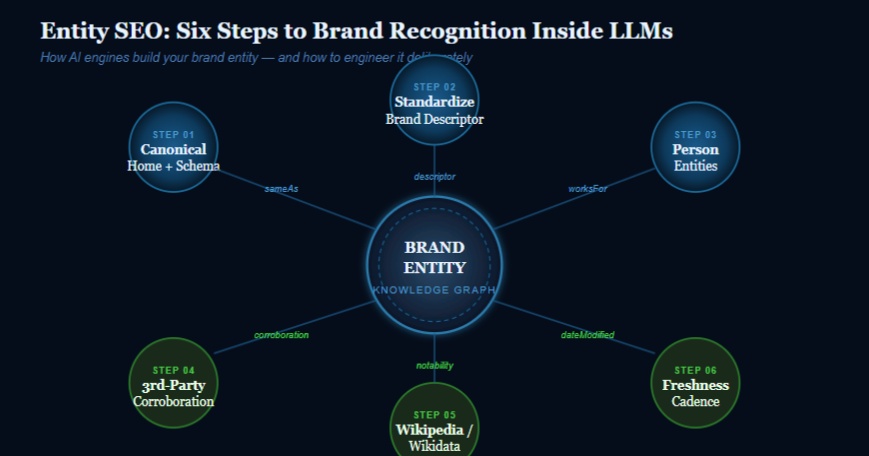
The Entity Building Framework: Six Steps
Step 1 — Establish a Canonical Entity Home. Every brand entity needs a primary URL that serves as its canonical reference point — the page the model associates with the entity when it needs to verify facts. This is typically your About page or homepage, and it must implement Organization schema with the following fields populated: name, url, logo, description, foundingDate, sameAs (linking to all authoritative external profiles), and contactPoint. This schema tells every AI engine and search system: this URL is the authoritative source for facts about this entity.
The sameAs field deserves special emphasis. It takes an array of URLs pointing to other authoritative representations of the same entity — your LinkedIn company page, your Crunchbase profile, your Wikipedia page (if you have one), your Wikidata entry, your G2 profile, your Twitter/X profile. Each sameAs link creates a cross-reference that strengthens the model's confidence that all these sources are describing the same entity. Without sameAs, the model treats your website and your LinkedIn as potentially unrelated entities that happen to share a name.
Step 2 — Standardize Your Brand Descriptor Across Every Surface. The model builds its entity representation by aggregating descriptions from many sources. When those descriptions use different language — "B2B PR platform" on your website, "media placement service" on your LinkedIn, "press release distribution alternative" on G2 — the model averages toward vagueness. When they use consistent language — "Performance PR platform that places editorial content on AI-cited publishers" — the model builds a confident, specific entity node.
Audit every external surface where your brand appears: LinkedIn, Crunchbase, G2, Capterra, AngelList, your press releases, your author bios, and your owned content. Write a single canonical brand descriptor — one sentence, under 25 words, that names your category, your mechanism, and your target customer. Deploy it consistently across every surface. The model is averaging; give it something specific to average toward.
Step 3 — Build Named Author Entities for Your Executives. Company entities are stronger when they are connected to person entities. A CEO or founder who is a recognized entity in the model's knowledge graph — with their own Wikipedia page, LinkedIn profile, published bylines, and consistent bio language — strengthens the company entity through the association. The model's confidence in a company entity increases when it can verify a real, credentialed person behind it.
Implement Person schema on every executive bio page on your site. Include name, jobTitle, worksFor (linked to your Organization schema), sameAs (LinkedIn, Twitter, Wikipedia), and alumniOf. Publish bylined content under the executive's name on third-party publications. Each third-party byline is an edge in the model's knowledge graph connecting the person entity to the publication entity to the topic entity — and through the worksFor relationship, back to your brand entity.
Step 4 — Earn Category-Defining Third-Party Mentions. Owned content cannot build entity authority alone — the model discounts self-descriptions. Third-party editorial sources that mention your brand in the context of your category are the primary mechanism by which the model builds and reinforces your entity's category edges. A Forbes article that describes your brand as "a leading performance PR platform" creates a Forbes→YourBrand→PerformancePR edge cluster that the model treats as corroborated fact.
The specific publications that matter most are the ones already in the model's knowledge graph as trusted entities — major business publications, top vertical trade journals, established review platforms, and analyst reports. Three editorial mentions in trusted publications outweigh thirty mentions on low-authority aggregators for entity building purposes.
Step 5 — Create a Wikipedia or Wikidata Entry Where Eligible. Wikipedia is among the most heavily weighted sources in AI knowledge graph construction. A Wikipedia page for your brand — if your brand meets Wikipedia's notability standards — creates a structured, machine-readable entity definition that directly feeds into Google's Knowledge Graph and into the training data of most major LLMs. Where a full Wikipedia article is not yet eligible, a Wikidata entry provides similar structured entity data without the editorial review requirement.
Wikipedia eligibility typically requires coverage in multiple independent reliable sources — which is another reason editorial placement investment compounds: each new third-party coverage piece moves your brand closer to Wikipedia notability. Wikidata entries can be created for any organization with a verifiable real-world existence and require only structured attribute data, not narrative prose.
Step 6 — Maintain Freshness and Consistency Over Time. Entity recognition is not a one-time achievement. The model's entity representation of your brand is updated with each training cycle and each retrieval event. Brands that maintain consistent, high-quality editorial presence over time — publishing regularly, earning third-party coverage regularly, updating their schema with new information — maintain strong entity nodes. Brands that build entity signals and then go quiet see their entity confidence decay as the model encounters fewer recent corroborations.
The minimum maintenance cadence for entity freshness is monthly: one substantive owned content update, one third-party mention, and schema review to ensure dateModified fields are current. Weekly cadence produces stronger compounding. The entity graph is not static; it requires consistent investment to remain strong.
How to Audit Your Current Entity Strength
The AI test. Open ChatGPT or Perplexity and type "Tell me about [Your Brand Name]." Read the response carefully. Does the model describe your brand accurately? Does it name your category correctly? Does it mention your key differentiators? Does it confabulate — inventing plausible-sounding but inaccurate details? The quality and accuracy of this response is a direct proxy for your current entity strength. An accurate, specific response indicates a well-built entity node. A generic, vague, or inaccurate response indicates entity gaps.
The schema test. Run your homepage and About page through Google's Rich Results Test. Verify that Organization schema is present and that sameAs, logo, description, and foundingDate are all populated. Check that Person schema exists on all executive bio pages. Any missing field is a gap the model cannot fill from structured data.
The consistency test. Search your brand name across LinkedIn, Crunchbase, G2, and your top five third-party mentions. Read the first sentence describing your brand on each. If those sentences describe your brand differently — different categories, different mechanisms, different target customers — you have a standardization gap that is directly suppressing entity confidence.
Further Reading · Curated by the DropPR Editorial Desk
Build Your Brand Entity — Starting With Schema
From unknown string to recognized entity — the infrastructure that makes AI citation possible.
DropPR builds brand entity strength across all six steps: schema implementation, descriptor standardization, person entity creation, editorial corroboration, and freshness cadence. The editorial placements we deliver are the third-party mentions that close the corroboration gap no owned content can close on its own.
Brand Entity Building Stack
Organization + Person schema implementation with sameAs ($600 value)
Brand descriptor standardization across all external surfaces ($350 value)
Editorial placement on a trusted publisher (corroboration) ($1,200 value)
Entity strength audit: AI test, schema test, consistency test ($400 value)
30-day citation share monitoring across 5 AI engines ($400 value)
Total stack value: $2,950 Charter pricing from $99.
No subscription. No retainer. Pay per placement.
Data Sources Referenced
Casey's SEO (2026) · 344% surge in search interest for "EEAT" over five years.
Aumcore (2026) · 5× citation lift from Organization + Article schema implementation.
Memorable Design (2026) · Entity recognition as entry condition for AI citation; knowledge graph edge building.
Schema.org · Organization, Person, and sameAs specification and implementation guidance.
Bigeye (2026) · AEO complete guide; entity-level vs. page-level evaluation in AI retrieval.
Google · February 2026 Core Update; knowledge graph as primary authority signal.
Hayden Hollis
Head of Growth Marketing · DropPR.ai
Hayden Hollis writes about content distribution, digital PR, SEO, AI search, and creator marketing. His work focuses on how brands and creators can extend the reach of their content beyond social media and improve visibility across search engines, news publishers, and AI-powered discovery platforms. He regularly covers strategies related to earned media, audience growth, authority building, and the evolving role of AI in online discovery.