The Founder-Led Article: Turning Executive POV Into Citable Authority
Most founders have the ideas but not the structure to turn them into published bylines. A seven-element repeatable article architecture — contrarian thesis, credentialing sentence, evidence block, mechanism explanation, reader implication, named prescriptive framework, and personal closing — plus the 4-step production workflow that separates the founder's 15-minute input from the editorial work. Why founder bylines produce double the entity-graph signal of brand content, and how a monthly byline program compounds into category authority.
By Hayden Hollis
The founder-led article is one of the most consistently underinvested assets in B2B content strategy. Most companies have a founder or CEO with genuine subject-matter authority — someone who has spent years building in a category, has a perspective on where it is going, and has the credibility to be taken seriously by the journalists, analysts, and buyers who read business media. And most of those founders publish either nothing at all, or LinkedIn posts that are forgotten within 48 hours and never cited by anyone.
The problem is not lack of ideas. It is lack of a repeatable structure — a template that converts a founder's genuine POV into a byline-ready article that editorial teams will publish, that AI engines will retrieve, and that compounds into measurable authority over time. Writing from scratch every time is too slow. Delegating entirely to a ghostwriter produces content that lacks the founder's voice. What works is a structured process: a defined article architecture that the founder populates with their thinking, that a skilled editor brings to publication standard, and that gets placed on a trusted publisher as a named byline.
This article describes that architecture — element by element — and explains why each structural decision serves both editorial publishability and AI citation share simultaneously.
561%
greater LinkedIn reach for personal founder profiles vs. company pages — the distribution multiplier for every byline placed
63%
of B2B buyers find a CEO more credible than the company's communications department as a content source
2×
entity-graph signal from a named founder byline vs. anonymous brand content — person entity + brand entity simultaneously
Why Founder Bylines Earn More Citations Than Brand Content
AI engines apply E-E-A-T (Experience, Expertise, Authoritativeness, Trustworthiness) at the author level. Content attributed to a named, credentialed expert with a verifiable identity — a LinkedIn profile, a professional bio, a history of bylines on trusted publications — is retrieved and cited more frequently than the same content attributed to a brand handle or an anonymous "editorial team." The author entity is a signal, not a decoration.
When a founder publishes a byline on a trusted publication, two entity-graph signals fire simultaneously. The brand entity gets an editorial mention from a trusted source (corroboration signal). The founder's person entity gets a byline attribution on that same trusted source (expert authority signal). The worksFor relationship in the schema connects the two — reinforcing the brand entity through the founder's credibility and the founder's entity through the brand's category associations. A single well-placed founder byline produces more entity-graph value than multiple anonymous brand content pieces on the same topic.
This is why the investment calculation on founder-led content is different from standard content marketing. The article is not just a distribution event. It is a structured data input that strengthens two entity nodes simultaneously, on a trusted third-party property, with the founder's credentials attached as the authority signal the model uses to evaluate the claim's trustworthiness.
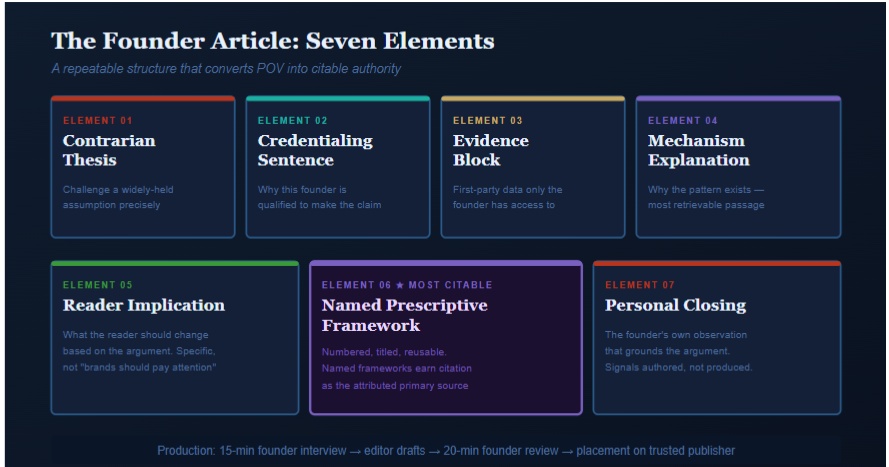
The Founder-Led Article Architecture: Seven Elements
Element 1 — The Contrarian Thesis. Every founder article worth publishing begins with a claim that challenges a commonly-held assumption in the category. Not a radical claim — a precise one. The format is: "[Widely-held belief] is wrong, and here is why it matters that you know this." Examples: "PR is not a brand function — it is a citation infrastructure problem." "Most content strategies are optimizing for a surface their buyers stopped using two years ago." The contrarian thesis is the reason the editorial team accepts the pitch and the reason the buyer reads past the headline. It signals that the founder has a perspective that earns its place in the publication.
Element 2 — The Credentialing Sentence. The second or third sentence of the article must establish why this founder is qualified to make the contrarian claim. Not a full bio — a single credentialing sentence that names the founder's relevant experience. "I have spent the last eight years building PR infrastructure for B2B SaaS companies, and what I have observed consistently is..." This sentence creates the expert-entity association the AI retrieval system uses to weight the passage's credibility. Without it, the article is an opinion. With it, it is expert commentary.
Element 3 — The Evidence Block. The contrarian thesis must be supported by evidence that the founder has access to and that the reader does not. First-party data from the founder's own operations (customer outcomes, internal metrics, observed patterns), primary research, or a novel synthesis of publicly-available data that the founder is uniquely positioned to interpret. "In the last 90 days, we have run citation share audits for 47 B2B brands. The median citation share on Consideration queries was 11%. The median on Awareness queries was 34%. That 23-point gap is the Consideration gap — and closing it is almost never a content problem." An evidence block with specific, first-party numbers is the most citable element of any founder article.
Element 4 — The Mechanism Explanation. After establishing what is happening (contrarian thesis) and what the evidence shows (evidence block), the article must explain why it is happening. This is the mechanism — the underlying dynamic that produces the pattern the evidence describes. The mechanism explanation is what converts the article from an observation into an insight. It is also the most retrievable element for definitional queries — AI engines extract mechanism explanations as the primary passage when a buyer asks "why does X happen?"
Element 5 — The Implication for the Reader. The article must explicitly state what the pattern and mechanism mean for the reader's specific situation. Not "brands should pay attention to this" — that is not an implication, it is a placeholder. A real implication names the specific action or belief the reader should change based on what the article has established. "If you are allocating your editorial budget based on keyword rankings rather than citation gap analysis, you are measuring the wrong outcome and will continue to lose AI discovery share to competitors who are not." This directness is what makes founder articles worth reading and worth citing — they take a position the reader can act on or argue with.
Element 6 — The Prescriptive Framework. The most citable section of any founder article is a named, numbered, reusable framework — a set of steps, principles, or criteria that the reader can apply to their own situation. Named frameworks earn citation as "the named author's framework" — they become the attributed primary source for an idea that propagates through the category. Examples: "The Citation Gap Diagnostic" (seven causes), "The Share of Model Methodology" (six steps), "The Entity Building Framework" (six steps). The framework does not need to be complex. It needs to be named, numbered, and genuinely useful.
Element 7 — The Personal Closing. The final paragraph of a founder article should return to the personal register — the founder's own experience or perspective that grounds the argument in a real observation rather than an abstract conclusion. "I started thinking about this problem when I ran my first AI brand audit and found that a company I had worked with for three years, with strong SEO and solid domain authority, was cited in 6% of the queries their buyers were asking ChatGPT. That number changed how I thought about what editorial investment was actually for." The personal closing is the element that makes the article feel authored — not ghostwritten, not brand-produced, but genuinely the founder's thinking on the page.
The Production Workflow: From Founder POV to Published Byline
The bottleneck in most founder content programs is production — the founder has the ideas but not the time to write 1,000 polished words on a deadline. The workflow below addresses this by separating the founder's input (15–20 minutes) from the editorial production (handled by a skilled editor or writing partner).
Step 1 — The Thesis Interview (15 minutes). The editor or writing partner runs a structured 15-minute conversation with the founder using the seven-element architecture as the interview guide. The output is a rough recording or transcript that covers: what is the contrarian claim, what evidence do you have for it, what is the underlying mechanism, what should the reader do differently, what framework names the solution, and what personal experience grounds it. This conversation, not a blank page, is where the article begins.
Step 2 — The First Draft (handled by editor). The editor produces a 900–1,200 word first draft in the founder's voice, following the seven-element architecture. The draft uses the founder's language from the interview, supplements with any external research needed for the evidence block, and structures every section for passage-level extraction.
Step 3 — The Founder Review (20 minutes). The founder reads the draft and adds the specific details only they have access to — exact numbers from their own operations, specific customer observations, the precise language of their personal experience. This review is not a full rewrite; it is the addition of the first-person specificity that the editor cannot invent.
Step 4 — Placement and Schema. The final article is submitted to the target publication as a byline pitch, with the founder's credentials and a one-paragraph pitch explaining why the article serves the publication's audience. Once accepted and published, the URL is added to the founder's Person schema sameAs field and linked from the brand's owned newsroom. The placement becomes both a citation asset and an entity-graph update.
The Compounding Effect of Monthly Founder Bylines
A single founder byline is a citation event. Monthly founder bylines are a compound authority program. Each new article adds a corroboration node to the founder's person entity and the brand entity. Each new publication that accepts a byline adds a new trusted source to the corroboration graph. Each new named framework becomes a citable primary source that generates attribution across subsequent coverage in the category.
The brands with the strongest AI citation share in their categories are almost universally running consistent founder byline programs — three to four articles per quarter, across two to three publications, covering the same category concepts with the same consistent brand descriptor. The compounding is not accidental. It is the systematic accumulation of the corroboration signals the majority rule heuristic requires to cite confidently.
Further Reading · Curated by the DropPR Editorial Desk
Turn Your Founder's POV Into a Citation Program
Monthly founder bylines on trusted publishers — written in your voice, placed in your category.
DropPR runs the full founder article production workflow: thesis interview, editorial drafting, founder review, and placement on a trusted AI-cited publisher. Your thinking becomes a named byline. Your byline becomes a citation asset. The program compounds monthly.
Founder Authority Byline Stack
15-minute thesis interview + seven-element article draft ($800 value)
Founder review and voice-matching editorial polish ($400 value)
Placement on a trusted AI-cited publisher as named byline ($1,200 value)
Person schema update and sameAs link to published byline ($200 value)
LinkedIn amplification kit for the published byline ($300 value)
Total stack value: $2,900 Charter pricing from $99.
For founders, CEOs, and executive teams. No subscription. Pay per placement.
Data Sources Referenced
Ordinal (Jan 2026) · LinkedIn personal profiles 561% greater reach than company pages.
Edelman Trust Barometer · 63% of buyers find CEO more credible than communications department.
Bigeye (2026) · AEO complete guide; named frameworks as primary citation-durable content format.
Workflows.io (May 2026) · Founder-led marketing as primary B2B GTM motion.
Hey Sid (2026) · Personal brand vs. business brand; 8× engagement gap between personal and company content.
DropPR analysis (2026) · Two-entity-signal effect of founder bylines; worksFor schema relationship compounding.
Hayden Hollis
Head of Growth Marketing · DropPR.ai
Hayden Hollis writes about content distribution, digital PR, SEO, AI search, and creator marketing. His work focuses on how brands and creators can extend the reach of their content beyond social media and improve visibility across search engines, news publishers, and AI-powered discovery platforms. He regularly covers strategies related to earned media, audience growth, authority building, and the evolving role of AI in online discovery.