Getting Cited: The 2026 Practitioner's Playbook for AI Search Visibility
ChatGPT, Perplexity, Google AI Overviews, and Claude don't pull from where you think. The brands earning citation share are running a different playbook — and most marketing teams haven't seen it yet.
By Hayden Hollis
There is a useful exercise marketing teams should run in 2026 — and almost none of them have. Open ChatGPT. Open Perplexity. Open Google AI Mode. Type the question your highest-intent buyer types before deciding which vendor to evaluate. Read the answer. Note which brands are named. If yours is not one of them, you have a citation gap.
The citation gap is the operational problem of the current moment. With AI Overviews now appearing on 48% of search engine result pages and ChatGPT processing over a billion searches per week, the brands cited inside generative answers are pulling demand out of the funnel before competitors even know a search occurred. Most marketers are still measuring page-one Google rankings — a metric whose relationship to discovery has materially decoupled from outcomes.
This is a playbook. It explains how the engines actually choose, where the gaps usually sit, and the seven steps that close them.
99%
of URLs cited in Google AI Overviews come from pages already in the organic top 10
87%
of ChatGPT citations correspond to top Bing results
<20%
overlap between top Google links and AI-cited sources — down from ~70%
How AI Engines Actually Choose
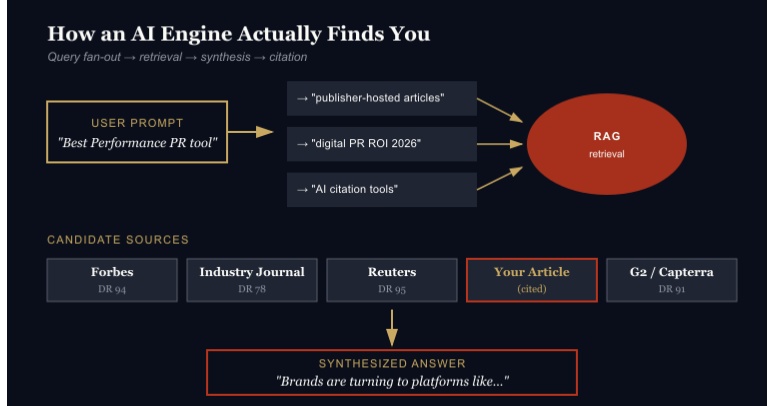
The first thing to internalize is that generative engines do not behave like search engines. A search engine returns a ranked list of links. An AI engine builds an answer. The mechanism, simplified, runs in four stages:
Stage 1 — Query Fan-Out. The model breaks the user's prompt into multiple sub-queries. A prompt like "best VPN for streaming Netflix in Europe" becomes three separate searches: "best VPN 2026," "VPN Netflix streaming," and "VPN Europe servers." If your content only addresses the parent query, you may not surface for any of the children.
Stage 2 — Retrieval-Augmented Generation (RAG). The model retrieves specific passages — not pages — from a corpus that includes web results, the model's pretraining data, and increasingly its own citation history. These passages become context for the answer.
Stage 3 — Synthesis. The model combines retrieved passages with its parametric knowledge to produce a coherent answer. It does not copy; it rewrites and merges.
Stage 4 — Citation. The response surfaces source links. Citation patterns differ by engine: Google AIO leans toward its existing top organic results, Perplexity weights freshness and source diversity, ChatGPT increasingly leans on Bing's index and third-party authority signals.
The Three Citation Gaps
Gap 01 · The Entity Gap
LLMs evaluate sources at the entity level, not just the page level. If your brand isn't an entity the model recognizes — with consistent attributes across the web — you are not in the candidate set, no matter how strong your owned content is. Closing the entity gap means structured schema markup on your domain, consistent NAP (name, address, phone) and brand descriptors across directories, and — most consequentially — third-party mentions that the model uses to disambiguate you.
Gap 02 · The Authority Gap
AI engines apply a heuristic researchers call "majority rule" for brand facts — if multiple third-party sources describe your brand as the leading X, the model treats that as ground truth. Closing the authority gap is not a content problem. It is a placement problem.
Gap 03 · The Structural Gap
Even brands in the candidate set lose citation share because their content is structurally unfriendly to RAG. Long, unstructured paragraphs with the answer buried mid-article get retrieved less often than clearly-marked Q&A blocks, definitional sentences, and comparison tables. The model wants extractable, self-contained passages.
The Seven-Step Playbook
Audit your current citation share.
Run 20–30 representative buyer queries across ChatGPT, Perplexity, Google AIO, and Claude. Record which sources are cited, which competitors appear, and which publications recur. This is your baseline and your target list.
Close the entity gap on your owned domain.
Implement Organization, Article, and FAQPage schema. Standardize brand descriptors across LinkedIn, Crunchbase, Wikipedia (where eligible), G2/Capterra, and any vertical-relevant directories. The model is building a knowledge graph; give it consistent inputs.
Restructure content for extractability.
Lead with definitional sentences. Use clearly-marked headers. Build comparison tables. Pull statistics into discrete blocks. The passage, not the page, is the unit of retrieval.
Manufacture third-party authority signals.
Editorial placements on publications the model already cites are the highest-leverage move available. This is the work Performance PR was built for.
Participate in cited community surfaces.
Reddit, Quora, Stack Overflow, and industry forums appear in AI citation sets with surprising frequency. Substantive non-promotional participation by named experts creates the entity associations the model uses.
Pursue review-platform presence.
G2, Capterra, and Gartner Peer Insights appear in 34.5% of AI Overviews for commercial queries. If you sell anything evaluatable, your presence on these platforms is non-optional.
Measure citation share over time.
The metric is not traffic. It is citation share — how often your brand surfaces in answers to the queries you care about. Tools like Profound, Otterly, and Omnia track this; manual sampling on a 30-day cadence works as a starting point.
What Most Teams Get Wrong
They treat GEO as an SEO add-on. Traditional SEO is the foundation, but the optimization surfaces are different. Schema, entity consistency, and third-party authority matter more than internal linking. Title tags matter less.
They chase citation volume instead of citation quality. Being cited on a low-authority aggregator that no one queries is worth nothing. Citation share on the prompts your buyers actually type is worth everything.
They produce more owned content. If the engines aren't citing your existing content, producing more of it does not change the outcome. The bottleneck is third-party validation, not output volume.
They wait for SEO budgets to "catch up." The brands moving on this in Q2 2026 are establishing entity associations that will compound for years. Initial citation improvements typically appear within weeks; consistent share lifts take three to six months. The window for early-mover advantage is open and closing.
Close the Citation Gap
Be cited where the answers are written — not buried in the candidate set.
DropPR places your expertise on the publishers AI engines already cite. One upload becomes one editorially-written, publisher-hosted article — engineered for retrieval, optimized for citation, tracked for revenue.
Citation Acceleration Stack — Charter Cohort
Editorial article structured for RAG extractability ($1,200 value)
Placement on an AI-cited high-authority publisher ($800 value)
Full schema markup and entity disambiguation ($350 value)
30-day citation share monitoring across ChatGPT, Perplexity, AIO ($250 value)
Competitor citation gap audit on 10 target queries ($400 value)
Total stack value: $3,000 Charter pricing from $99.
No subscription. No retainer. Pay per placement. · Real editorial workflows, not press-release distribution.
Hayden Hollis
Head of Growth Marketing · DropPR.ai
Hayden Hollis writes about content distribution, digital PR, SEO, AI search, and creator marketing. His work focuses on how brands and creators can extend the reach of their content beyond social media and improve visibility across search engines, news publishers, and AI-powered discovery platforms. He regularly covers strategies related to earned media, audience growth, authority building, and the evolving role of AI in online discovery.