How AI Search Engines Decide Which Brands to Cite: A Source-Selection Breakdown
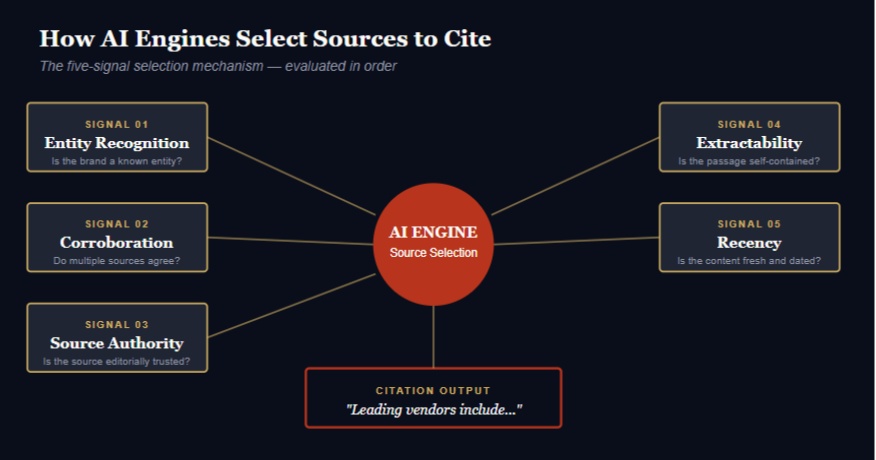
Every AI answer names a small set of cited sources. That selection is not random — it runs on five specific signals: entity recognition, corroboration, source authority, structural extractability, and recency. Lou Schwartz breaks down each signal, how it is weighted, and what it means in practice for any brand trying to earn citation share in 2026.
By Hayden Hollis
Every week, more than a billion people ask ChatGPT a question. Several hundred million more ask Perplexity, Google AI Mode, Claude, or Gemini. In each case, the engine produces a synthesized answer — and in most cases, it names sources. The brands and publications that appear in those answers are not there by accident. They are there because the engine's selection mechanism evaluated them against a specific set of signals and found them worthy of citation.
Understanding those signals is now one of the most commercially important problems in marketing. The brand that appears in the answer to "best CRM for mid-market SaaS companies" has been considered by every buyer who typed that query. The brand that does not appear has been filtered out before the buyer ever visited a website. The mechanism of that filtration is knowable, and it is engineered — not random.
What follows is a source-selection breakdown: the five signals AI engines use to decide which brands and sources to cite, how each signal is weighted, and what it means in practice for any marketing team trying to earn inclusion.
99%
of URLs cited in Google AI Overviews already appear in the organic top 10 — authority is the entry condition
87%
of ChatGPT citations correspond to top Bing results — retrieval and training data compound each other
<20%
overlap between top Google organic links and AI-cited sources — citation is a separate discipline from SEO
Signal 1 — Entity Recognition
What it is: Before an AI engine can cite a brand, it must recognize that brand as a distinct entity in its knowledge graph. An entity is a named, identifiable thing — a company, a person, a product, a concept — with consistent attributes across multiple sources. Entities that are well-defined in the model's knowledge graph are candidates for citation. Entities that are ambiguous, inconsistently described, or absent are not.
How it works: The model maintains a knowledge graph that stores entities as nodes and relationships as edges. When your brand name appears consistently across multiple trusted sources — with the same category description, the same founding story, the same key differentiators — the model builds a strong, confident entity node. When your brand name appears inconsistently, or only on low-authority sources, the model's entity node is weak or absent.
What it means in practice: Standardize your brand descriptor across every surface — your website, LinkedIn, Crunchbase, G2, Wikipedia (where eligible), and every editorial placement. The model is averaging across sources. Inconsistency averages toward vagueness. Consistency averages toward a confident, citable entity.
Signals that strengthen entity recognition: Organization schema markup on your domain. Named author entities on every piece of content. Consistent NAP (name, address, phone) across directories. Third-party editorial coverage that uses your brand name in conjunction with your category keywords. Wikipedia presence for brands with sufficient notability.
Signal 2 — Corroboration (Majority Rule)
What it is: AI engines apply what researchers describe as a majority rule heuristic for brand facts. If multiple independent, trusted sources make the same claim about a brand — that it is the leading provider of X, that it is used by Y type of customer, that it was founded in Z year — the model treats that claim as ground truth and is willing to cite it confidently. If only one source makes a claim, the model treats it as uncertain.
How it works: Retrieval-augmented generation pulls multiple passages from multiple sources and synthesizes them. When passages from different sources agree, the synthesis is confident. When passages conflict, the model hedges. When only one source addresses a question, the model either cites that source with low confidence or declines to make the claim at all.
What it means in practice: A single editorial placement does not produce confident AI citation. A pattern of consistent editorial placements — across multiple publications, over time, making consistent claims about your brand's category position — produces the corroboration the model needs to cite you confidently. This is why editorial cadence matters more than any individual placement.
Signals that strengthen corroboration: Multiple editorial placements in different publications describing your brand consistently. Review platform content that corroborates your positioning. Analyst report mentions that use your own category language. Podcast appearances and newsletter features that use consistent descriptors.
Signal 3 — Source Authority (Editorial Trust)
What it is: Not all sources are equally trusted by AI engines. The retrieval corpus weights sources by editorial credibility — a property that correlates with domain authority, citation history, editorial standards, and the model's prior experience citing the source accurately. Forbes, TechCrunch, Reuters, Bloomberg, and their vertical equivalents are highly trusted. Self-published content, press-release syndication sites, and low-authority aggregators are discounted.
How it works: Each source in the retrieval corpus carries an implicit trust weight derived from its training history. Sources that the model has previously cited and that have been validated (through user feedback, RLHF, and downstream citation behavior) accumulate higher trust weights over time. The trust weight multiplies the probability that a passage from that source will be included in a synthesized answer.
What it means in practice: A single editorial placement on a high-trust publication produces more citation lift than dozens of mentions on low-authority sources. The investment calculation for PR changes materially when you understand this: one Forbes placement, one TechCrunch article, one Reuters mention is worth more for AI citation share than a hundred press-release distributions.
Signals that strengthen source authority: Placement on publications with established editorial history and high domain authority. Vertical trade publications with substantive editorial standards. Review platforms (G2, Capterra, Gartner Peer Insights) that appear in 34.5% of commercial AI Overviews. Analyst reports from Gartner, Forrester, and IDC.
Signal 4 — Structural Extractability
What it is: AI engines do not retrieve pages — they retrieve passages. A passage is a semantically coherent block of text, typically a few sentences to a paragraph, that can be extracted from its context and incorporated into a synthesized answer. Content that is structured for passage extraction — with clear definitional sentences, labeled sections, comparison tables, and discrete statistical blocks — is significantly more likely to be cited than content of equal quality that is structurally dense and difficult to extract from.
How it works: Retrieval-augmented generation uses vector similarity search to find passages that match the query's semantic intent. Passages that are self-contained — that answer a question without requiring context from surrounding paragraphs — score higher in retrieval. Passages that are buried in long, uninterrupted prose score lower, because the model cannot confidently extract them without including large amounts of surrounding context.
What it means in practice: The most extractable content leads with the answer. A definitional sentence at the top of a section ("X is defined as...") is more extractable than the same definition buried in paragraph four. A comparison table is more extractable than a prose comparison. A bulleted list of numbered signals — like this article — is more extractable than a narrative essay covering the same ground.
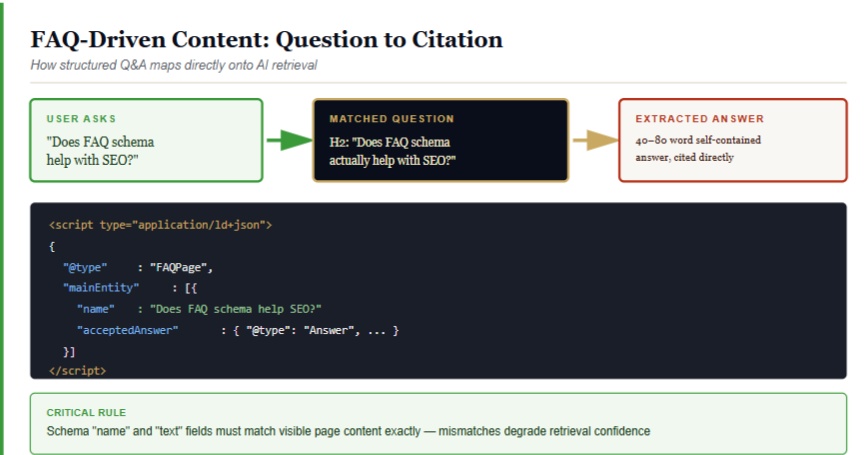
Signals that strengthen extractability: Clearly-marked H2 and H3 headers on every section. Definitional sentences at the start of each section. Comparison tables for any topic involving multiple options. Statistics pulled into their own discrete blocks or callout elements. FAQ sections that explicitly match the format of likely queries. Schema markup (FAQPage, Article, HowTo) that tells the engine what type of content it is reading.
Signal 5 — Recency and Freshness
What it is: AI engines, particularly in retrieval mode, weight recently published and recently updated content more heavily than older content for time-sensitive queries. Freshness matters most for rapidly evolving categories — technology, marketing, finance, regulatory topics — where information from 2022 may be materially inaccurate by 2026. It matters least for evergreen definitional content where the answer does not change.
How it works: Sources with visible publication dates, accurate last-modified timestamps in their schema, and regular update cadences signal freshness to the retrieval system. Sources with hidden or absent dates, or with content that has not been updated for years, receive a freshness discount for queries where recency is a relevance signal. Google's ranking algorithm has applied freshness weighting for years; AI retrieval systems apply a version of the same logic.
What it means in practice: Newsroom and blog content should always include visible publication dates and accurate last-modified dates in Article schema. Content published in 2022 that still describes your product accurately should be updated and re-dated, not left to age. An editorial cadence of at least monthly substantive entries keeps the property in the freshness window for time-sensitive retrieval.
Signals that strengthen freshness: Visible datePublished and dateModified fields on all content. Regular editorial cadence — weekly where possible, monthly at minimum. Active updating of existing content when facts change. News and announcement coverage that references current events in your category.
How the Five Signals Work Together
The five signals do not operate independently. They form a compound selection function. A brand that scores well on entity recognition but poorly on corroboration will be recognized but not cited confidently. A brand that scores well on source authority but poorly on structural extractability will appear in the retrieval corpus but not make it into the synthesized answer. A brand that scores well on all five is the brand that gets named.
The practical implication is that citation share optimization is a systems problem, not a single-lever problem. Improving one signal while neglecting others produces marginal results. Building across all five signals — consistently, over a sustained period — produces the compounding citation share that becomes a durable competitive advantage.
The sequence that produces the fastest results: establish entity recognition first (schema, standardized descriptors, third-party directory presence), then build corroboration through editorial placements, then optimize structural extractability in owned content, then maintain freshness through editorial cadence. Source authority compounds naturally as placements accumulate on trusted properties.
Further Reading · Curated by the DropPR Editorial Desk
Engineer All Five Signals — Starting With Editorial
Get cited where your buyers are searching — not just ranked where they used to click.
DropPR builds citation share across all five AI source-selection signals: entity recognition, corroboration, source authority, structural extractability, and freshness. One placement triggers the flywheel. Consistent placements compound it.
Citation Signal Stack — What You Get
Editorial article on a high-trust, AI-cited publisher ($1,200 value)
Entity schema markup and brand descriptor standardization ($350 value)
Structural extractability audit on your top 5 owned pages ($400 value)
30-day citation share monitoring across ChatGPT, Perplexity, AIO ($400 value)
Competitor citation gap audit on 10 target queries ($400 value)
Total stack value: $2,750 Charter pricing from $99.
No subscription. No retainer. Pay per placement.
Data Sources Referenced
LLMrefs (2026) · 99% of Google AI Overview URLs from organic top 10; <20% overlap between organic and AI-cited sources.
Bigeye (2026) · 87% of ChatGPT citations correspond to top Bing results; majority rule heuristic.
BrightEdge · Review platforms cited in 34.5% of commercial AI Overviews.
Frase (2026) · GEO Playbook; passage-level retrieval in RAG systems.
Aumcore (2026) · EEAT and trust signals as primary citation and ranking drivers.
Google Developers · Article structured data; FAQPage and HowTo schema specifications.
Hayden Hollis
Head of Growth Marketing · DropPR.ai
Hayden Hollis writes about content distribution, digital PR, SEO, AI search, and creator marketing. His work focuses on how brands and creators can extend the reach of their content beyond social media and improve visibility across search engines, news publishers, and AI-powered discovery platforms. He regularly covers strategies related to earned media, audience growth, authority building, and the evolving role of AI in online discovery.