How to Audit Your Brand Across ChatGPT, Perplexity, and Google AI Overviews
Most marketing teams have no idea how their brand is currently described inside ChatGPT, Perplexity, or Google AI Overviews. This step-by-step audit covers five prompt categories — entity recognition, awareness, consideration, decision, and source attribution — with the exact prompts to run on each of four AI engines, what to look for in every response, and how to prioritize and act on what you find. Takes 90 minutes on first run, 30 minutes monthly.
By Hayden Hollis
Most marketing teams have no idea how their brand is currently represented inside ChatGPT, Perplexity, or Google AI Overviews. They know their keyword rankings. They know their domain authority. They know their organic traffic by landing page. But when a buyer opens an AI engine and types the exact question they ask before deciding which vendors to evaluate, most marketing teams cannot tell you whether their brand appears in the answer, what the answer says if it does, and which competitors are named instead if it does not.
This is not a small blind spot. It is the central blind spot of 2026 marketing measurement. The buyer's shortlist is increasingly being assembled inside AI engines before any vendor website is visited. The brands appearing in those answers are winning consideration. The brands absent are being filtered out. And the teams that have never run a structured AI brand audit do not know which category they are in.
This article is a step-by-step AI brand audit guide with the exact prompts to run, the engines to run them on, what to look for in each response, and how to interpret and act on what you find. Run this audit once to establish your baseline. Run it monthly to track progress. It takes ninety minutes on first run and thirty minutes on subsequent updates.
4
AI engines your brand audit must cover: ChatGPT, Perplexity, Google AI Overviews, and Claude or Gemini
90
minutes for a complete first-run brand audit across all four engines and all five prompt categories
30
prompts: the recommended panel size for a complete AI brand visibility baseline
Before You Start: What You Are Measuring
An AI brand audit measures three things simultaneously. First, entity recognition — does the model know your brand as a distinct entity, and does it describe you accurately? Second, citation inclusion — does your brand appear in synthesized answers to the queries your buyers are actually asking? Third, competitive position — which brands appear alongside yours, or instead of yours, in the answers your buyers read?
These three measurements require three different prompt types, run across four AI engines. The audit is organized into five prompt categories, each targeting a specific dimension of AI brand visibility. Run every prompt on every engine and record the results in a simple spreadsheet: brand named (Y/N), description accurate (Y/N), competitors named, sources cited.
Engine Setup: How to Run Each Prompt Correctly
ChatGPT: Use GPT-4o with browsing enabled. Go to chat.openai.com, start a new conversation (do not use a conversation that has discussed your brand previously — prior context influences responses), and run each prompt fresh. Enable web search when available to capture retrieval-augmented responses, not just parametric memory.
Perplexity: Use perplexity.ai in Focus: Web mode. Perplexity is the most retrieval-heavy of the four engines and will cite specific sources in its responses — record which sources it cites for each prompt, as this tells you directly which publications are driving brand representation in its answers.
Google AI Overviews: Search each prompt in Google with AI Overviews enabled (ensure you are signed into a Google account in a region where AI Overviews are active). Capture the AI Overview response at the top of the results page before the organic links. Note whether an AI Overview appears at all — for some queries it will not, which is itself informative.
Claude or Gemini: Use claude.ai or gemini.google.com. These engines have different training data emphases and retrieval corpus characteristics — Claude leans toward published editorial content; Gemini integrates more heavily with Google's index. Differences between their responses and ChatGPT/Perplexity responses reveal which sources are driving your brand representation in each corpus.
Prompt Category 1 — Entity Recognition Prompts
Entity recognition prompts test whether the model knows your brand as a distinct entity and whether its description of you is accurate. Run these first — they establish the foundation for interpreting all other audit results.
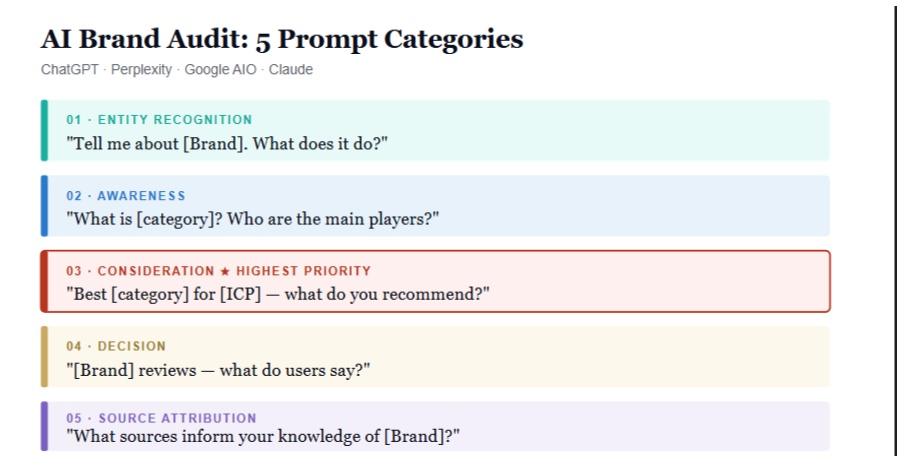
Prompt 1.1 — Direct entity query: "Tell me about [Your Brand Name]. What does it do, who does it serve, and what makes it different?"
What to look for: Does the model produce a response at all, or does it say it has no information? Is the category description accurate — does it describe what you actually do? Are the differentiators accurate — does it identify your actual key features or positioning? Are there any confabulations — plausible-sounding but incorrect details about your funding, founding, team size, or product features? Record every inaccuracy; these are active misinformation events that require entity-building intervention.
Prompt 1.2 — Founding and background query: "When was [Your Brand Name] founded, and who founded it?"
What to look for: Accurate founding date and founder name. Confabulation on historical facts is common for brands with weak entity nodes — the model fills gaps with plausible-sounding inventions. Any inaccuracy here indicates your Wikipedia/Wikidata and schema data is insufficient.
Prompt 1.3 — Verification query: "Is [Your Brand Name] a real company? What do you know about it?"
What to look for: Confidence level. A confident, specific response indicates strong entity recognition. A hedged response ("I believe..." or "I don't have detailed information...") indicates weak entity recognition. A response that confuses you with another brand indicates entity disambiguation failure — your sameAs schema and brand descriptor standardization need immediate attention.
Prompt Category 2 — Awareness Citation Prompts
Awareness prompts test whether your brand is cited in definitional and educational answers about your category. These are typically the easiest citations to earn and the best starting point for understanding your baseline visibility.
Prompt 2.1 — Category definition: "What is [your category]? Give me an overview of the market and the main players."
What to look for: Is your brand named as a player in your category? If not, which brands are named? This tells you which competitors the model considers the canonical representatives of your category — and how far your Share of Model is from category-representative status.
Prompt 2.2 — Category explainer: "How does [your category] work, and what should I know before buying?"
What to look for: Brand citations within educational content. Brands cited in explainer answers have achieved educational authority status in the model's knowledge graph — a strong foundation for Consideration-level citation.
Prompt Category 3 — Consideration Citation Prompts
Consideration prompts are the highest-value audit prompts. These simulate the exact queries a buyer asks when assembling their shortlist. Your brand's presence or absence in these responses is the most consequential measurement in the entire audit.
Prompt 3.1 — Best-for query: "What is the best [your category] for [your ideal customer profile]?"
What to look for: Is your brand named? At what position? What language does the model use to describe your brand's fit for this ICP? If absent, which competitors are named, and what language is used to describe them? The language used is itself informative — it tells you what claims the model has extracted from editorial coverage about each brand.
Prompt 3.2 — Comparison query: "[Your Brand Name] vs [Top Competitor] — what are the differences?"
What to look for: Does the model produce a meaningful comparison, or does it hedge ("I don't have enough information to compare these")? Is the comparison accurate? Which differentiators does the model attribute to your brand versus your competitor? Inaccurate comparisons indicate that competitor editorial coverage is stronger than yours on the specific attributes being compared.
Prompt 3.3 — Alternatives query: "What are the best alternatives to [Top Competitor in your category]?"
What to look for: Is your brand named as an alternative? This is a high-value citation because it places you in the consideration set of buyers actively evaluating your competitor. If absent, the editorial coverage linking your brand to this competitive dynamic does not yet exist — a targeted placement opportunity.
Prompt Category 4 — Decision Citation Prompts
Decision prompts simulate queries from buyers who have a shortlist and are making a final evaluation. Citation in Decision-category answers indicates the model treats your brand as trustworthy enough to recommend to buyers in the final stage of evaluation.
Prompt 4.1 — Review query: "[Your Brand Name] reviews — what do users say about it?"
What to look for: Does the model cite review platform data? Are the sentiments cited accurate? Which review platforms does the model pull from (G2, Capterra, Gartner Peer Insights)? If the model hedges or produces generic responses, your review platform presence is insufficient for the model to synthesize a confident assessment.
Prompt 4.2 — Pricing query: "How much does [Your Brand Name] cost? What is their pricing model?"
What to look for: Accuracy of pricing information. Outdated or confabulated pricing is a common failure mode and a direct sales risk — buyers who receive incorrect pricing from an AI engine may approach your sales team with incorrect expectations. Any inaccuracy here requires immediate schema and owned content intervention.
Prompt 4.3 — Trustworthiness query: "Is [Your Brand Name] a reputable company? Are there any red flags I should know about?"
What to look for: Does the model produce a confident positive assessment, or does it hedge? Does it cite specific trust signals — editorial coverage, analyst reports, review platform ratings, notable customers? If the model produces a weak or hedged response, your trust signal stack — editorial coverage, reviews, analyst mentions — requires strengthening.
Prompt Category 5 — Source Attribution Prompts
Source attribution prompts identify which publications and platforms are driving the model's representation of your brand. This is the most actionable output of the entire audit — it tells you exactly where to place editorial content to improve your results.
Prompt 5.1 — Source reveal: "What sources are you drawing on to describe [Your Brand Name]?" (Run this immediately after any response that describes your brand.)
What to look for: Which specific publications does the model cite? In Perplexity, sources appear automatically; in ChatGPT with browsing, ask directly. The publications cited are your current editorial authority sources — they are producing your Share of Model. Publications not mentioned are the gaps. If your competitor's Share of Model is higher than yours, run the same prompt for them and compare the source lists. The difference is your editorial placement target list.
Prompt 5.2 — Competitor source comparison: "What sources inform your knowledge of [Top Competitor]?"
What to look for: Which publications are cited for your competitor that are not cited for you? Those are the properties where editorial placement investment will produce the largest Share of Model lift — because the model already trusts them for your category and cites them for your competitive set.
Interpreting Your Audit Results
After running all five prompt categories across four engines, you have a complete picture of your AI brand visibility. Organize results into three priority tiers and address them in sequence.
Tier 1 — Entity failures (fix within 2 weeks): Any confabulation, inaccuracy, or model refusal in Category 1 prompts. These are active misinformation events. Fix: implement Organization and Person schema, standardize brand descriptors across all external surfaces, update all external profiles with accurate information.
Tier 2 — Consideration gaps (fix within 30–60 days): Absence from Category 3 prompts — the shortlist-construction queries. These require editorial corroboration from trusted publishers. Fix: identify which publications the model cites for your competitors in Consideration answers (from Prompt 5.2) and target those properties for editorial placement.
Tier 3 — Decision and trust gaps (fix within 60–90 days): Weak or hedged responses to Category 4 prompts. Fix: increase review volume and substance on G2 and Capterra, pursue analyst mentions in Gartner or Forrester reports for your category, and ensure pricing and product information in your schema is current and accurate.
Further Reading · Curated by the DropPR Editorial Desk
Know Where You Stand — Then Close the Gaps
A complete AI brand audit across four engines — with editorial placements that fix what it finds.
DropPR runs your full five-category AI brand audit across ChatGPT, Perplexity, Google AIO, and Claude, identifies your Tier 1–3 gaps, and delivers the editorial placements that close them. You get the audit and the fix in a single stack.
AI Brand Audit + Gap Closure Stack
Full 5-category brand audit across 4 AI engines (30 prompts) ($600 value)
Tier 1–3 gap prioritization report with action plan ($400 value)
Editorial placement closing your highest-priority Consideration gap ($1,200 value)
Entity schema fix: Organization + Person schema with sameAs ($350 value)
30-day re-audit measuring improvement across all five categories ($500 value)
Total stack value: $3,050 Charter pricing from $99.
No subscription. No retainer. Pay per placement.
Data Sources Referenced
LLMrefs (2026) · AI brand audit methodology; fresh-conversation requirement for accurate prompt results.
Bigeye (2026) · AEO complete guide; Consideration citation as shortlist construction mechanism.
Omnia (2026) · Citation monitoring; 90-minute audit framework; source attribution methodology.
Frase (2026) · GEO Playbook; five prompt category framework for brand visibility measurement.
BrightEdge · AI Overviews coverage across search result pages as of Q1 2026.
DropPR analysis (2026) · Tier 1–3 gap prioritization framework based on audit result patterns.
Hayden Hollis
Head of Growth Marketing · DropPR.ai
Hayden Hollis writes about content distribution, digital PR, SEO, AI search, and creator marketing. His work focuses on how brands and creators can extend the reach of their content beyond social media and improve visibility across search engines, news publishers, and AI-powered discovery platforms. He regularly covers strategies related to earned media, audience growth, authority building, and the evolving role of AI in online discovery.