Measuring What Can't Be Clicked: Building the Performance PR Attribution Stack
Half of marketing leaders name ROI measurement as their single biggest challenge. The reason is structural: the metrics inherited from the analog PR era cannot describe outcomes that no longer pass through a click.
By Hayden Hollis
In a survey of marketing leaders released in late 2025, fifty percent named accurate measurement of ROI as the single greatest challenge facing their function. Not creator costs. Not attribution gaps in paid social. Not measurement of brand. The biggest problem in marketing, in their own words, was figuring out whether their work was working. The result was paradoxical: budgets were still growing aggressively, but confidence in measurement had collapsed.
The collapse has a structural source. The metric framework most PR teams still rely on was designed for a world in which earned media existed as visible, click-tracked traffic — articles a buyer read, banners they saw, links they followed. That world has been quietly dismantled. AI Overviews now surface on nearly half of search engine result pages. ChatGPT answers a billion queries per week without sending traffic anywhere. Forty to sixty percent of high-intent buyer research occurs inside surfaces that do not produce trackable clicks.
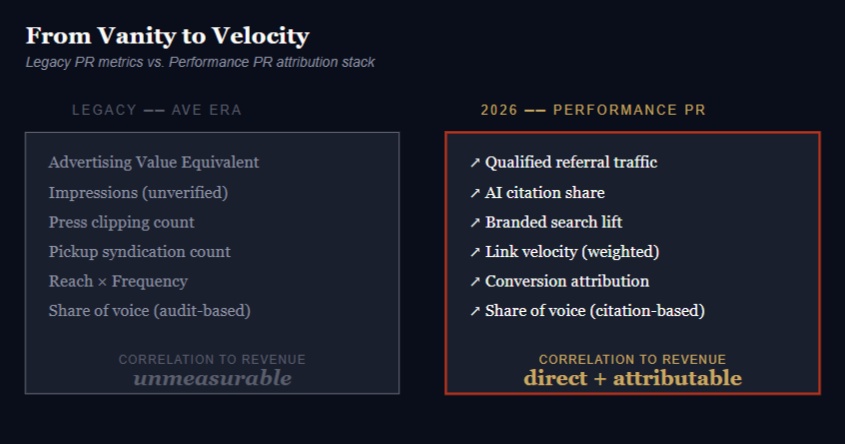
The work to be done is not nostalgia. It is replacement. What follows is the six-metric attribution stack that the most disciplined performance-oriented PR teams are running in 2026 — and what each metric is actually telling them.
50%
of marketing leaders cite ROI measurement as their single greatest challenge in influencer and earned media
10%
of Vercel signups attributed to ChatGPT — a leading indicator across SaaS
$5.78
benchmark return per $1 spent on creator partnerships, when attribution is actually instrumented
The AVE Hangover
For the better part of three decades, the PR industry sold a metric called Advertising Value Equivalent — the notional dollar value of earned media expressed as if it had been purchased as advertising. AVE survived because it produced a number large enough to defend a budget. It did not measure outcomes; it measured surface area. The Barcelona Principles, the industry's own measurement standard, formally rejected AVE in 2010 and again in 2020. The industry largely ignored its own guidance because no replacement had the same satisfying size.
The replacement only arrived when search and discovery moved into surfaces that produced trackable, attributable, conversion-tied signals — surfaces where the cost of not measuring became higher than the cost of measuring. Today's CMOs are not asking for a better impression count. They are asking for the same kind of data their paid-media stack already returns. Performance PR is the discipline that gives it to them.
The Six-Metric Attribution Stack
01 — Tracked Referral Traffic. The most familiar metric, but now segmented by intent. UTM-tagged inbound traffic from each placement, scored against time-on-site, pages per session, and assisted conversion. The objective is not raw volume; it is qualified volume from named sources. Tools: GA4, server-side analytics, attribution platforms (Dreamdata, HockeyStack, Common Room).
02 — AI Citation Share. The 2026 KPI that replaces share of voice. Run a representative panel of 25–50 buyer queries against ChatGPT, Perplexity, Google AI Overviews, Claude, and Gemini on a 30-day cadence. Measure citation frequency, position, and competitive coverage. Tools: Profound, Otterly, Omnia, Brandlight — and increasingly, manual sampling protocols inside marketing-ops teams.
03 — Branded Search Lift. When a placement runs, branded search volume should move. The lift is the most reliable indicator of demand creation in a zero-click world — because a buyer who encountered your brand inside an AI summary, podcast, or newsletter often confirms via a direct Google search before converting. Tools: Google Search Console, branded-keyword tracking in Ahrefs or Semrush, lift modeling against placement timestamps.
04 — Weighted Link Velocity. Not "how many backlinks did we earn" but "how is the weighted authority of our inbound link graph changing." Filter for niche-relevant, topically-aligned sources. Track the velocity of high-quality additions, not the cumulative count. The Knowledge Graph rewards consistent reinforcement over one-time spikes. Tools: Ahrefs Domain Rating trend, Majestic Trust Flow, custom weightings in spreadsheet.
05 — Conversion Attribution. The hardest metric to instrument correctly, and the one CFOs care about most. Multi-touch attribution combined with self-reported source-of-discovery surveys at conversion. Most reliable signal: form-fill question "Where did you first hear about us?" Vercel reports 10% of signups attribute to ChatGPT — that figure is only knowable because they instrumented for it. Tools: Dreamdata, HockeyStack, self-report instruments inside the conversion form.
06 — Citation-Based Share of Voice. Not how often you are mentioned in trade press — that is the old metric. How often your brand is named, versus each named competitor, inside generative answers and editorial coverage Google's algorithm trusts. The competitive market position the algorithm sees is not the position your impressions report shows. Tools: same as AI Citation Share, with a competitor panel layered on.
Three Implementation Realities
You will not get to perfect. Attribution in a zero-click era is structurally probabilistic, not deterministic. The objective is a defensible model that produces directionally correct decisions — not a perfectly accurate ledger of which click caused which sale. CMOs that demand the latter end up paralyzed; CMOs that operate from the former end up with budget protected and outcomes improving.
The right cadence is monthly, not weekly. Most of these metrics have signal-to-noise problems on weekly horizons. AI citation share fluctuates; branded search lifts compound. The reporting rhythm that produces stable insight is a monthly dashboard with quarterly strategic reviews. Weekly tracking turns into reactive noise management.
Instrument before you scale. The most common mistake is to scale PR investment and then attempt to retroactively measure outcomes. The work order is the opposite: instrument the attribution stack first, scale into it once baseline is established, and the marginal value of each placement becomes legible from the first month forward.
Further Reading · Curated by the DropPR Editorial Desk
Get a Dashboard, Not a Press Clipping Book
Every placement, instrumented. Every metric, tracked. Every dollar, accountable.
DropPR ships every editorial placement with a real Performance PR dashboard — referral traffic, citation share, branded search lift, and revenue attribution. Not impressions. Not AVE. Receipts.
Performance PR Dashboard — Per-Placement Reporting
UTM-tracked referral traffic and qualified visitor analytics ($300 value)
30-day AI citation share monitoring across 5 engines ($400 value)
Branded search lift tracking with placement timestamp overlay ($250 value)
Conversion attribution dashboard tied to your CRM ($500 value)
Competitive citation-share benchmark on 25 buyer queries ($350 value)
Monthly executive summary, CFO-ready ($200 value)
Dashboard value: $2,000 Included with placements starting at $99.
Real attribution. Per-placement reporting. No retainer required.
Data Sources Referenced
Later × PR Newswire Report (2025) · 50% of marketing leaders cite ROI/ROAS measurement as #1 challenge.
Vercel (2026 disclosures) · 10% of new signups attributed to ChatGPT-sourced discovery.
Jem Social · State of Influencer Marketing 2026 · "Receipts" framing for placement-to-revenue attribution.
Aspire State of Influencer Marketing 2026 · $5.78 ROI per $1 benchmark; performance-based compensation 53%.
AMEC · Barcelona Principles 3.0 (2020) · Industry measurement standards rejecting AVE.
BrightEdge · AI Overviews on 48% of search engine result pages as of Q1 2026.
Hayden Hollis
Head of Growth Marketing · DropPR.ai
Hayden Hollis writes about content distribution, digital PR, SEO, AI search, and creator marketing. His work focuses on how brands and creators can extend the reach of their content beyond social media and improve visibility across search engines, news publishers, and AI-powered discovery platforms. He regularly covers strategies related to earned media, audience growth, authority building, and the evolving role of AI in online discovery.