Owned vs. Earned vs. AI-Distributed: Choosing the Right Surface per Message
Publishing on the wrong surface wastes content investment and misses citation opportunities simultaneously. A ten-row decision matrix mapping every major B2B message type — product announcements, positioning claims, thought leadership, original research, customer proof, competitive comparison — to the primary and secondary distribution surfaces that serve each job best, with the AI citation path for each. Four decision rules the matrix encodes, and three worked examples showing how to apply it.
By Hayden Hollis
One of the most persistent errors in content strategy is treating distribution as an afterthought — writing the content first and asking where to publish it second. The error compounds in 2026 because the surfaces available for distribution have multiplied and diverged, and each surface now has a distinct relationship with AI citation systems, buyer trust, and measurement. The decision of where to publish a given message is not a logistics question. It is a strategic one — and getting it wrong wastes content investment and misses citation opportunities simultaneously.
This article provides a decision matrix: a practical framework for mapping message types to the surfaces that will amplify them most effectively. The matrix covers three primary surface categories — owned (content you publish on properties you control), earned (coverage on properties controlled by others), and AI-distributed (surfaces that feed directly into AI citation systems) — and maps each to the message types, buyer journey stages, and outcomes they are best suited for.
Use it as a checklist before any content investment. The question is not "where should we publish?" but "what is this message trying to do, and which surface does that job best?"
3
primary distribution surfaces in 2026: owned, earned, and AI-distributed — each serving a distinct strategic function
<20%
overlap between top-ranked owned content and AI-cited sources — owned alone is not enough for citation share
~25%
of AI citations come from editorial sources — earned media is the primary driver of AI-distributed visibility
Understanding the Three Surfaces
Owned surfaces are properties your organization controls: your website, newsroom, blog, email newsletter, LinkedIn company page, YouTube channel, and podcast feed. You control the content, the timing, and the format. You do not control the distribution algorithm or the trust weight the AI engine assigns to the source. Owned content is high-control and low-trust-weight for AI citation purposes — the model discounts self-descriptions.
Earned surfaces are properties controlled by others: trade publications, business media, vertical journals, analyst reports, review platforms, podcast appearances on other shows, and journalist coverage. You control the quality of the pitch and the substance of the content; you do not control placement, timing, or framing. Earned content is low-control and high-trust-weight for AI citation — the model treats third-party editorial coverage as corroborated fact.
AI-distributed surfaces are the retrieval corpora of AI engines — the text indexes that ChatGPT, Perplexity, Google AI Mode, and Claude draw from when generating answers. This is not a separate publication channel; it is the aggregated output of what gets indexed from owned and earned surfaces. Content reaches AI-distributed surfaces by being published on sources the engines already trust (earned) or on owned sources with sufficient authority and structure to be retrieved (owned newsroom with full schema). The AI-distributed surface is the destination; owned and earned are the paths to it.
The Decision Matrix: Message Type to Surface
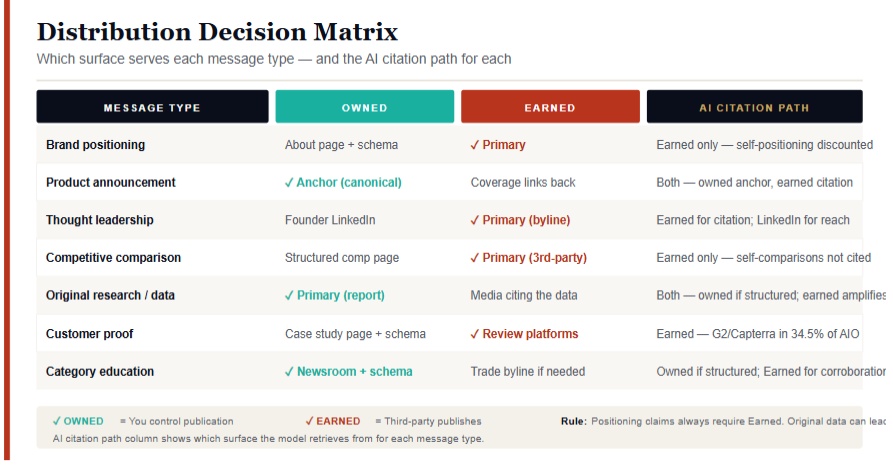
Message TypePrimary SurfaceSecondary SurfaceAI Citation PathCategory education (what is X, how does X work)Owned newsroom with Article schemaEarned: trade publication bylineOwned if well-structured; Earned if corroboration neededBrand positioning (we are the leading X for Y)Earned: editorial placement on trusted publisherOwned: standardized About page + schemaEarned only — self-positioning is discounted by AI enginesProduct announcementOwned newsroom (canonical) + direct journalist pitchEarned: trade press coverage linking back to newsroomOwned as anchor; Earned as corroboration and citation driverCompetitive comparison (we vs. them)Earned: third-party comparison article or review platformOwned: structured comparison pageEarned only — self-authored comparisons are not cited by AI enginesThought leadership (founder POV, category opinion)Earned: byline in business or trade mediaOwned: founder LinkedIn (personal, not company page)Earned for AI citation; LinkedIn for immediate audience distributionOriginal research and dataOwned: research report with full schema and permanent URLEarned: media coverage citing the researchBoth — owned research is citable if well-structured; Earned coverage amplifies itCustomer proof (case studies, testimonials)Owned: structured case study page with schemaEarned: review platform (G2, Capterra) customer reviewsEarned (review platforms cited in 34.5% of commercial AI Overviews)Executive credibility (expertise, authority)Earned: podcast appearances, speaking coverage, bylinesOwned: executive bio page with Person schemaEarned for AI citation; Owned for entity disambiguationAnnouncement (funding, partnership, hire)Owned newsroom (canonical with schema) + earned pitchEarned: trade press and relevant vertical mediaBoth — owned as anchor, earned as citation driverCategory comparison (tools roundup, best-for list)Earned: third-party editorial roundup or analyst report inclusionOwned: structured comparison page as supporting resourceEarned only — AI engines retrieve third-party roundups, not self-authored ones
Four Decision Rules the Matrix Encodes
Rule 1 — Positioning claims always require earned surfaces. Any message that asserts your brand's superiority, category leadership, or competitive differentiation cannot earn AI citation from owned sources alone. The model discounts self-positioning. If you want AI engines to describe your brand as "the leading X for Y," that description must appear in multiple independent trusted sources — editorial articles, analyst reports, review platform summaries. Owned content can reinforce and anchor earned coverage; it cannot substitute for it.
Rule 2 — Original data and research earn citation from owned surfaces, when structured correctly. This is the primary exception to the earned-first rule. A genuine original research report — with unique data, full methodology, named authors, proper schema, and a permanent canonical URL — is one of the few owned content types that AI engines retrieve from and cite directly. The key requirements: the data must be genuinely novel (not a repackaging of public statistics), the report must be attribution-friendly (clear quotes and figures that journalists can reference), and the schema must be complete. Without these, even original research lives on owned surfaces without producing AI citation.
Rule 3 — Announcements need an owned anchor before earned distribution. The common error in announcement strategy is pitching journalists before the canonical source exists on your owned newsroom. Journalists who cover the announcement link to wherever they find the release — often a wire service's hosted version, not your domain. Publishing the canonical announcement on your owned newsroom first, with full schema, ensures that all coverage links back to an asset you control. The earned coverage amplifies an owned asset rather than creating an orphaned citation on a third-party domain.
Rule 4 — AI-distributed reach requires both surfaces working together. The brands with the highest AI citation share are not the ones investing exclusively in either owned or earned — they are the ones running both surfaces as a coordinated system. Owned content provides the entity anchor (schema, canonical URLs, structured data). Earned content provides the corroboration (third-party attribution, majority rule, trust weight). Neither alone produces the compounding citation share that both together produce. The matrix above is not a binary choice; it is a sequencing guide.
Applying the Matrix: Three Worked Examples
Example 1 — A B2B SaaS company launching a new product. Message: "Our product now includes AI-powered workflow automation." Primary surface decision: owned newsroom announcement (canonical, with schema, published first). Secondary surface: earned pitch to three journalists who cover automation in your vertical, plus an editorial article placement framing the announcement in category context. AI citation path: the editorial article on the trusted publisher becomes the citable source; the newsroom announcement becomes the anchor it links to. The owned asset controls the canonical record; the earned asset drives the citation.
Example 2 — A DTC brand trying to establish category authority. Message: "We are the most trusted [category] brand for [customer type]." Primary surface decision: earned — this positioning claim cannot be made credibly on owned surfaces. Required path: editorial placement in a relevant consumer or trade publication that names the brand as a trusted option; G2 or Trustpilot review campaign to build corroborated customer sentiment; and optionally, inclusion in an analyst or research firm's category report. Once earned corroboration exists, owned surfaces (structured About page, consistent descriptors across directories) reinforce the entity node the earned coverage built.
Example 3 — A founder building thought leadership in their category. Message: "I have a genuinely novel perspective on where this category is going." Primary surface decision: earned byline — the founder's opinion piece in a relevant trade or business publication, attributed with full credentials and a link to the brand's newsroom. Secondary surface: the founder's personal LinkedIn profile, not the company page — personal profiles generate 561% more reach than company pages for the same content. AI citation path: the byline in the trusted publication becomes the citable expert source; the LinkedIn post drives immediate audience exposure and branded search that reinforces the entity association.
Where Most Teams Go Wrong
They default to owned for everything. The path of least resistance is always to publish on the brand blog. It requires no pitch, no relationship, no approval from an external editor. It also produces no AI citation for positioning claims, no corroboration for entity building, and no trust-weight signal for the retrieval system. Defaulting to owned is the choice that feels productive and produces the least citation share.
They treat earned as occasional rather than systematic. The PESO Model framing that most teams understand conceptually is often implemented as "we do some earned media when we have something newsworthy." The brands with the highest citation share treat earned as the primary editorial channel — three to four placements per month, consistently, on a planned calendar — not as an ad-hoc response to announcements.
They do not connect the surfaces. Owned and earned surfaces compound only when they are structurally connected — when owned newsroom posts link to relevant earned coverage, when earned articles link back to canonical owned resources, and when the brand descriptor used on owned surfaces matches the language used in earned placements. Teams that run owned and earned as separate functions without coordination leave the compounding value on the table.
Further Reading · Curated by the DropPR Editorial Desk
Run Owned and Earned as One Coordinated System
Editorial placements that anchor to your owned newsroom — and compound into AI citation share.
DropPR operates the earned surface of your content strategy — placing editorial articles on trusted publishers, linking to your owned newsroom anchor, and measuring the AI citation share that results. The matrix above tells you which messages need earned surfaces. We deliver them.
Owned + Earned Coordination Stack
Distribution strategy audit using the decision matrix ($400 value)
Earned editorial placement on a trusted AI-cited publisher ($1,200 value)
Owned newsroom schema audit and connector links ($350 value)
Brand descriptor standardization across all surfaces ($300 value)
30-day AI citation share measurement across 4 engines ($400 value)
Total stack value: $2,650 Charter pricing from $99.
No subscription. No retainer. Pay per placement.
Data Sources Referenced
LLMrefs (2026) · <20% overlap between top-ranked owned content and AI-cited sources.
Muck Rack (via PR.co, Dec 2025) · ~25% of AI citations from editorial/journalistic sources.
Bigeye (2026) · AEO complete guide; earned corroboration as primary AI citation driver.
BrightEdge (Q1 2026) · 34.5% of commercial AI Overviews cite review platforms.
Ordinal (Jan 2026) · LinkedIn personal profiles 561% greater reach than company pages.
Gini Dietrich / Spin Sucks · PESO Model framework — earned-first sequencing for AI-era distribution.
Hayden Hollis
Head of Growth Marketing · DropPR.ai
Hayden Hollis writes about content distribution, digital PR, SEO, AI search, and creator marketing. His work focuses on how brands and creators can extend the reach of their content beyond social media and improve visibility across search engines, news publishers, and AI-powered discovery platforms. He regularly covers strategies related to earned media, audience growth, authority building, and the evolving role of AI in online discovery.