The PageRank Successor: Why Brand Mentions Now Outrank Backlinks
For 27 years, Google's algorithm was built on a single insight: links are votes. After the February 2026 core update, that insight has been quietly replaced — and most brand teams haven't noticed.
By Hayden Hollis
In 1996, two Stanford graduate students named Larry Page and Sergey Brin published a paper describing a way to rank web pages by treating hyperlinks as citations. They called the algorithm PageRank. It worked, and it became the foundation of a $2 trillion company. For nearly three decades, the link was the unit of authority on the internet.
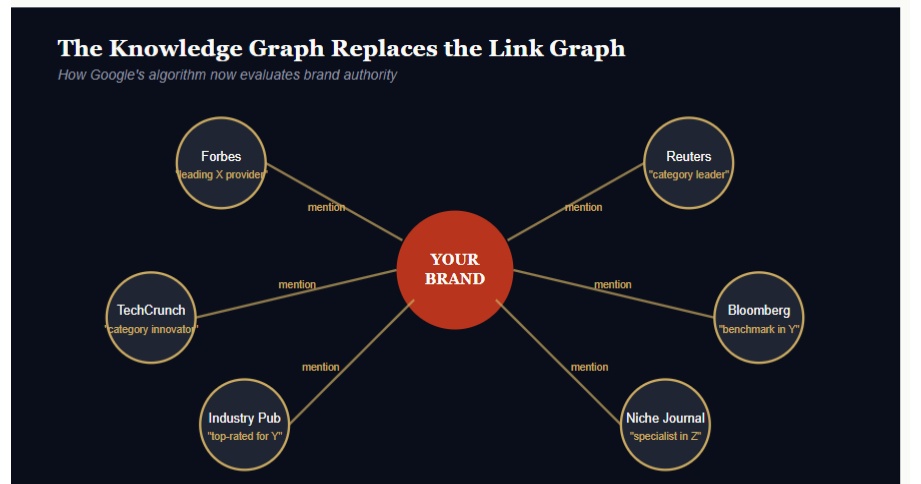
That assumption is no longer operative. After Google's February 2026 core update, the algorithm's primary authority signal has shifted from the link graph to the knowledge graph — from "who links to you" to "who talks about you, and what do they say." The shift has been telegraphed for years through E-E-A-T guidance and quality-rater documentation. The core update made it operational.
The consequence is straightforward: a brand can now outrank a competitor without acquiring a single new backlink, simply by being talked about — accurately, consistently, and by sources Google already trusts.
344%
surge in search interest for "EEAT" over the past five years
10:1
approximate weighting of niche-relevant mentions vs. irrelevant high-authority backlinks
Feb '26
Google core update that operationalized entity-based authority scoring
The Death of the Hyperlink as Primary Signal
The hyperlink did not literally die — it remains a useful signal, and quality editorial links continue to move rankings. What died is the hyperlink's primacy. For most of internet history, an SEO team's marching orders read like: acquire as many links from as many high-DR domains as possible. That instruction has been quietly invalidated.
Three things changed at the algorithm level. First, large language models embedded inside Google's ranking systems can now parse what a mention says, not just whether it exists. A mention is interpreted in semantic context — what concepts does it associate with your brand? Second, unlinked brand mentions are now treated as ranking signals on their own, because they are far harder to manipulate than links. Third, the Knowledge Graph — the structured database Google maintains of entities and their relationships — now functions as a primary input to the ranking algorithm rather than a display-layer feature.
How the Knowledge Graph Math Works
The Knowledge Graph stores entities — brands, people, places, concepts — as nodes, and relationships as weighted edges. Every time your brand is mentioned alongside a relevant concept on a trusted source, the edge between those two nodes gets stronger. Strong edges become candidate facts the algorithm trusts.
Proximity beats prestige. A mention on a niche-relevant Domain Rating 60 site sits closer to your category in the graph than a mention on a Domain Rating 90 lifestyle blog with no topical connection. Ten mentions on authoritative niche-relevant sites can outweigh a single backlink from an irrelevant prestige site.
Co-occurrence matters more than anchor text. When your brand name appears next to your target keywords — even without a link — the algorithm treats the proximity as confirmation. The new "anchor text" is the words that show up within a few sentences of your brand name.
Consistency compounds. Brands that show up repeatedly across the same conceptual neighborhood develop what researchers describe as "neighborhoods of trust" — clusters of consistent third-party validation that AI models treat as ground truth.
The "Majority Rule" Problem
LLMs apply a heuristic researchers call majority rule for brand facts. If a critical mass of third-party sources describes your brand a particular way, the model treats that description as factual. If most sources are silent or describe you generically, the model has no claim to make about you — and in a synthesized answer environment, having no claim made about you is functionally indistinguishable from not existing.
This is the central operational challenge of the post-PageRank era. You cannot solve it with owned content. Your own description of yourself is exactly the input the algorithm discounts. The mentions must come from elsewhere.
How Brand Mentions Are Actually Earned
Editorial placements. Articles written for and published by credible media properties. Highest signal value, slowest historically — though the cost-and-cycle-time curve has compressed dramatically with AI-assisted editorial production. This is the surface DropPR was built for.
Expert source platforms. HARO (now Connectively), Qwoted, Featured, and Muck Rack connect journalists to expert sources. Substantive responses to relevant queries can produce a steady drip of high-authority mentions when done consistently by named experts with real credentials.
Data-led research that earns coverage. Original surveys, reports, and benchmark studies that journalists cite as primary sources. Capital-intensive to produce but high-leverage when the data is genuinely novel.
Niche-relevant community participation. Substantive non-promotional presence in vertical Reddit communities, Quora, and industry forums. These now appear in AI citation sets at meaningful rates and contribute to the entity graph.
The Three Placements That Move the Needle Most
Vertical trade publications. Less prestigious than Forbes or Bloomberg, but topically dense and trusted by AI models for category-specific queries. A mention in a top trade journal for your vertical typically outperforms a mention in a general-business publication on category-specific prompts.
Expert-authored thought-leadership placements. When a named subject-matter expert from your team is quoted or bylined in editorial coverage, the algorithm credits both the brand entity and the expert entity — a double signal.
Comparison and review content. Articles that name your brand alongside competitors in the same category strengthen the category-edge in the graph. "Best X for Y" content is disproportionately valuable, even when your brand is not named first.
What This Means for the Next Twelve Months
Most marketing teams will spend 2026 acquiring backlinks the way they spent 2024 acquiring backlinks. They will measure DR and link volume, build outreach lists, and run guest-posting campaigns. They will produce results — diminishing ones.
The brands that move now will build entity associations that the algorithm reinforces for years. The bar to be in the conversation is being named, repeatedly, by sources Google's models already trust. That bar can be cleared at speed. The work is straightforward; the timing window is not infinite.
Earn the Mentions Google Now Counts
Build the entity graph that ranks you — placement by placement, mention by mention.
DropPR places your brand inside the editorial conversation Google's algorithm and AI engines already reward. Each placement is a graph edge. The flywheel compounds.
Entity Authority Stack — What You Get
Editorially-written article naming your brand in category context ($1,200 value)
Placement on a topically-relevant high-DR publisher ($800 value)
Strategic co-occurrence of brand + category keywords ($300 value)
Knowledge Graph entity audit and disambiguation ($450 value)
Branded-search and citation-share monitoring (30 days) ($250 value)
Total stack value: $3,000 Charter pricing from $99.
No subscription. No retainer. Pay per placement.
Hayden Hollis
Head of Growth Marketing · DropPR.ai
Hayden Hollis writes about content distribution, digital PR, SEO, AI search, and creator marketing. His work focuses on how brands and creators can extend the reach of their content beyond social media and improve visibility across search engines, news publishers, and AI-powered discovery platforms. He regularly covers strategies related to earned media, audience growth, authority building, and the evolving role of AI in online discovery.