The Podcast-to-Citation Path: Making Spoken Content Discoverable by AI
Podcasts are invisible to AI citation systems. The same expert insight that earns zero AI citations as audio can earn consistent citation share as structured editorial text. A practical four-part checklist covering transcript structuring (H2 headers, entity tagging, summary lead sentences), show notes architecture, schema markup, and the editorial conversion step that transforms any substantive episode into a citable primary source.
By Hayden Hollis
Podcasts are among the most trusted content formats in B2B. A 45-minute conversation between a founder and an industry analyst, a 30-minute solo breakdown of a category's defining problem, a weekly interview series with named subject-matter experts — these are substantive, credible, citation-worthy pieces of content. And because they live in audio format, AI engines cannot cite them. Not because the content is poor. Because the content is inaccessible to the text-based retrieval systems that determine what gets cited.
This is the podcast citation problem: a format that builds genuine authority with human audiences is structurally invisible to the AI engines that are increasingly mediating those same audiences' research. The fix is not to stop podcasting. It is to add a structured text layer to every episode — a layer that AI engines can retrieve from, cite, and use to build your brand's entity associations in the knowledge graph.
This article is a practical checklist for making podcast content discoverable by AI. It covers transcript structuring, entity tagging, show note architecture, and the editorial conversion step that transforms a transcript into a citable primary source.
135M
monthly podcast listeners in the US — an audience AI engines cannot currently serve citations from
~25%
of AI citations come from editorial sources — the format podcast transcripts must be converted into to earn citation share
0%
of raw audio is retrievable by RAG systems — structured text conversion is the only path to AI citation
Why Podcasts Are Invisible to AI — and What Makes Them Visible
Retrieval-augmented generation retrieves text passages. It does not process audio files, transcribe MP3s at query time, or interpret video streams. A podcast episode — however substantive — is a binary audio file from the perspective of every AI retrieval system. The knowledge inside it is inaccessible until it exists in a structured text format that can be indexed, chunked into passages, and retrieved by vector similarity search.
Three text formats can make podcast content visible to AI engines. The first is a raw transcript — the least effective, because raw transcripts contain spoken-language patterns (filler words, incomplete sentences, conversational register) that are difficult for retrieval systems to extract clean passages from. The second is a structured show notes page — more effective, but typically too brief to carry the semantic weight of the full episode. The third is an editorially-structured article derived from the episode — the most effective, because it converts the episode's insights into the passage-extraction-friendly format that retrieval systems are optimized for.
All three can work in combination. The checklist below covers what each requires to contribute meaningfully to AI citation share.
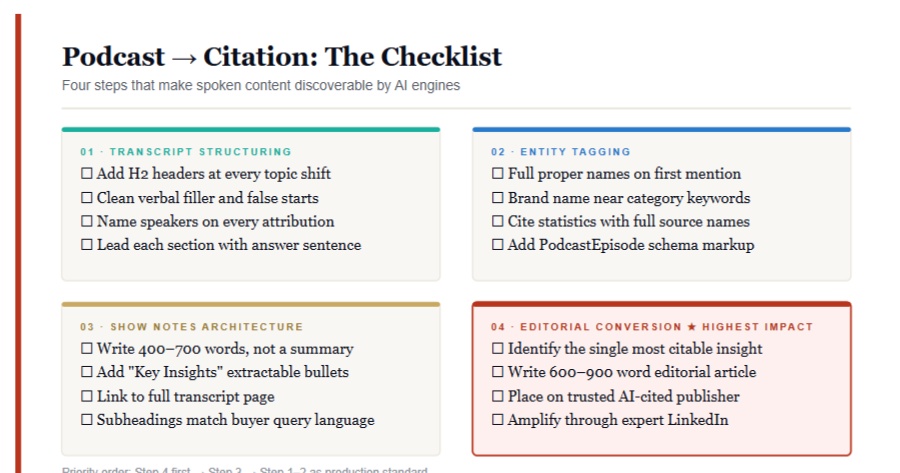
Checklist Part 1 — Transcript Structuring
☐ Publish the full transcript as a text page. The transcript must exist as an indexable HTML page — not a PDF, not a downloadable document, not embedded text in an image. It must be crawlable, with a canonical URL, and linked from the episode's primary show notes page. If you publish on a podcast host that does not support HTML transcript pages, publish the transcript on your own domain and link from the episode page.
☐ Add H2 section headers at topic transitions. Raw transcripts are continuous text with no structural landmarks. AI retrieval systems extract passages most cleanly when those passages are bounded by HTML headers. Review each transcript and insert H2 headers at every major topic transition — typically every 300–500 words. Header text should match the language of queries your audience would ask ("What is X" or "How does Y work"), not the internal language of the episode ("Around the 12-minute mark, we discussed...").
☐ Clean verbal filler and incomplete sentences. Spoken language contains filler words ("you know," "kind of," "like"), false starts, and run-on sentences that reduce passage quality for retrieval. The transcript does not need to be rewritten — it needs to be cleaned. Remove filler, complete interrupted sentences, and break run-on passages at natural clause boundaries. The goal is readable prose, not a polished essay.
☐ Add speaker attribution to every passage. Expert attribution is a retrieval signal. "According to [Expert Name], [claim]" is more retrievable than the same claim in anonymous text. Ensure every substantive claim in the transcript is clearly preceded by the speaker's name. In transcript format: use "Speaker Name:" labels before each turn, not time codes alone.
☐ Lead each section with a summary sentence. After inserting H2 headers, add a one-sentence summary at the top of each section that states the key claim made in that section. This summary sentence is the primary extraction target for the retrieval system — it is the passage that will most likely appear in a synthesized answer. Write it as a complete, self-contained statement: "According to [Expert], [claim with specific detail]."
Checklist Part 2 — Entity Tagging
☐ Use full proper names on first mention — always. AI engines build entity associations from co-occurrences of named entities in text. "Sarah" does not build an entity association. "Sarah Chen, Head of Growth at Acme Corp" builds three entity associations simultaneously (person, role, company). Every person, company, product, and organization mentioned in the transcript should appear with its full proper name on first mention in each section.
☐ Include your brand name in proximity to category keywords. This is the entity-category association the knowledge graph needs. At least once per major section, ensure your brand name appears within two sentences of your primary category keyword. "DropPR is a performance PR platform" creates the entity-category edge. A section that uses only "we" and "our platform" does not.
☐ Name and link to any statistics or research cited. If the episode references a specific study, report, or data point, the transcript should cite it with the source's full name and — where possible — a link. "According to BrightEdge's Q1 2026 analysis, AI Overviews appear on 48% of search result pages" is more extractable and more trustworthy to the retrieval system than "according to recent research, about half of searches now show AI answers."
☐ Implement BreadcrumbList and Podcast schema on the episode page. At the page level, add Podcast (or PodcastEpisode) schema with fields for name, description, datePublished, author (the host entity), and guest (if applicable, as a Person schema entity). This gives AI engines the structured metadata to identify the episode as a citable source with named, credentialed contributors.
Checklist Part 3 — Show Notes Architecture
☐ Write show notes as standalone editorial content — not summaries. Most show notes are three-paragraph summaries that gesture at the episode's content. They are too brief to carry retrievable passages. Show notes should be 400–700 words of structured editorial content — with the episode's key claims stated directly, attributed to the named guest, and organized under descriptive subheadings. A show notes page of this quality is itself a citable passage source, independently of the transcript.
☐ Include a "Key Insights" section with extractable bullets. After the editorial prose, add a "Key Insights" section with three to five bullet points, each stating a specific, attributable claim from the episode in a complete sentence. "According to [Guest Name], brands that appear in AI Overviews for commercial queries see 3–8× higher conversion rates than brands visible only in organic links." This format is among the most reliably extracted by retrieval systems — discrete, labeled, and self-contained.
☐ Link the show notes page to the full transcript page. Create a clear navigational link from the show notes page to the full transcript. This signals to crawlers that the transcript is the authoritative long-form text source for the episode, and creates a crawl path that ensures both pages are indexed. Use anchor text that describes the content: "Read the full transcript" or "Full episode transcript with timestamps."
Checklist Part 4 — The Editorial Conversion Step
☐ Identify the single most citable insight from each episode. Every substantive podcast episode contains one claim that, if extracted and placed in a trusted editorial source, would earn consistent AI citation for queries your buyers ask. This is typically the most specific, most novel, most evidence-backed claim the guest makes — the insight that would make a journalist say "that's the lede." Identify it. It is the basis for the editorial conversion.
☐ Convert the insight into a publisher-ready article. Using the identified insight as the thesis, write a 600–900 word editorial article structured for passage extraction: definitional lead sentence, mechanism explanation, supporting evidence, named examples. The article attributes the insight to the guest by name and links back to the full episode as the source. This article, placed on a trusted publisher, completes the citation path from spoken content to AI-citable editorial source.
☐ Place the article on a publisher AI engines already trust. Self-publishing on a brand blog or Medium does not close the citation circuit — the model must retrieve from a source it already trusts. Submit the article to trade publications, business media, or vertical journals with established editorial credibility. The placement produces the third-party corroboration that makes the insight citable across the AI engines your buyers use.
Priority Order: Which Steps Move the Needle Fastest
If you are applying this checklist to an existing podcast library, the following priority order produces the fastest citation share lift for the effort invested.
Priority 1 — Editorial conversion for your top three episodes. Identify the three episodes with the most specific, novel, high-demand insights. Convert each into a publisher-ready article and place on a trusted publisher. This single action produces more citation share lift than any transcript structuring work alone, because it creates the third-party corroboration the model requires to cite confidently.
Priority 2 — Show notes rebuild for your ten most-searched episodes. Using your podcast analytics and Google Search Console data, identify the ten episodes that drive the most search traffic. Rebuild their show notes to the editorial standard described above. These pages are already indexed and trusted by search engines — upgrading them to retrieval-friendly format produces citation lift without new publishing delay.
Priority 3 — Transcript structuring as a production standard. For all new episodes going forward, add transcript structuring (H2 headers, cleaned prose, entity tags, summary sentences) as a standard production step. This compounds over time as the transcript library grows — each new episode contributes to citation share rather than remaining invisible in its audio format.
Further Reading · Curated by the DropPR Editorial Desk
Turn Your Best Episodes Into Citations
Your podcast is building authority with humans. Let DropPR make it visible to AI.
DropPR runs the full podcast-to-citation workflow: insight identification, editorial article conversion, placement on a trusted AI-cited publisher, and LinkedIn amplification. Your episode becomes a citable source within days.
Podcast-to-Citation Stack
Top insight identification across your 3 best episodes ($400 value)
Editorial article conversion structured for AI extraction ($800 value)
Placement on a trusted AI-cited publisher ($800 value)
Transcript structuring template for future episodes ($300 value)
30-day citation share lift tracking post-placement ($400 value)
Total stack value: $2,700 Charter pricing from $99.
For podcasters, brands, and agencies. No subscription. Pay per placement.
Data Sources Referenced
Edison Research (2026) · 135M monthly US podcast listeners.
Muck Rack (via PR.co, Dec 2025) · ~25% of AI tool citations from journalistic/editorial sources.
Frase (2026) · GEO Playbook; transcript structuring for passage-level AI retrieval.
LLMrefs (2026) · RAG systems and text-only retrieval corpus; audio format invisibility.
Bigeye (2026) · AEO complete guide; editorial conversion as primary citation mechanism.
Google Developers · PodcastEpisode and Person schema specification for structured data.
Hayden Hollis
Head of Growth Marketing · DropPR.ai
Hayden Hollis writes about content distribution, digital PR, SEO, AI search, and creator marketing. His work focuses on how brands and creators can extend the reach of their content beyond social media and improve visibility across search engines, news publishers, and AI-powered discovery platforms. He regularly covers strategies related to earned media, audience growth, authority building, and the evolving role of AI in online discovery.