The Press Release, Reborn: What the Format Looks Like in the AI Era
The press release as a wire distribution mechanism is finished. The press release as a structured, schema-marked announcement format is not. An element-by-element annotated template of the modern press release — covering headline construction, dateline requirements, lede structure, named executive quotes, About section standardization, and required Article schema fields — plus the distribution strategy that makes it a citation asset rather than a vanity metric.
By Hayden Hollis
The press release is not dead. The argument made in this journal's earlier piece — Why the Press Release Died — was more specific than that: the press release as a primary distribution mechanism, sent through a wire service to aggregator sites that no buyer, journalist, or AI engine treats as authoritative, has lost its commercial justification. That argument stands. What also stands is the press release as a format — a structured, dated, attributed announcement that, when written correctly and distributed strategically, still performs a useful function in a modern PR stack.
The format needed to change, not be abandoned. In 2026, a press release structured for AI retrieval, published on an owned newsroom with proper schema, and used as the anchor for editorial placements rather than the primary distribution event, is a legitimate tool. A press release sent down a wire to 500 aggregator sites, measured by pickup count and AVE, is not.
This article describes what the modern press release format looks like — annotated element by element — and how each structural decision either improves or undermines its value as an AI-era communications asset.
$3,000+
fully-loaded cost of a national PR Newswire wire release — producing syndication to aggregators, not editorial citation
5×
citation lift when a press release links to a structured owned newsroom page with Article schema
0
press release syndication sites in the top sources cited by AI engines for commercial category queries
The Two Jobs a Modern Press Release Does
Before annotating the format, it is worth being precise about what a modern press release is for — because the two jobs it performs are different from the job it performed in the wire era.
Job 1 — Anchor for editorial placements. The release establishes the canonical, datestamped, attributed version of an announcement. It lives on your owned newsroom at a permanent URL. Every editorial article, journalist mention, or third-party coverage of the announcement links back to it. The release is not the story; it is the source the story points to. Gini Dietrich's PESO Model framing is correct: issue the release after the anchor hub is live, and link everything to the hub.
Job 2 — Structured data input for AI engines. A press release published with Article schema, named authorship, visible dates, and consistent brand descriptors is a structured fact input to the AI knowledge graph. It tells the model: this announcement happened on this date, was made by this organization, and involves these entities. That structured input improves entity recognition and contributes to the corroboration graph — even if the release is never picked up by a single journalist.
What it is no longer for: primary media distribution. The wire model assumed that sending a release to 270,000 journalist email addresses would produce editorial coverage. That assumption is no longer operative. The journalists have left. The beats have consolidated. The inboxes are unmonitored. Distribution produces nothing that editorial relationship-building does not produce better.
The Annotated Modern Press Release Template
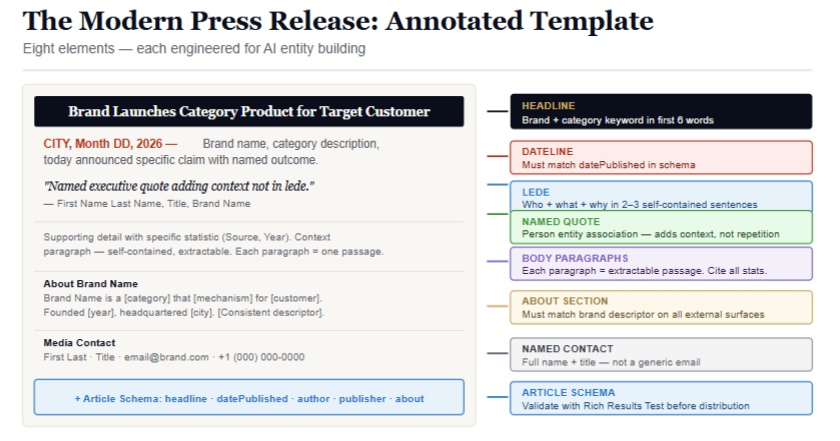
The following is a full annotated template. Each element is labeled with the structural decision it represents and why that decision matters for AI-era effectiveness.
[ELEMENT 1 — Headline]
Write in active voice, present tense, with your brand name and category keyword in the first six words. Example: "DropPR Launches Performance PR Platform for AI-Era Citation Building." Not: "DropPR Announces New Product." The headline is the passage the model is most likely to extract for entity-recognition queries. It must contain your brand entity, your category keyword, and the announcement's core claim — all in one sentence of under 12 words.
[ELEMENT 2 — Dateline]
City and date in standard AP format: "SAN FRANCISCO, June 25, 2026 —" The dateline establishes temporal context for the AI retrieval system. A release without a visible date receives a freshness discount for any query where recency is a relevance signal. The date must also appear in the Article schema's datePublished field — visible date and schema date must match.
[ELEMENT 3 — Lede Paragraph]
The first paragraph must answer the five Ws in two to three sentences: who, what, where, when, and why it matters. It must use your brand's full proper name (not a pronoun), your category keyword, and a specific, attributable claim. Example: "DropPR, a performance PR platform that places editorial content on AI-cited publishers, today launched its Citation Acceleration Stack — a structured placement and monitoring service designed to close citation gaps for B2B brands absent from ChatGPT, Perplexity, and Google AI Overviews." This lede is extractable as a standalone passage. It contains the brand entity, category keyword, announcement detail, and benefit claim in 55 words.
[ELEMENT 4 — Named Executive Quote]
One quote from a named, titled executive — not "a company spokesperson." The quote should add perspective or context that the factual lede does not contain — not restate the headline. Example: "Lou Schwartz, Founder of DropPR, said: 'Most B2B brands are ranking on page one of Google and still absent from every AI answer their buyers read. This product closes that gap with a single upload.'" The named executive quote creates a Person entity association — it links the announcement to an expert with credentials, which the model uses to evaluate the claim's authority.
[ELEMENT 5 — Supporting Detail Paragraphs]
Two to three paragraphs providing context, market data, and product/announcement specifics. Each paragraph should be structurally self-contained — a complete thought that can be extracted as a passage without requiring the surrounding context. Use specific numbers over vague claims. "AI Overviews appear on 48% of search engine result pages" is extractable. "AI is everywhere in search now" is not. Cite the source of any statistics in-text: "(BrightEdge, Q1 2026)" immediately after the figure.
[ELEMENT 6 — Second Quote (Optional)]
If a customer, partner, or analyst quote is available and genuine, include it here. Third-party quotes inside a press release create additional entity associations and contribute to the corroboration signal. A customer quote that names a specific use case and outcome is more valuable than a generic endorsement. "Jane Smith, VP Marketing at Acme Corp, said: 'Our citation share on target queries increased from 18% to 41% within 60 days of our first DropPR placement.'" — this quote names entities, provides specific data, and is extractable as a standalone validation claim.
[ELEMENT 7 — About Section]
A standardized boilerplate paragraph describing your company. This is the most important structural element for entity-building purposes. It must: use your brand's full proper name; state your category in the first sentence; describe your mechanism and target customer; and be identical to the brand descriptor you use on every other surface (LinkedIn, Crunchbase, G2). Consistency here is the entity standardization signal. Example: "DropPR is a performance PR platform that places editorial content on AI-cited publishers for B2B brands. Founded in 2025 and headquartered in San Francisco, DropPR replaces wire distribution with editorially-written publisher articles structured for AI retrieval, citation, and conversion tracking."
[ELEMENT 8 — Contact Information]
A named press contact with a real email address — not a generic "press@company.com" if avoidable. The named contact creates an additional person-entity association and signals that real humans stand behind the announcement. Include the contact's name, title, email, and — optionally — a direct phone number.
The Schema Layer: What Must Accompany the Release
A press release without schema markup is a text file. A press release with proper Article schema is a structured data input to the AI knowledge graph. The schema layer is not optional — it is what converts the format from a legacy communication tool into a modern citation asset.
Required schema fields for every press release published on your owned newsroom: @type (Article or NewsArticle), headline (matching the release headline exactly), datePublished (matching the dateline), dateModified (updated if the release is corrected or expanded), author (linked to a Person schema entity for the named press contact or executive), publisher (linked to your Organization schema entity), and about (a brief description of the announcement's subject). The mentions field can be used to explicitly link any named entities — people, companies, products — referenced in the release to their own schema entities.
Run the release URL through Google's Rich Results Test within 24 hours of publication. Any validation errors in the schema reduce the release's value as a structured data input and should be corrected before the release is used as the anchor for editorial placements.
Distribution: What Changes in the Modern Model
The distribution question is where most teams make the error that neutralizes the format improvements above. A perfectly-structured, schema-marked press release that is then sent down a wire to 500 aggregator sites has not been improved — it has been associated with low-authority syndication that the model discounts. The distribution strategy must match the format strategy.
Publish on your owned newsroom first. The canonical URL for the announcement must be on your domain, not on a wire service's domain. The wire, if used, should link to your canonical newsroom URL — not host the primary version of the release.
Pitch directly to journalists covering your beat. The release is source material for a pitch — not the pitch itself. Send the release URL to three to five journalists with a three-paragraph pitch explaining why the announcement is relevant to their specific audience. This produces genuine editorial coverage that the wire never will.
Use the release as the editorial anchor. Every editorial article covering the announcement should link to the release's canonical newsroom URL. The release becomes the most-linked, most-cited page in the coverage cluster — which is exactly what strengthens its value as an entity-building asset in the knowledge graph.
Wire distribution as a compliance instrument only. For public companies with SEC disclosure requirements, wire distribution remains a procedural necessity. For private companies, it is optional — and the ROI calculation on a $1,500–$3,000 wire release should be evaluated honestly against the citation outcomes it produces, which are typically close to zero.
When to Issue a Press Release in 2026
Not every announcement warrants a press release. The format is worth investing in — with proper schema, named authorship, and editorial follow-through — for the following announcement types: product launches and major feature releases that represent a genuine category claim; funding rounds above the threshold of journalist interest in your vertical; executive appointments that create person-entity associations worth building; partnership announcements that create co-entity associations between your brand and a recognized partner; and original research or data releases that produce a citable statistic the model can extract.
The format is not worth investing in for: minor product updates, team hires below the executive level, award wins that have no independent verification, or announcements that do not contain a specific, attributable, AI-extractable claim. These are better served by a structured newsroom post — shorter, with the same schema, at a fraction of the effort.
Further Reading · Curated by the DropPR Editorial Desk
Make Your Next Announcement a Citation Asset
A schema-marked, editorially-anchored press release — plus the publisher placement that makes it citable.
DropPR writes your announcement in modern press release format, publishes it with full Article schema on your newsroom, and places the editorial article it anchors on a trusted AI-cited publisher. The announcement becomes a citation asset from day one.
Modern Press Release + Editorial Anchor Stack
Modern press release written to 2026 AI-era format ($600 value)
Full Article schema implementation and Rich Results validation ($350 value)
Editorial article placement on a trusted AI-cited publisher ($1,200 value)
Direct journalist pitch to 5 beat-relevant contacts ($400 value)
30-day citation share monitoring post-announcement ($400 value)
Total stack value: $2,950 Charter pricing from $99.
No subscription. No retainer. Pay per placement.
Data Sources Referenced
Pressonify (April 2026) · PR Newswire fully-loaded release pricing: $1,500–$3,000+ with standard add-ons.
PR.co (Dec 2025) · Press release AI citation analysis; PESO Model framework from Gini Dietrich.
Signal Genesys (March 2026) · Wire services as compliance instruments rather than performance channels.
Aumcore (2026) · 5× citation lift from Article schema and named authorship implementation.
Google Developers · Article and NewsArticle structured data specification.
Bigeye (2026) · Zero press release syndication sites among top AI citation sources for commercial queries.
Hayden Hollis
Head of Growth Marketing · DropPR.ai
Hayden Hollis writes about content distribution, digital PR, SEO, AI search, and creator marketing. His work focuses on how brands and creators can extend the reach of their content beyond social media and improve visibility across search engines, news publishers, and AI-powered discovery platforms. He regularly covers strategies related to earned media, audience growth, authority building, and the evolving role of AI in online discovery.