The Prompt-to-Citation Pipeline: Mapping Buyer Queries for AI
Your buyers are asking AI engines full questions — "best project management software for a 50-person remote engineering team" — and the answers are assembling their vendor shortlist before your sales team gets a call. A repeatable five-stage method for building your buyer's prompt map: query inventory, citation baseline audit, gap analysis by category, content and editorial action mapping, and monthly tracking cadence. Includes a complete 12-row query template.
By Hayden Hollis
There is a research task most marketing teams have never done that would immediately change how they think about content strategy, PR investment, and where they spend their editorial budget. The task takes two hours. It requires no tools beyond the AI engines your buyers already use. And it produces a map of the exact queries your highest-intent buyers are typing into ChatGPT, Perplexity, and Google AI Mode — right now, before they ever visit your website.
This is prompt research: the discipline of systematically identifying the questions your buyers ask AI engines, mapping the answers those engines currently give, and diagnosing the gap between where your brand appears and where it should appear. It is the AI-era equivalent of keyword research — and like keyword research in 2010, the teams doing it now are building a structural advantage over the teams that will start doing it in 2027.
What follows is a repeatable, templated method for building your buyer's prompt-to-citation map. The output is a prioritized list of queries your brand should be cited for, a baseline of your current citation share on each, and a content and editorial roadmap for closing the gaps.
1B+
weekly queries to ChatGPT alone — your buyers are in this corpus; the question is whether your brand is named in the answers
3–5
brands named in a typical AI synthesized answer for a commercial category query — the shortlist your brand must enter
25–50
representative queries: the recommended panel size for a complete citation share baseline measurement
Why Prompt Research Is Different From Keyword Research
Keyword research identifies the terms buyers type into Google. It produces a list of short queries — two to five words — optimized for search engine matching. The optimization target is a ranked position on a results page. The mechanism is relatively deterministic: rank for the keyword, receive the click.
Prompt research identifies the questions buyers ask AI engines. It produces a list of full questions — often eight to twenty words — that reflect the actual reasoning the buyer is doing during vendor evaluation. The optimization target is not a ranked position but a citation inside a synthesized answer. The mechanism is probabilistic: build the entity strength, corroboration, and structural extractability that makes your brand the most likely citation for that query.
The queries themselves are categorically different. A keyword researcher finds "project management software." A prompt researcher finds "what is the best project management software for a 50-person engineering team that already uses Slack and Jira?" The second query is longer, more specific, and far more predictive of purchase intent — because it reflects the actual question a buyer with a real decision to make is asking. The brands that appear in the answer to the second query are competing for a buyer who is ready to evaluate vendors, not browsing.
The Prompt-to-Citation Mapping Method
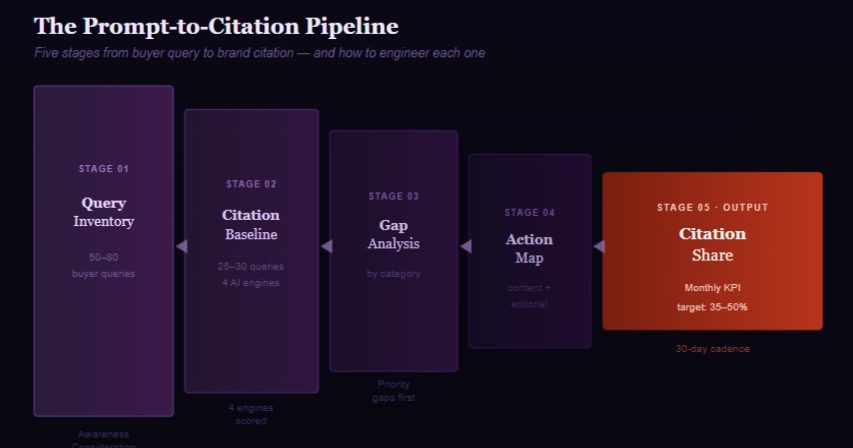
The method runs in five stages. Each stage builds directly on the previous. The full process takes two hours on first run and thirty minutes on subsequent monthly updates.
Stage 1 — Build Your Buyer Query Inventory. Generate a list of 50–80 questions your ideal buyer would ask an AI engine during vendor evaluation. Organize them into four categories: Awareness queries (what is X; how does X work), Consideration queries (best X for Y; X vs. Z comparison), Decision queries (X pricing; X reviews; X for [specific use case]), and Validation queries (is X trustworthy; X case studies; who uses X). Use three sources to generate this list: interviews with five recent customers asking "what questions were you trying to answer during evaluation," your sales team's FAQ list, and the "People Also Ask" sections of Google results for your category's main keyword.
Stage 2 — Run Your Baseline Citation Audit. Select your top 25–30 highest-priority queries from the inventory — weighted toward Decision and Consideration categories where purchase intent is highest. Run each query across four AI engines: ChatGPT, Perplexity, Google AI Mode, and one of Claude or Gemini. For each query on each engine, record: (a) whether your brand is named, (b) what position it appears in if named, (c) which competitors are named, and (d) which sources are cited. This four-column output is your citation share baseline.
Stage 3 — Identify Your Citation Gaps by Category. Analyze your baseline for patterns. Which query categories are you consistently absent from? Which competitors appear on queries where you do not? Which publications are cited most frequently across engines — those are your target placement properties. The gaps cluster: most brands are absent from Consideration queries (comparison and "best X for Y" queries) and present on Awareness queries (definitional content they own). The highest-value gap to close is almost always the Consideration category.
Stage 4 — Map Gaps to Content and Editorial Actions. For each citation gap, identify the specific action that closes it. Gaps in Awareness queries typically close through owned content restructuring — moving answer sentences to the lead, adding schema, improving author attribution. Gaps in Consideration and Decision queries typically require third-party editorial corroboration — placements on trusted publications that name your brand in the context of the comparison or decision the buyer is making. Use the following template to map each gap to its action.
Stage 5 — Set Your Measurement Cadence. Run the full 25-query audit monthly across all four engines. Track citation share as a percentage: (queries where you are named) / (total queries in panel) × 100. Set a 90-day target — most teams can move from 15–20% citation share to 35–50% with consistent editorial investment. Track which placements correlated with citation share increases by comparing placement dates to audit dates. The correlation is not always immediate — expect a two-to-six-week lag between editorial placement and measurable citation lift.
The Prompt Research Template
The following template produces a complete prompt-to-citation map for any B2B brand. Copy it, fill in your category, and run Stage 2 against the completed list.
Query CategoryTemplate QueryCustomized Example (SaaS PM Tool)Awareness — DefinitionWhat is [your category]?What is project management software?Awareness — How it worksHow does [your category] work?How does AI-powered project management work?Awareness — Who uses itWho uses [your category]?What types of teams use project management tools?Consideration — Best for use caseBest [your category] for [your ICP]Best project management software for remote engineering teamsConsideration — Comparison[Your brand] vs [Top competitor]Linear vs Asana for software development teamsConsideration — FeaturesWhat features should I look for in [category]?What features matter most in project management software?Decision — Reviews[Your category] reviews 2026Project management software reviews 2026Decision — Pricing[Your category] pricing comparisonProject management software pricing comparison 2026Decision — Specific use case[Your category] for [specific situation]Project management tools for teams using Jira and SlackValidation — TrustIs [your brand] trustworthy / reliable?Is Linear reliable for enterprise teams?Validation — Case studies[Your brand] customer resultsLinear customer case studies engineering teamsValidation — AlternativesAlternatives to [your brand]Alternatives to Asana for software teams
What to Do With the Map
Prioritize Consideration query gaps first. Consideration queries — "best X for Y," "X vs Z," "top X tools" — are where the buyer's shortlist is being assembled. A brand absent from Consideration query answers is not in the running before the first sales conversation. These gaps are almost always closed by third-party editorial corroboration: a Forbes or trade-publication article that names your brand in a category comparison is worth more for Consideration citation share than a dozen owned blog posts.
Use the source analysis to build your editorial target list. The publications cited most frequently across your query panel are your highest-priority placement targets. If Gartner Peer Insights, TechCrunch, and G2 are cited in 60% of your Decision-category answers, those three properties represent the majority of your editorial placement ROI. The query audit tells you where to publish before you spend a dollar on outreach.
Track citation share as your primary marketing KPI. Traffic, rankings, and impressions are proxies for the underlying goal — appearing in the answers your buyers read. Citation share on your 25-query panel is the direct measurement of that goal. It is the number your marketing team should report to your CEO every month, because it measures the only discovery surface that is growing while all others are flat or declining.
Further Reading · Curated by the DropPR Editorial Desk
Map Your Buyer's Prompts. Close the Citation Gaps.
Know which queries your buyers ask AI — and be named in every answer that matters.
DropPR runs your prompt-to-citation audit, identifies the Consideration and Decision query gaps where your brand is absent, and places editorial content on the exact publishers those queries are already citing. You get a map. We close the gaps.
Prompt-to-Citation Closure Stack
25-query citation audit across ChatGPT, Perplexity, AIO, Claude ($500 value)
Gap analysis by query category with editorial target list ($350 value)
Editorial placement closing your highest-priority Consideration gap ($1,200 value)
30-day re-audit measuring citation share lift post-placement ($400 value)
Monthly citation share reporting dashboard ($300 value)
Total stack value: $2,750 Charter pricing from $99.
No subscription. No retainer. Pay per placement.
Data Sources Referenced
OpenAI disclosures (2026) · ChatGPT processing over 1 billion queries per week.
LLMrefs (2026) · Prompt research as primary AI visibility discipline; query-to-citation mapping methodology.
Omnia (2026) · Citation analysis tools and 25-query panel methodology for citation share baseline.
Bigeye (2026) · AEO complete guide; Consideration query gaps as highest-value citation target.
Frase (2026) · GEO Playbook; query fan-out and sub-query coverage for citation inclusion.
Profound / Otterly / Brandlight · Citation monitoring tools for ongoing prompt-to-citation tracking.
Hayden Hollis
Head of Growth Marketing · DropPR.ai
Hayden Hollis writes about content distribution, digital PR, SEO, AI search, and creator marketing. His work focuses on how brands and creators can extend the reach of their content beyond social media and improve visibility across search engines, news publishers, and AI-powered discovery platforms. He regularly covers strategies related to earned media, audience growth, authority building, and the evolving role of AI in online discovery.