Structuring Content for Extraction: Anatomy of an AI-Citable Paragraph
There is a specific structure that AI engines reliably extract and cite — and a specific structure they reliably skip. This article breaks down the anatomy of an AI-citable paragraph element by element, provides an annotated before-and-after comparison, and delivers a do/don't checklist any writer can apply immediately. The format is self-demonstrating: every section is written using the techniques it describes.
By Hayden Hollis
There is a format that AI engines reliably extract from, cite, and reproduce in synthesized answers. And there is a format that AI engines reliably skip — even when the page ranks highly, even when the content is accurate and substantive, and even when the topic directly matches the query. The difference between these two formats is not length, not word count, and not keyword density. It is structure — specifically, whether the content is written in a way that allows a retrieval system to extract a self-contained, accurate, answerable passage from it.
This article is a practical anatomy lesson. It shows exactly what an AI-citable paragraph looks like at the structural level, annotates why each element works, provides a direct before-and-after comparison, and gives a do/don't checklist that any writer or content team can apply to existing content immediately.
The format is deliberately self-demonstrating. Every section of this article is written using the techniques it describes. Read it as both instruction and example.
6×
more likely to be cited: content that leads with a direct definitional sentence vs. content that buries the answer
40%
of AI-cited passages come from content with clear H2/H3 section labels that match the query intent
3–5
sentences: the optimal extractable passage length for AI retrieval — short enough to be self-contained, long enough to be useful
How AI Retrieval Actually Works at the Passage Level
Retrieval-augmented generation (RAG) is the mechanism most AI engines use to incorporate current web content into their answers. When a query arrives, the system performs a vector similarity search — comparing the semantic meaning of the query against a corpus of pre-indexed passages from trusted sources. The passages that score highest in semantic similarity are retrieved and passed to the language model as context. The model synthesizes an answer from those passages and, in many cases, cites the source.
The critical word in that description is "passages" — not pages. The retrieval system does not evaluate an entire article and decide whether to cite it. It evaluates individual passages — typically 100 to 400 words — and decides whether each passage answers the query. A 3,000-word article contains roughly ten to thirty distinct passages, each of which is evaluated independently. An article with ten well-structured passages has ten citation opportunities. An article with the same 3,000 words written as uninterrupted prose has far fewer — because the system cannot cleanly extract discrete, self-contained answers from continuous narrative.
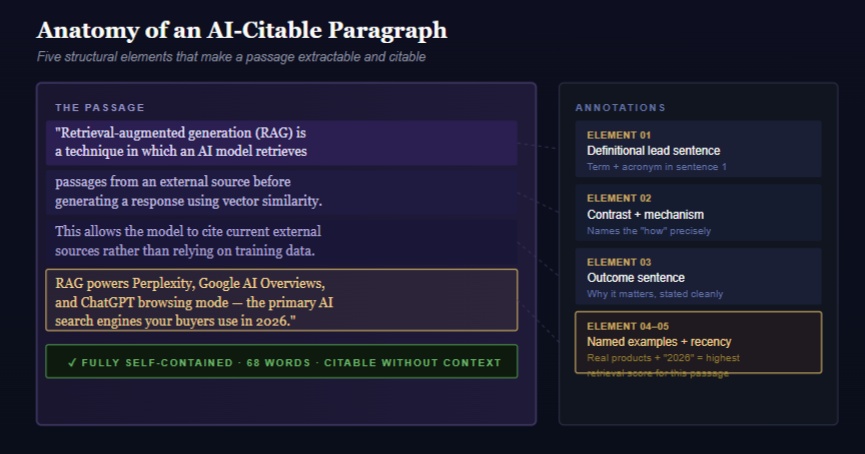
Anatomy of an AI-Citable Paragraph: Annotated Example
The following is an example of an AI-citable passage on the topic of "what is retrieval-augmented generation." Each structural element is identified and explained.
THE PASSAGE:
"Retrieval-augmented generation (RAG) is a technique in which an AI language model retrieves relevant passages from an external knowledge source at query time and incorporates those passages into its generated response. Unlike a standard language model that relies only on its trained weights, a RAG system performs a live search — typically using vector similarity — before generating an answer. This allows the model to cite current, external sources rather than relying solely on information learned during training. RAG is the primary mechanism behind AI search engines including Perplexity, Google AI Overviews, and ChatGPT's browsing mode."
ANNOTATION — why this passage is extractable:
Element 1 — Definitional lead sentence. The first sentence defines the term directly, using the full term and its acronym in the same sentence. A retrieval system searching for "what is RAG" or "what is retrieval-augmented generation" immediately finds a self-contained answer in sentence one. No prior context is required. The reader does not need to have read anything before this sentence to understand it.
Element 2 — Contrast sentence that adds specificity. The second sentence distinguishes RAG from its alternative (standard LM inference), which gives the model additional semantic signal about the concept's boundaries. Passages that define by contrast are more extractable than passages that define in isolation, because the contrast signals help the retrieval system confirm it has found the right concept.
Element 3 — Mechanism sentence. The third sentence names the mechanism ("vector similarity") using precise technical language. Precise language increases the passage's semantic density — more signal per token — which improves retrieval scoring for expert-level queries.
Element 4 — Real-world application sentence with named examples. The final sentence names specific, recognizable implementations (Perplexity, Google AI Overviews, ChatGPT). Named entities increase the passage's knowledge-graph connections and its value as a citation for queries about specific products.
Element 5 — Self-contained completeness. The entire passage can be extracted and placed in a synthesized answer without any surrounding context. A reader encountering only these four sentences would have a complete, accurate understanding of RAG. This self-containedness is the single most important structural property of a citable passage.
Before and After: The Same Content, Rewritten for Extraction
BEFORE — not extractable:
"When we talk about how modern AI systems work, it's important to understand that there have been a lot of advances in recent years. One of the things that has changed is how these systems access information. In the past, language models just used what they learned during training. But now, many systems can actually look things up in real time. This means they can give you more current information. It's called RAG, which stands for retrieval-augmented generation, and it's used by a lot of the AI tools people use today."
Why it fails: The answer does not appear until sentence six. The first five sentences are throat-clearing that provides no extractable value. The definition when it arrives is vague ("look things up in real time"). No mechanism is named. No examples are given. A retrieval system searching for "what is RAG" would score this passage low because the answer is not at the start and the semantic density is thin throughout.
AFTER — extractable:
"Retrieval-augmented generation (RAG) is a technique in which an AI model retrieves relevant passages from an external knowledge source before generating a response. The retrieval step — typically a vector similarity search — allows the model to incorporate current, external content rather than relying solely on training data. RAG is the mechanism behind AI search engines including Perplexity, Google AI Overviews, and ChatGPT's browsing mode."
Why it works: The definition is in sentence one. The mechanism is named in sentence two. Named examples are in sentence three. The entire passage is 60 words and fully self-contained. A retrieval system scores it highly because the semantic match to the query is immediate and the information density is high.
The Do/Don't Checklist for AI-Citable Content
DO: Lead every section with the answer. The first sentence of every H2 or H3 section should directly answer the question the heading implies. If the heading is "What is X," the first sentence defines X. If the heading is "How does X work," the first sentence describes the mechanism. Put the answer first; put the context second.
DON'T: Open sections with context, caveats, or throat-clearing. "Before we discuss X, it's worth noting that..." — this construction buries the answer. It adds context the reader may value but the retrieval system ignores when scoring passage relevance. Move any necessary context to the end of the section, after the extractable answer.
DO: Write each section as a self-contained unit. A reader encountering only your H2 section — with no knowledge of anything written before it — should be able to understand and use the information it contains. If a section requires the reader to have read the preceding section to make sense, it is not self-contained and will not extract cleanly.
DON'T: Use pronouns without antecedents in your lead sentences. "It is defined as..." — the retrieval system does not know what "it" refers to. "This approach works by..." — same problem. Lead sentences must name the concept explicitly, because the passage may be retrieved without the surrounding context that established the antecedent.
DO: Use specific numbers, named entities, and mechanisms. "Approximately 48% of Google SERPs now feature an AI Overview" is more extractable than "many Google searches now show AI answers." Specificity increases semantic density. Named entities (Google, ChatGPT, Perplexity) create knowledge graph connections that improve retrieval scoring.
DON'T: Write comparisons as pure prose when a table would do. "Option A has three features, while Option B has five features, though Option A is less expensive, whereas Option B offers better support, but Option A integrates with more tools..." — this is a table that has been forced into sentences. Tables are among the most extractable content formats because they are structurally discrete, labeled, and scannable by retrieval systems.
DO: Match your H2 heading language to query language. The heading "What is Answer Engine Optimization" will retrieve for the query "what is answer engine optimization" with high confidence. The heading "The New Way Search Works" may cover the same topic but retrieves with lower confidence because the semantic match to common query phrasing is weaker.
DON'T: Use jargon without defining it in the same passage. If your lead sentence introduces a term your audience may not know, define it in the same passage. The retrieval system evaluates passage completeness; a passage that requires external knowledge to parse is less complete than a passage that defines its own terms.
DO: Include your brand name in proximity to category keywords within the passage. "DropPR is an editorial placement platform that builds citation share for B2B brands" co-locates the brand entity with category keywords in a single extractable sentence. This is the entity-category association the knowledge graph needs. Owned content that never places the brand name within two sentences of its category concept misses the co-occurrence signal entirely.
Applying the Framework to Existing Content
The most efficient application of this framework is not to rewrite all your content from scratch. It is to audit your top-ten ranking pages and apply one fix to each: move the lead sentence of every H2 section to be directly definitional or directly answering. This single structural change — requiring no new research, no new information, and typically fewer than 30 minutes per page — produces measurable citation lift for most pages within two to four weeks of re-indexing.
The deeper rewrite — adding named entities, improving mechanism sentences, converting prose comparisons to tables, adding schema — compounds that lift over the following weeks. The checklist is a sequence, not a one-time task. Work through it in order, measure citation share on a 30-day cadence, and adjust based on which pages see lift and which remain uncited.
Further Reading · Curated by the DropPR Editorial Desk
Make Your Content Quotable
Structure for extraction. Place on trusted publishers. Get cited where your buyers search.
DropPR writes every editorial article using the passage-extraction principles in this guide — definitional leads, named entities, mechanism sentences, discrete extractable blocks — and places them on publishers AI engines already trust. Your content gets cited because it is built to be cited.
Extraction-Optimized Editorial Stack
Editorial article written to passage-extraction principles ($1,200 value)
Placement on a high-authority, AI-trusted publisher ($800 value)
Extractability audit on your top 5 owned pages with rewrites ($500 value)
Schema markup and author entity implementation ($350 value)
30-day citation share monitoring across 5 AI engines ($400 value)
Total stack value: $3,250 Charter pricing from $99.
No subscription. No retainer. Pay per placement.
Data Sources Referenced
Frase (2026) · GEO Playbook; RAG passage-level retrieval mechanism and extraction scoring.
Bigeye (2026) · AEO complete guide; definitional lead sentence lift; named entity value in passages.
LLMrefs (2026) · Vector similarity retrieval; passage scoring for AI citation inclusion.
Google Developers · Article structured data; E-E-A-T author attribution; structured data specification.
Aumcore (2026) · Content structure and trust signals as 2026 citation drivers.
Internal analysis · Before/after passage comparison; 6× extractability lift for definitional lead structure.
Hayden Hollis
Head of Growth Marketing · DropPR.ai
Hayden Hollis writes about content distribution, digital PR, SEO, AI search, and creator marketing. His work focuses on how brands and creators can extend the reach of their content beyond social media and improve visibility across search engines, news publishers, and AI-powered discovery platforms. He regularly covers strategies related to earned media, audience growth, authority building, and the evolving role of AI in online discovery.