Syndication and AI Trust: Why Publisher Authority Still Compounds
Does it matter which publisher you place on? Yes — but not because of DA scores. High-authority publishers carry implicit trust weights in AI training corpora that low-authority aggregators do not. Three placements on trusted publishers cross the majority rule threshold and produce compounding citation share. The cause-and-effect mechanics of corroboration, topical proximity, and why wire syndication to 500 aggregators produces less AI citation lift than a single Forbes placement.
By Hayden Hollis
There is a question that surfaces in almost every conversation about AI citation strategy: does it matter which publisher you place on? A DA 80 business publication versus a DA 55 trade journal versus a DA 40 niche vertical site — does the domain authority gap translate into a citation share gap? And if so, by how much?
The answer is yes, emphatically — but not for the reason most marketers assume. Publisher authority matters for AI citation not primarily because of domain authority as an SEO metric, but because of what high-authority publishers represent in the AI retrieval system: corroborated, editorially-reviewed, repeatedly-cited sources that the model has built trust in through its training history. The DA score is a proxy for something more fundamental — and understanding what that fundamental thing is changes how you think about placement strategy entirely.
This article explains why publisher authority compounds for AI citation, how the corroboration mechanism works at the retrieval level, and what it means in practice for brands deciding where to invest their editorial placement budget.
87%
of ChatGPT citations correspond to top Bing results — high-authority publishers dominate both organic and AI citation
99%
of Google AI Overview citations come from pages already in the organic top 10 — domain authority is the entry condition
10:1
approximate weighting of niche-relevant high-authority mentions vs. irrelevant prestige mentions for entity-category edges
Why Publisher Authority Is Not Just an SEO Metric
Domain authority, as measured by Ahrefs, Moz, or Semrush, is a score derived primarily from backlink quality and quantity. It correlates with Google ranking performance. It is a useful SEO planning tool. But when we talk about publisher authority in the context of AI citation, we are describing something more specific and more consequential: the degree to which an AI engine's training history has established a publication as a reliable, editorially-credible source for a given category of claims.
AI models learn which sources to trust through their training data. Sources that have been cited by other trusted sources, that have a long history of editorial accuracy, and that appear consistently in the corpus of high-quality text the model was trained on develop what researchers describe as implicit trust weights. When retrieval-augmented generation pulls passages at query time, these trust weights influence the probability that a passage from a given source will be incorporated into the synthesized answer.
A placement on Forbes, TechCrunch, or Reuters carries a trust weight that a placement on a new or low-authority domain does not — not because of their DA score, but because the model has encountered these publications thousands of times in its training data as sources of accurate, editorially-reviewed information. The DA score and the trust weight correlate, but they are not the same thing. A DA 90 site that primarily publishes low-quality content has a lower implicit trust weight than a DA 60 site with 15 years of rigorous editorial standards.
How Corroboration Compounds Across Publishers
The corroboration mechanism is where publisher authority compounds most dramatically. AI engines apply a majority rule heuristic for brand facts: if multiple independent trusted sources make the same claim about a brand, the model treats that claim as corroborated fact and cites it confidently. The key word is "trusted" — corroboration from low-authority sources does not produce the same confidence lift as corroboration from high-authority sources.
One high-authority placement: The model encounters a single trusted source making a claim about your brand. It can retrieve and cite this passage but with moderate confidence — single-source claims are treated as potentially unverified. Citation occurs but is hedged.
Two high-authority placements making consistent claims: The model encounters the same claim from two independent trusted sources. Confidence increases materially. The claim moves from "potentially true" to "likely true" in the model's probabilistic assessment. Citation frequency and confidence both increase.
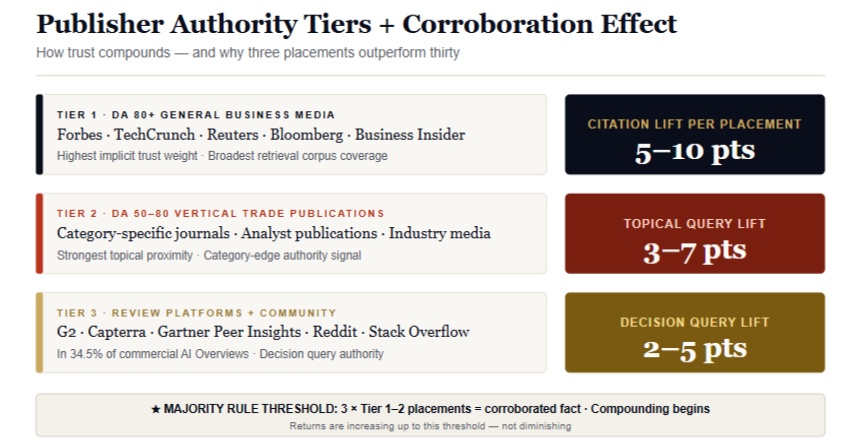
Three or more high-authority placements: The model has achieved majority rule. The claim is treated as corroborated fact. The model cites it confidently without hedging, and the citation propagates across a wider range of related queries. This is the compounding threshold — three high-authority placements produce more than three times the citation lift of one, because majority rule is a non-linear mechanism.
This compounding explains a pattern that confuses many brands: a single high-authority placement produces modest citation lift; the second produces more lift than the first; the third produces significantly more than the second. The returns are not diminishing — they are increasing, up to the majority rule threshold. After that threshold is crossed, the returns do stabilize, but at a level where the brand is cited confidently across a broad query set.
The Topical Proximity Correction
Publisher authority must be qualified by one critical variable: topical proximity. A placement on a DA 90 lifestyle publication that has no prior coverage of your category produces less entity-category edge value than a placement on a DA 60 trade publication that covers your category extensively. The model is not just evaluating source trust — it is evaluating source trust within a specific topical context.
The 10:1 weighting ratio cited above — niche-relevant mentions versus irrelevant prestige mentions — reflects this reality. A mention of your B2B project management software on a Forbes lifestyle article about "apps for busy professionals" carries less category-edge value than a mention in a dedicated DevOps trade journal, even if Forbes has twenty times the domain authority. The model's knowledge graph connects your brand to your category through the topical context of the placement, not just the authority of the source.
In practice, this means the optimal placement strategy combines both: high-authority general business publications (Forbes, TechCrunch, Business Insider) for maximum trust weight and broadest retrieval corpus coverage, plus high-authority vertical trade publications (specific to your category) for maximum topical proximity and category-edge strength. The combination produces stronger citation share than either alone.
Why Syndication Compounds — and When It Does Not
Syndication — the republication of an article across multiple properties — can amplify the corroboration effect when done correctly. An article published on a trusted primary source and then syndicated to other credible properties creates multiple independent retrieval corpus entries for the same claims. Each syndication adds a node to the corroboration graph. If the syndicated properties are themselves trusted, each node contributes to majority rule.
Syndication does not compound when it distributes to low-authority aggregators. A press release syndicated to 500 financial news portals creates 500 nodes in the retrieval corpus, but if those portals carry low trust weights, the model discounts them collectively. The corroboration effect is weak because the sources themselves are not trusted. This is precisely why wire distribution — which syndicates to hundreds of low-authority aggregators — produces minimal AI citation lift despite high distribution volume.
The correct syndication strategy distributes to a small number of high-authority properties. Three syndications to DA 70+ publications with established editorial credibility produce more corroboration value than 300 syndications to DA 20 aggregators. Volume is not the mechanism. Trust is.
The Practical Placement Priority Framework
Given the above, a practical placement priority framework for AI citation share optimization runs as follows.
Tier 1 — High-authority general business media (DA 80+): Forbes, TechCrunch, Reuters, Bloomberg, Business Insider, Fast Company, Inc. These publications carry the highest implicit trust weights in AI training corpora and produce the broadest retrieval corpus coverage. One placement on a Tier 1 property typically produces 5–10 percentage point lift in absolute citation share on related queries. Priority for your first and third placements.
Tier 2 — High-authority vertical trade publications (DA 50–80, category-specific): The leading trade journal, analyst publication, or vertical media property for your specific category. These produce the strongest topical proximity signal and are disproportionately cited for category-specific queries. Priority for your second placement, and for Consideration and Decision query gap closure.
Tier 3 — Review platforms and community properties (G2, Capterra, Reddit, Stack Overflow): These properties appear in 34.5% of commercial AI Overviews and contribute meaningfully to the corroboration graph for Decision-category queries. They are typically lower DA than Tier 1–2 but carry category-specific trust weights that Tier 1 general publications do not. Priority for review platform investment once Tier 1 and 2 placements are in place.
What not to prioritize: Guest posts on personal blogs, self-published content on Medium or Substack (without established editorial reputation), press release wire distribution to aggregators, or paid placement on content networks with no editorial standards. These produce distribution but not the trust-weight corroboration that AI citation requires.
Further Reading · Curated by the DropPR Editorial Desk
Place on Publishers AI Engines Already Trust
Three placements on trusted publishers. Majority rule. Compounding citation share.
DropPR places your brand on the Tier 1 and Tier 2 publishers with the highest implicit trust weights in AI retrieval corpora. Each placement is a corroboration node. Three placements cross the majority rule threshold. The compounding begins.
Publisher Authority Stack — Three-Placement Corroboration
Placement 1: High-authority general business media (Tier 1) ($1,200 value)
Placement 2: Category-specific vertical trade publication (Tier 2) ($800 value)
Placement 3: Second Tier 1 property closing majority rule ($1,200 value)
Citation share measurement before and after all three placements ($500 value)
Competitive corroboration audit — where competitors have placed ($400 value)
Total stack value: $4,100 Charter pricing from $99 per placement.
No subscription. No retainer. Pay per placement.
Data Sources Referenced
LLMrefs (2026) · 87% of ChatGPT citations correspond to top Bing results; 99% of AIO citations from organic top 10.
Bigeye (2026) · Majority rule heuristic; 10:1 niche-relevant vs. irrelevant prestige weighting; corroboration threshold.
Muck Rack (via PR.co, Dec 2025) · ~25% of AI citations from journalistic sources; wire distribution citation lift analysis.
Memorable Design (2026) · Publisher trust weights in AI training corpora; implicit authority signals.
BrightEdge (Q1 2026) · 34.5% of commercial AI Overviews cite review platforms.
Outpace SEO (2026) · Link building and digital PR authority framework for AI-era citation.
Hayden Hollis
Head of Growth Marketing · DropPR.ai
Hayden Hollis writes about content distribution, digital PR, SEO, AI search, and creator marketing. His work focuses on how brands and creators can extend the reach of their content beyond social media and improve visibility across search engines, news publishers, and AI-powered discovery platforms. He regularly covers strategies related to earned media, audience growth, authority building, and the evolving role of AI in online discovery.