The Audience Migration: Where Your Buyers Actually Read the News Now
The audience for business news did not disappear. It relocated — to four specific surfaces, in measurable proportions, with distinct authority dynamics. Most PR strategies are still distributing to the geography readers left in 2022.
By Hayden Hollis
A common error in marketing-leadership conversations is to describe the decline of legacy media as the end of an audience. That framing is wrong. The audience for business and category-relevant news in 2026 is, by most measurable indicators, larger than it was a decade ago. The difference is that it is no longer concentrated in the places where the PR industry was built to reach it. The audience migrated. The PR stack, in most organizations, did not.
This matters for one practical reason: every dollar spent distributing through a channel the buyer no longer uses is a dollar that produces nothing — and worse, it satisfies the appearance of activity in ways that make the underlying problem hard to surface in budget conversations. The 2026 question is not "are we doing PR." It is "are we doing PR on the surfaces our buyer actually occupies."
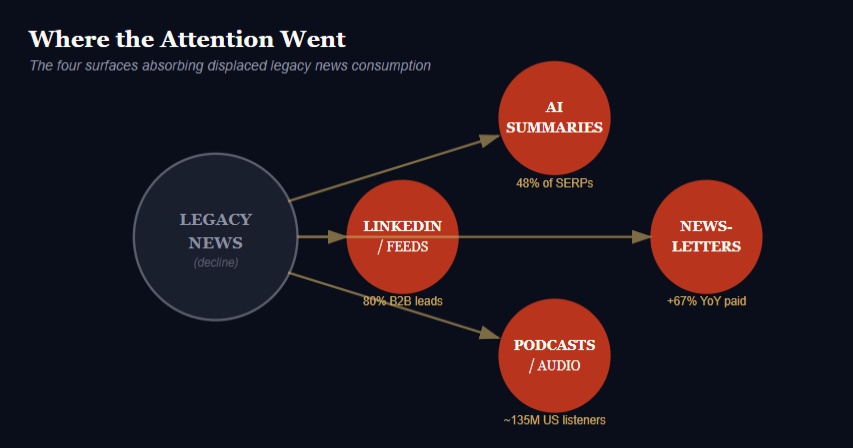
Four surfaces have absorbed the bulk of the migration. Each has its own trust dynamic, its own access mechanism, and its own role in the modern PR stack.
5M+
Substack paid subscriptions in early 2025 — a 67% YoY increase
140K
newsletters now operating on Beehiiv alone, up 60% in 2025
80%
share of B2B leads from social media that come through LinkedIn
Surface One · AI-Generated Answers
AI Overviews now appear on 48% of search engine result pages. ChatGPT processes more than a billion queries weekly. Perplexity, Claude, and Gemini absorb the long tail of substantive research questions that used to drive top-of-funnel referral traffic. The defining property of this surface is that it is substitutional — it answers the question rather than pointing to the article that would have answered it.
PR implication: Citation share inside generative answers is the new top-of-funnel metric. The work is editorial placement on the publishers AI engines already cite, structured for retrieval-augmented generation.
Surface Two · Direct-to-Inbox Publishing
Substack reported five million paid subscriptions in early 2025 — a 67% year-over-year increase — and now hosts launched media properties valued in the hundreds of millions, including The Free Press, acquired for $150 million. Beehiiv has crossed $30 million in annualized revenue, doubling year over year, and hosts 140,000 newsletters. Legacy properties (Time, Newsweek, New York magazine, The Wall Street Journal opinion section) have brought editorial onto these platforms. The category-specific newsletter has functionally replaced the trade publication for many verticals.
PR implication: Five to fifteen substantive operator-run newsletters in your category are now your most important media list. Treat them the way you would treat a beat reporter at a top trade outlet. Pitch substantively. Provide data. Build relationships.
Surface Three · Long-Form Audio
Podcast listenership has crossed the threshold where it now functions as a primary news source for category-relevant audiences in most B2B and high-consideration B2C verticals. Beehiiv's recent launch of native podcast hosting and Substack's aggressive courtship of audio creators both reflect the same underlying observation: long-form audio is where attention is concentrating for the kinds of substantive conversations that drive purchase consideration. The 60-minute conversation now outperforms the 30-second clip for high-consideration purchases.
PR implication: A 50-episode podcast circuit, properly executed, can produce more category authority than a Tier-1 publication feature. Each podcast appearance becomes source material for editorial articles, AI citations, and branded search lift.
Surface Four · Professional Social Feeds
LinkedIn now generates approximately 80% of B2B leads sourced from social media. The platform's algorithm has structurally migrated authority away from company pages toward personal profiles — personal posts now generate 561% greater reach than equivalent company-page posts. The implication is not subtle. The brand voice that moves business decisions on the platform is the voice of identified humans — founders, operators, subject-matter experts — not the corporate handle.
PR implication: Your founder's LinkedIn presence is now a distribution asset comparable to a Tier-2 trade publication, often more valuable for direct conversion. Earned editorial that names your founder gets amplified through their personal network at multiples of corporate-channel reach.
What This Map Implies for PR Strategy
Distribution is now four-channel, not one. The single-channel approach — Tier-1 placement pursued via traditional pitching — produces diminishing returns because it reaches only one of the four surfaces where buyers actually spend attention. A modern PR strategy distributes coordinated coverage across editorial placement, newsletter inclusion, podcast appearance, and amplified LinkedIn voice.
The unit economics have inverted. Reaching a top-tier publication used to be the hardest of these surfaces. It is now arguably the easiest, because the publication is hungry for substantive expert content and the cycle time has compressed. The hardest surface to reach substantively in 2026 is the right operator-run newsletter, which has earned its audience's trust over years and is selective about what it covers.
The brand cannot do this on its own surface. The buyer does not consume the owned newsroom directly. They encounter your brand through AI citations, newsletter coverage, podcast appearances, and personal-feed amplification — and only then come to the owned property to verify. Inverting that funnel is the single most consequential strategic shift available to most marketing teams this year.
Further Reading · Curated by the DropPR Editorial Desk
Reach Buyers on the Surfaces They Actually Use
One placement. Distributed across four attention surfaces. Tracked end-to-end.
DropPR distributes each editorial placement for compounding visibility across AI citation surfaces, newsletter ecosystems, podcast circuit references, and LinkedIn amplification. Not single-channel PR. Multi-surface Performance PR.
Multi-Surface Distribution Stack
Editorial article placement on AI-cited publisher ($1,200 value)
Newsletter syndication kit (5-newsletter target list per niche) ($350 value)
Podcast-ready short-form derivative + creator outreach ($400 value)
LinkedIn amplification package (founder + executive scripts) ($300 value)
Cross-surface attribution dashboard ($300 value)
Stack value: $2,550 Charter pricing from $99.
No retainers. Per-placement pricing. Coverage on every surface that matters.
Data Sources Referenced
Whalesbook (Jan 2026) · Substack 5M paid subscriptions, 67% YoY growth.
Sacra (April 2026) · Beehiiv $30M ARR, 140,000 newsletters, $28M revenue in 2025 (doubled).
BrightEdge · AI Overviews on 48% of SERPs as of Q1 2026.
Ordinal (Jan 2026) · LinkedIn personal profiles 561% greater reach than company pages.
La Growth Machine 2026 · 80% of B2B leads from social media come through LinkedIn.
TechCrunch (April 2026) · Beehiiv launches native podcast hosting; audio surface convergence.
Hayden Hollis
Head of Growth Marketing · DropPR.ai
Hayden Hollis writes about content distribution, digital PR, SEO, AI search, and creator marketing. His work focuses on how brands and creators can extend the reach of their content beyond social media and improve visibility across search engines, news publishers, and AI-powered discovery platforms. He regularly covers strategies related to earned media, audience growth, authority building, and the evolving role of AI in online discovery.