The B2B Trust Stack: Rebuilding Analyst Relations, Reviews, and Thought Leadership for AI Search
The B2B buyer reaches AI before they reach you. By the time a sales team gets a first meeting, the trust signals have already been weighed inside a synthesized answer. Every legacy layer of the B2B trust stack must now be re-engineered for that reality.
By Hayden Hollis
Roughly ninety-four percent of B2B buyers, by recent research, finalize their vendor shortlist before contacting any of the vendors on it. That number has been climbing for a decade, but the introduction of generative search has changed something more fundamental than its trajectory. The shortlist is no longer being built only by the buyer; it is being built by the AI engine the buyer consults during research. By the time a sales team gets a first meeting, the candidate set was assembled by a model — and that model anchored its candidate set in a small number of trust signals it considers reliable.
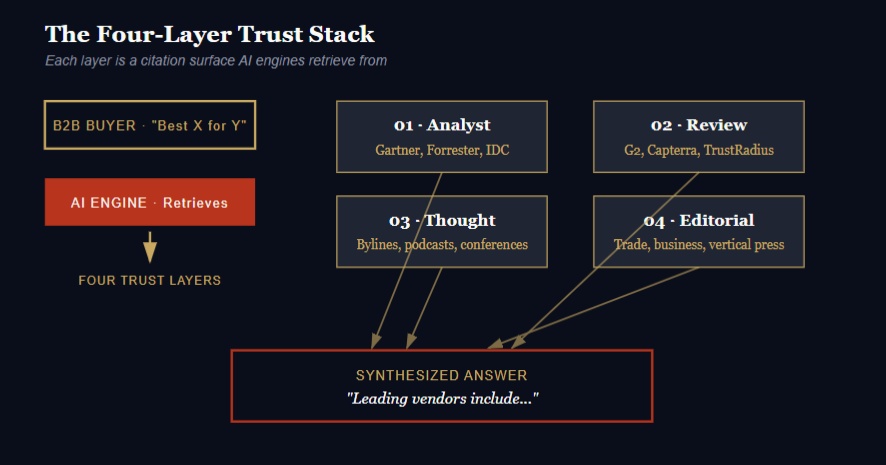
For B2B marketing leaders, this is the controlling fact of the current moment. The mechanisms that traditionally generated trust — analyst placements, peer reviews, thought leadership, editorial coverage — still matter, but they matter for a different reason. They are no longer the means by which a buyer gets convinced of your brand. They are the means by which an AI engine gets convinced to include your brand in the shortlist a buyer reads.
This article describes the four-layer trust stack as it now operates, what changed inside each layer, and how to re-engineer it for citation share rather than impression count.
94%
of B2B buyers rank vendors before first contact with any of them
34.5%
of AI Overviews for commercial queries cite a review platform (G2, Capterra, Gartner Peer Insights)
~25%
of AI tool citations come from journalistic / editorial sources
The Stack Was Built for the Old Buyer Journey
The B2B trust stack of 2015 had a defensible logic. Analyst firms aggregated demand-side intelligence and produced Magic Quadrants. Review platforms aggregated user voice. Thought leadership built individual credibility. Editorial coverage built brand authority. Each layer fed a stage of a known buyer journey. Sales teams could intercept the buyer when they entered the funnel, and the trust signals worked sequentially.
Three structural changes broke that logic. First, the buyer journey collapsed temporally — the decision is being made before the funnel begins, often in a single AI-mediated research session. Second, the AI engine became the layer that consults all four trust signals on the buyer's behalf, weighting them in ways neither the analyst firms nor the vendors fully control. Third, the unit of trust shifted from human relationships to citation share — being named, repeatedly, by sources the model trusts is now the load-bearing signal.
The four layers must be rebuilt with that reality in mind. Each rebuild is concrete; none is optional.
Layer One · Analyst Relations
Gartner · Forrester · IDC · 451 Research
Magic Quadrants, Wave reports, and category overviews remain among the most heavily-cited sources inside AI answers for B2B queries. The buyer does not read these reports as often as they used to, but the AI engine ingests them comprehensively. Inclusion in an analyst report is now valuable less for the direct buyer-eyeball impact and more for the citation it generates in dozens of generative answers downstream.
What still matters: substantive analyst briefings, accurate vendor self-disclosures, customer reference programs, and inclusion in category reports. What matters less: vanity placement in custom reports without organic citation distribution.
What changed: Analyst relations now optimizes for AI-engine ingestion. The right report is the one that gets cited in the LLM responses your buyers see — not the one that produces the prettiest PDF in the booth.
Layer Two · Review Platforms
G2 · Capterra · TrustRadius · Gartner Peer Insights
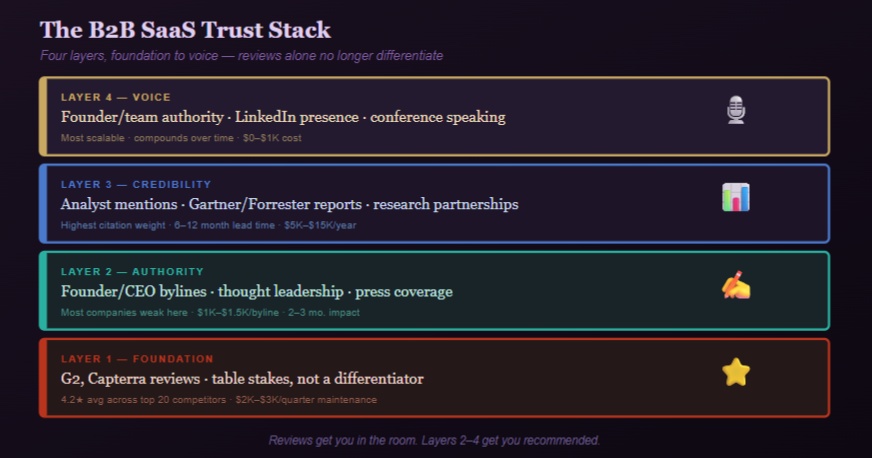
Review platforms appear in approximately 34.5% of AI Overviews for commercial queries. The reason is straightforward: these properties contain structured, user-attested information about vendors that AI engines treat as ground truth. A brand without substantive presence on G2, Capterra, or its category equivalents is functionally invisible to the AI layer of the trust stack.
The optimization vector is review volume, recency, and substance. Volume signals market presence. Recency signals current relevance. Substance — long-form, specific reviews from named buyers — gives the AI engine extractable text to cite.
What changed: Review platforms moved from "credibility check at the bottom of the funnel" to "primary citation surface at the top." Customer-marketing programs that drive review velocity now have AI-citation lift as a measurable downstream outcome.
Layer Three · Thought Leadership
Bylines · Podcasts · Conference Stages · Newsletters
The B2B thought-leadership category is being restructured around named individuals rather than brand voices. AI engines weight content authored by credentialed experts more heavily than content attributed only to a corporate handle. The implication is that "company thought leadership" produced anonymously generates substantially less authority than the same content attributed to a named, verifiable expert from the company.
The Edelman-LinkedIn Thought Leadership Impact Report has tracked this for years on the buyer side — buyers consume thought leadership produced by individuals at higher rates and trust it more. The new variable is that AI engines apply the same weighting, in some respects more aggressively. The CEO's byline gets cited; the company blog largely does not.
What changed: Thought leadership is no longer a content-marketing function. It is an executive-development function. The right metric is not how much your company published; it is how many executives at your company are cited by name in answers about your category.
Layer Four · Editorial Coverage
Trade Publications · Vertical Press · Business Media
Editorial placement remains the layer that drives the most consequential AI citation lift, because the publications themselves are the sources LLMs treat as most authoritative for any category. A Forbes feature, a TechCrunch article, a Reuters mention, or a top-vertical trade article carries citation weight that none of the other layers can substitute for. Editorial is also the most controllable layer of the stack — analyst relations, review velocity, and thought leadership all require longer cycles, while a well-pitched editorial placement can run within a week.
The shift here is that earned editorial coverage now compounds across the rest of the stack. A trade-publication article naming your CEO improves your analyst briefing material, generates language reviewers cite, and gives your thought-leadership program canonical assets to reference.
What changed: Editorial is no longer the "outcome" of PR — it is the input that improves every other layer of the trust stack. The brands that grasp this run editorial first, then drive analyst, review, and thought-leadership activities off the editorial library.
How to Run the Four Layers as One System
The most operationally effective B2B marketing programs in 2026 do not run these four layers as separate functions. They run them as a coordinated system, with editorial coverage as the seed that improves all four. The order is consequential.
Start with editorial. A steady cadence of editorial placements in trade and business media — naming your CEO and executive team, addressing category-defining questions, providing genuine subject-matter substance — becomes the asset library that improves everything else.
Feed analyst relations from editorial. Your most recent ten editorial placements are the strongest possible substantiation in an analyst briefing. They demonstrate market presence, industry recognition, and category authority in a single curated package.
Drive review velocity with proof points. The customer marketing motion that drives review volume should reference the editorial coverage as social proof. Customers asked to leave reviews after seeing their company referenced in a trade publication about your category convert at materially higher rates.
Amplify thought leadership through executive channels. Each editorial placement becomes content for the CEO's LinkedIn feed, source material for podcast pitches, and substantive evidence in conference proposals. The single editorial asset produces compounding authority across all four layers.
Further Reading · Curated by the DropPR Editorial Desk
Engineer the Trust Stack for Citation Share
Editorial coverage that compounds across every layer of the B2B trust stack.
DropPR places your executives and brand in the trade, vertical, and business publications AI engines cite — then provides the asset library that improves analyst relations, review velocity, and thought-leadership amplification across the rest of the stack.
B2B Trust Stack — Editorial as Force Multiplier
Editorial placement naming your executive team as quoted experts ($1,200 value)
Asset kit for analyst briefings (excerpts, quotes, third-party citations) ($400 value)
Customer-marketing pack to drive review velocity off the placement ($300 value)
Thought-leadership amplification scripts for founder and exec LinkedIn ($350 value)
30-day AI citation share dashboard across G2, Gartner, AIO, ChatGPT ($400 value)
Stack value: $2,650 Charter pricing from $99.
For B2B marketing leaders rebuilding for an AI-mediated buyer journey.
Data Sources Referenced
6sense · 2025 B2B Buyer Experience Report · 94% of buyers rank vendors before vendor contact.
Bigeye (2026) · Review platforms cited in approximately 34.5% of commercial AI Overviews.
Muck Rack (via PR.co, Dec 2025) · ~25% of AI tool citations from journalistic sources.
Edelman-LinkedIn · 2024 B2B Thought Leadership Impact Report.
Aumcore (2026) · EEAT and trust signals as primary 2026 ranking drivers.
Thinkster (2026) · Authority signals beyond backlinks in EEAT SEO 2026.
Hayden Hollis
Head of Growth Marketing · DropPR.ai
Hayden Hollis writes about content distribution, digital PR, SEO, AI search, and creator marketing. His work focuses on how brands and creators can extend the reach of their content beyond social media and improve visibility across search engines, news publishers, and AI-powered discovery platforms. He regularly covers strategies related to earned media, audience growth, authority building, and the evolving role of AI in online discovery.