The Citation Gap: Why Top-Ranking Pages Still Don't Get Quoted by AI
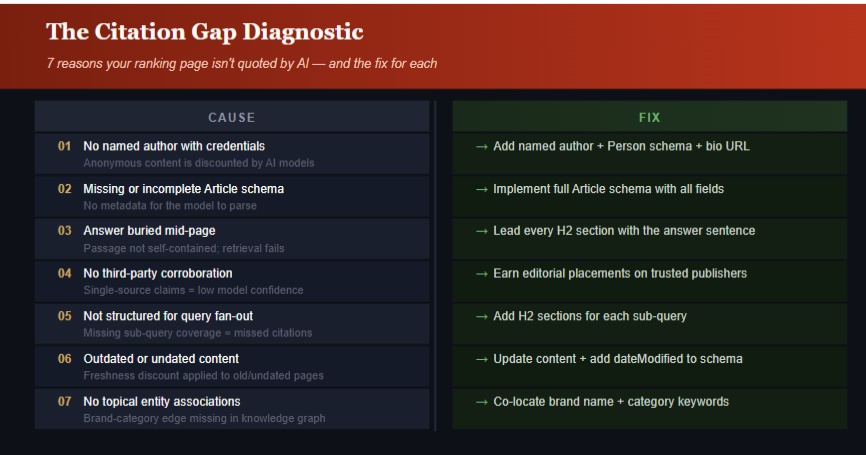
Your page ranks on page one. ChatGPT still doesn't cite it. This is the citation gap — and it has seven specific causes, each with a concrete fix. A diagnostic checklist covering missing author attribution, incomplete schema, buried answers, absent corroboration, query fan-out gaps, outdated dates, and weak entity association — with cause-to-fix pairs any content team can action this week.
By Hayden Hollis
Here is a problem that is becoming increasingly common in marketing teams with mature SEO programs: the site ranks well. Organic traffic is solid. The content is substantive, well-written, and technically correct. And yet when someone types the category's defining questions into ChatGPT, Perplexity, or Google AI Mode, the brand is not named. Competitors with weaker domain authority are cited instead. The ranking is real. The citation is absent.
This is the citation gap — and it is structurally different from an SEO problem. Ranking and being cited are two different outcomes, produced by two different mechanisms, and closing the gap between them requires diagnosing which specific mechanism is failing. The diagnosis is not difficult. The fixes are not expensive. But neither is obvious to a team that has been optimizing exclusively for rankings.
What follows is a diagnostic checklist: the seven most common reasons a page ranks but is not quoted by AI engines, each paired with the specific fix that closes it.
<20%
overlap between top-ranked organic pages and AI-cited sources — ranking is a necessary but not sufficient condition
99%
of Google AI Overview citations come from pages already in the organic top 10 — but only a fraction of those pages are cited
5×
approximate citation lift when a page adds proper Article schema and structured author attribution
Cause 1 — No Named Author with Verifiable Credentials
Why it blocks citation: AI engines apply E-E-A-T (Experience, Expertise, Authoritativeness, Trustworthiness) at the author level, not just the domain level. A page published under a generic "Staff Writer" or "Marketing Team" byline is structurally indistinguishable — from the model's perspective — from anonymous corporate content. Anonymous content is discounted as a citation source regardless of its ranking position.
The fix: Every page that you want cited must have a named author with a persistent bio page at a stable URL. The bio page must include credentials, experience, a professional photo, and external verification — typically a LinkedIn profile or equivalent. Implement Person schema linking the article to the author entity. The author bio page is the signal the model uses to evaluate whether the content is expert-produced.
Diagnostic check: View source on your ranking pages. Search for "author" in the schema. If the author value is absent, a generic string, or not linked to a Person schema entity, you have a named author gap.
Cause 2 — Missing or Incomplete Article Schema
Why it blocks citation: AI engines parse structured data to understand what type of content they are reading, who produced it, when it was published, and what organization stands behind it. A page without Article schema — or with incomplete schema missing datePublished, dateModified, author, or publisher — gives the model insufficient metadata to confidently treat the page as a citable editorial source. The model may retrieve the content but decline to cite it formally.
The fix: Implement complete Article or NewsArticle schema on every content page. Required fields: headline, datePublished, dateModified, author (linked to Person schema with URL), publisher (linked to Organization schema with logo), and image. Run every page through Google's Rich Results Test and Schema.org validator to confirm the schema is rendering correctly. Fix any validation errors before proceeding.
Diagnostic check: Paste your URL into Google's Rich Results Test (search.google.com/test/rich-results). If the Article type is not detected, or if required fields are flagged as missing, you have a schema gap.
Cause 3 — The Answer Is Buried Mid-Page
Why it blocks citation: AI retrieval systems use vector similarity search to find passages that match a query's semantic intent. A passage scores highest when it is self-contained — when it answers the question without requiring the reader to have read the surrounding paragraphs. When the most relevant answer on a page appears in paragraph seven, after 600 words of introductory context, the passage retrieval system often cannot extract it cleanly. It either retrieves a larger, noisier block of text or skips the page in favor of a competitor whose answer leads.
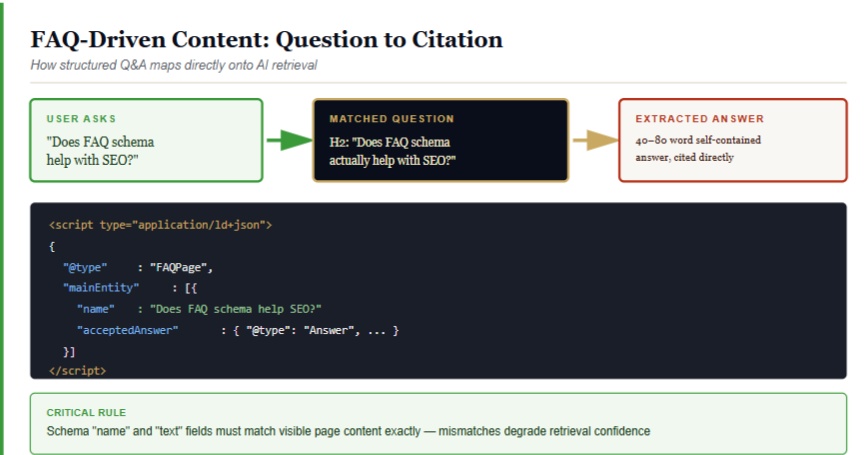
The fix: Audit every section of your ranking pages. Each H2 section should open with a definitional or answer sentence — a single sentence that directly responds to the question the section heading implies. Move the answer up. The context and elaboration follow. A reader who wants the answer gets it immediately; a reader who wants the reasoning reads further. The AI retrieval system gets a clean, self-contained passage at the top of every section.
Diagnostic check: Read only the first sentence of each H2 section on your ranking page. Does each first sentence directly answer the question the heading implies? If not, the passage retrieval position needs to move up.
Cause 4 — No Third-Party Corroboration
Why it blocks citation: AI engines apply a majority rule heuristic for brand and product facts. When a claim appears on only one source — even a high-authority, well-ranked source — the model treats it as unverified and is reluctant to cite it confidently. When the same claim appears across multiple independent trusted sources, the model treats it as corroborated fact and cites it readily. Owned content that is not corroborated by third-party editorial coverage sits in the "unverified" bucket regardless of its ranking.
The fix: Identify the three to five claims on your ranking pages that are most important for your brand's category positioning. Find or create editorial coverage — on trusted third-party publications — that makes the same claims independently. The specific language need not match; the semantic claim must. Once corroboration exists across three or more trusted sources, the model has the majority it needs to cite confidently.
Diagnostic check: Take your brand's most important positioning claim — "the leading X for Y" or equivalent. Search for that claim in ChatGPT and Perplexity. If the model does not make that claim when asked about your category, third-party corroboration is absent.
Cause 5 — Content Is Not Structured for the Query Fan-Out
Why it blocks citation: When a user submits a query to an AI engine, the engine internally expands that query into multiple sub-queries before retrieving. A search for "best project management software for remote teams" becomes sub-queries for "project management software features," "remote team collaboration tools," "project management pricing comparison," and others. A page that addresses the parent query comprehensively but does not contain clearly-labeled sections addressing each sub-query misses the retrieval for most of those sub-queries.
The fix: Map the sub-queries your target query fans out into. Use keyword research tools, "People Also Ask" sections, and AI engine query suggestions to build this map. Ensure your page has a clearly-labeled H2 or H3 section that directly addresses each sub-query with its own extractable lead sentence. A page that addresses twelve sub-queries has twelve citation opportunities. A page that addresses only the parent query has one.
Diagnostic check: Type your target query into Perplexity and expand the "Sources" section. Note which sub-questions Perplexity breaks the query into. Compare those sub-questions against your page's H2 structure. Every unaddressed sub-question is a missed citation opportunity.
Cause 6 — Outdated or Undated Content
Why it blocks citation: AI retrieval systems weight freshness for any query where the answer might have changed. A page that ranks well but carries a 2022 publication date — or no visible date at all — receives a freshness discount for time-sensitive queries. For categories evolving as rapidly as AI, marketing technology, or any regulated sector, a page from two years ago may be retrieved but explicitly flagged by the model as potentially outdated, which reduces the probability of direct citation.
The fix: Audit every ranking page for publication and modification dates. Pages with outdated facts should be updated with current information and re-dated using both visible on-page dates and the dateModified field in Article schema. Pages covering stable evergreen topics can be left, but should still carry visible dates. Remove the convention of hiding publication dates — freshness signaling requires visible dates.
Diagnostic check: View source and search for "dateModified" in the page schema. If it is absent, or if it matches the original publication date from 2022 or earlier, the page is not signaling freshness to retrieval systems.
Cause 7 — The Page Has No Topical Entity Associations
Why it blocks citation: AI engines maintain knowledge graphs that connect brand entities to category concepts. A page that uses generic language — "our software," "our platform," "our solution" — without consistently naming and connecting specific category concepts gives the model nothing to build the brand-category edge on. The brand may rank for a query without the model's knowledge graph having a strong enough edge between the brand entity and the query's category to include it in a synthesized answer.
The fix: Every page targeting a category query should use your brand name in direct proximity to the category's defining concepts. Not "our platform helps remote teams" but "[Brand Name] is a project management platform built for remote engineering teams." The co-occurrence of your brand name with the category concept — repeated across the page and across multiple trusted sources — is how the model builds the entity-category edge that determines citation inclusion.
Diagnostic check: Search your page's text for your brand name. Count how many times it appears within two sentences of your primary category keyword. If the answer is fewer than three, topical entity association is weak.
Running the Full Diagnostic
The seven causes above are not mutually exclusive. Most pages that rank but do not get cited have multiple gaps open simultaneously. The diagnostic is most useful as a sequential checklist — work through each cause, confirm whether it applies to your page, and fix before moving to the next. The sequence matters: schema and author attribution (Causes 1–2) are foundational and must be in place before structural fixes (Causes 3, 5) produce their full lift.
The typical timeline from diagnosis to measurable citation lift is four to eight weeks. Schema and structural fixes produce lift within days to weeks as the page is re-crawled and re-indexed. Third-party corroboration (Cause 4) takes longer — editorial placements require cycle time — but produces the most durable lift once in place. Freshness and entity association improvements (Causes 6–7) compound gradually as the updated content is retrieved and evaluated over time.
Further Reading · Curated by the DropPR Editorial Desk
Close Your Citation Gap — Starting This Week
Your content ranks. Now make it quotable — with editorial placements that close every gap on this checklist.
DropPR addresses the hardest citation gap to close on your own: third-party corroboration. One editorial placement on a trusted publisher provides the independent source the model needs to cite your brand's positioning confidently — and triggers lift across all seven diagnostic dimensions.
Citation Gap Closure Stack
Editorial article on a trusted AI-cited publisher (corroboration) ($1,200 value)
Article schema audit and full structured data implementation ($350 value)
Extractability audit on your top 5 ranking pages ($400 value)
Entity co-occurrence optimization for 3 target queries ($300 value)
30-day citation share monitoring across ChatGPT, Perplexity, AIO ($400 value)
Total stack value: $2,650 Charter pricing from $99.
No subscription. No retainer. Pay per placement.
Data Sources Referenced
LLMrefs (2026) · <20% overlap between top-ranked organic pages and AI-cited sources.
BrightEdge · 99% of Google AI Overview citations from pages already in organic top 10.
Frase (2026) · GEO Playbook; passage-level extraction; query fan-out mechanism in RAG systems.
Bigeye (2026) · AEO complete guide; majority rule corroboration; citation gap diagnostic framework.
Google Developers · Article structured data; E-E-A-T author attribution specification.
Aumcore (2026) · 5× citation lift from schema markup addition; EEAT trust signals.
Hayden Hollis
Head of Growth Marketing · DropPR.ai
Hayden Hollis writes about content distribution, digital PR, SEO, AI search, and creator marketing. His work focuses on how brands and creators can extend the reach of their content beyond social media and improve visibility across search engines, news publishers, and AI-powered discovery platforms. He regularly covers strategies related to earned media, audience growth, authority building, and the evolving role of AI in online discovery.