The Creator Newsroom: How Independent Voices Became the New Media Establishment
A $234 billion creator economy is not an audience play. It is a structural transfer of publishing power — and brands still treating creators as influencer line items are missing the strategic surface entirely.
By Hayden Hollis
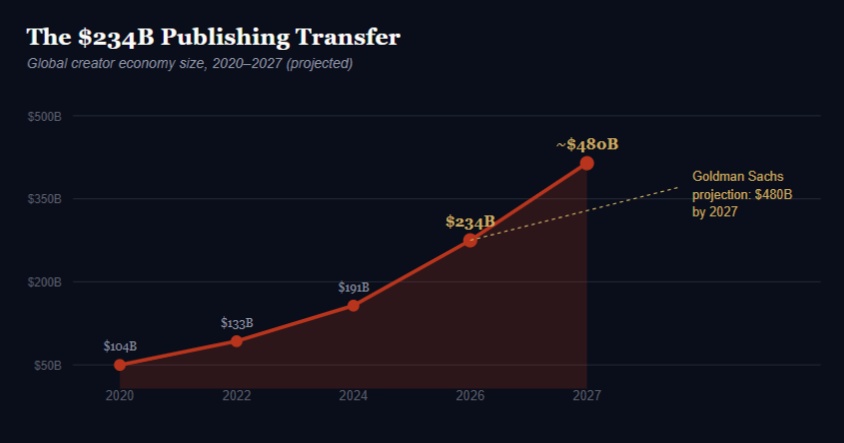
In the United States in 2026, brands will spend more than $21 billion on creator partnerships — a figure that has more than doubled since 2022. Globally, the broader creator economy now exceeds $234 billion. Eighty-six percent of US marketers use influencer marketing, and seventy-four percent plan to increase their budgets again this year. These numbers are real and consequential, but they obscure the more important story underneath: the brands writing those checks are not really buying audience. They are quietly buying publishing infrastructure.
This distinction matters because the marketing industry continues to discuss creators using vocabulary inherited from the influencer era — reach, impressions, engagement rate, follower count. That vocabulary is increasingly incapable of describing what is actually happening. The most consequential creators in 2026 are not "influencers." They are publishers — operating with editorial calendars, audience trust, vertical specialization, and authority signals that increasingly rival those of established media properties.
The brands that grasp this distinction are rewriting their PR stack accordingly. The brands that do not are paying premium rates for transactional posts that produce diminishing returns.
$234B
global creator economy size in 2026 — up from $104B in 2020
$5.78
average revenue returned per $1 spent on influencer marketing; top programs exceed $18
49.9%
share of US creator spend now going to nano and micro creators — up from <20% a few years ago
From Influencer to Publisher: The Structural Shift
The first generation of influencer marketing — roughly 2014 through 2021 — was about discovering audiences inside walled-garden social platforms and renting access to them. The unit of work was a sponsored post. The metric was reach. The economics were a function of follower count.
That model has fragmented. The creators who matter now sit at the intersection of three things the legacy influencer category never quite had: subject-matter expertise, persistent audience relationships (newsletters, podcasts, owned channels), and editorial cadence. They are not personalities renting access to followers. They are publishers operating one-person — or small-team — media properties with topical authority that AI engines now treat as citation-worthy.
The implications run in every direction. Max Willens of EMARKETER framed it bluntly at the Creator Trends 2026 Summit: creators have graduated from being a shiny object to being a critical plank in nearly every CMO's strategy. The industry has moved away from hunting for cheap reach.
Why Brand Creator Content Fails as PR
Many brands have responded to the creator-as-publisher shift by pouring more spend into traditional influencer partnerships — and have been disappointed by the diminishing returns. The diagnosis is usually simple: those campaigns were structured as advertising, not as press.
The difference matters. A sponsored creator post is disclosed advertising. It is appropriately discounted by AI engines, treated skeptically by audiences, and contributes nothing meaningful to the entity graph the algorithm uses to evaluate brand authority. A creator-authored editorial endorsement — where the creator's substantive analysis features the brand on their own terms, within their own editorial voice — is something else entirely. It functions as third-party validation. It compounds.
This is the gap most brands miss. Buying a sponsored post from a creator gets you reach. Earning genuine editorial coverage from that same creator — coverage they would write, link to, and stand behind — gets you authority that scales.
The Creator Newsroom Thesis
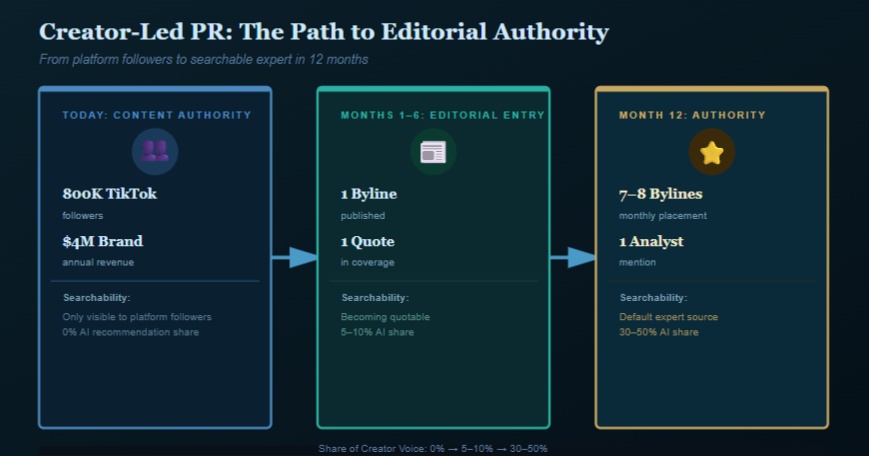
Treat the leading independent voices in your category not as influencer partners, but as media properties. They have an editorial calendar. They have an audience that trusts their judgment. They have publishing infrastructure — newsletters, podcasts, video channels, communities — that distributes their work in perpetuity.
It changes who in the brand owns the relationship. Influencer marketing typically reports into paid social or brand marketing. Creator-as-publisher relationships should sit closer to PR, communications, and analyst relations — the functions accustomed to managing media properties rather than ad buys.
It changes the deliverable. Instead of branded posts measured in impressions, the unit becomes editorial coverage — long-form video, podcast features, newsletter editions, substantive write-ups — measured in citations, branded search lift, and qualified referral traffic.
It changes the economics. Average influencer CPM dropped to $2.68 in 2025, down 42% year over year. The channel is getting dramatically more efficient — but only for brands that have the infrastructure to repurpose creator output across their full marketing stack rather than treating each post as a one-off.
How One Creator Asset Becomes Editorial Press
The economics break in the brand's favor when a single creator artifact — a podcast episode, a long-form YouTube video, a vertical-specific newsletter feature — becomes the seed for distributed editorial coverage across multiple publisher properties.
The mechanism is simple in description and powerful in compounding. A subject-matter creator covers your brand in their native format. That coverage becomes the source material for editorially-written articles placed on publisher properties in adjacent verticals. Each placement carries the original creator's authority as the cited source, the publisher's authority as the placement venue, and your brand as the named subject — three authority signals stacked into one cohesive content unit.
This is the workflow DropPR was purpose-built to operate. A creator's video becomes a publisher-hosted article. The article becomes an AI citation. The citation becomes branded search. The branded search becomes the conversion. The flywheel runs not because any one piece worked but because each piece reinforced the others.
What This Means for Your 2026 Roadmap
Stop benchmarking creator spend against paid social CPMs. The comparison is wrong. Benchmark it against your PR retainer, your wire distribution spend, and your trade-publication advertising — those are the budgets the work should actually displace.
Build a creator newsroom roster. Five to fifteen substantive independent voices in your category — newsletter operators, podcast hosts, vertical YouTube creators, Substack writers — whom you treat as media properties. Pitch them like you would pitch a reporter. Provide them with sources, data, and substantive content. Compensate appropriately when they do branded work.
Convert creator output into editorial asset multiples. A single creator placement that lives only on a creator's platform is one impression of value. The same placement, converted into editorial articles on adjacent publisher properties, indexed for AI citation, and used as source material for entity-graph reinforcement, is five to ten impressions of value over time — without proportional incremental cost.
Further Reading · Curated by the DropPR Editorial Desk
U.S. Creator Marketing Spending To Surpass $21B As Brands Move Beyond SocialNet Influencer / EMARKETER
The 2026 State of Influencer MarketingJem Social
Influencer Marketing Trends 2026CreatorIQ
2026 Influencer Marketing Budgets: How Brands Are Allocating SpendAspire
Influencer Marketing Benchmark Report 2026Influencer Marketing Hub
Convert Creator Content Into Editorial Press
Turn one creator video into publisher-hosted press — in under 10 minutes.
Upload a video, paste a YouTube, TikTok, Instagram, or podcast link, and DropPR transforms it into a professionally written, editorial article distributed across licensed publisher properties. The creator gets reach. Your brand gets authority. The AI engines get a citation.
Creator-to-Press Conversion Stack
AI-powered video-to-editorial-article transformation ($800 value)
Human editorial review and publisher-style polish ($400 value)
Placement on a high-authority licensed publisher ($800 value)
Branded backlink + full conversion tracking ($400 value)
30-day performance dashboard with citation monitoring ($300 value)
Repurposing rights for paid social and owned channels (Included)
Total stack value: $2,700 Charter pricing from $99.
For brands, agencies, and creators. No subscription. Pay per placement.
Data Sources Referenced
EMARKETER (Feb 2026) · U.S. creator revenue to reach $21.10B in 2026; nano/micro share 49.9% of U.S. spend.
Jem Social State of Influencer Marketing 2026 · Global creator economy at $234B; influencer marketing industry exceeds $40B; CPM dropped to $2.68 in 2025.
Goldman Sachs Research · Creator economy projection of ~$480B by 2027.
Influencer Marketing Hub Benchmark Report 2026 · Industry reached $32.55B globally; 33.11% CAGR.
Aspire State of Influencer Marketing 2026 · 74% of marketers planning to increase budget; 86% of US marketers using influencer marketing.
Multiple sources · Brand ROI of $5.78 per $1 spent on average; top programs exceed $18 per $1.
Hayden Hollis
Head of Growth Marketing · DropPR.ai
Hayden Hollis writes about content distribution, digital PR, SEO, AI search, and creator marketing. His work focuses on how brands and creators can extend the reach of their content beyond social media and improve visibility across search engines, news publishers, and AI-powered discovery platforms. He regularly covers strategies related to earned media, audience growth, authority building, and the evolving role of AI in online discovery.