The Founder Channel: Why Personal Brand Is Now the Most Valuable Distribution Asset in B2B
LinkedIn company pages have quietly lost most of their organic reach. Founder profiles are now the highest-leverage owned channel a B2B brand has — and the brands treating earned media as an amplification input for founders, rather than the other way around, are running away with the category.
By Hayden Hollis
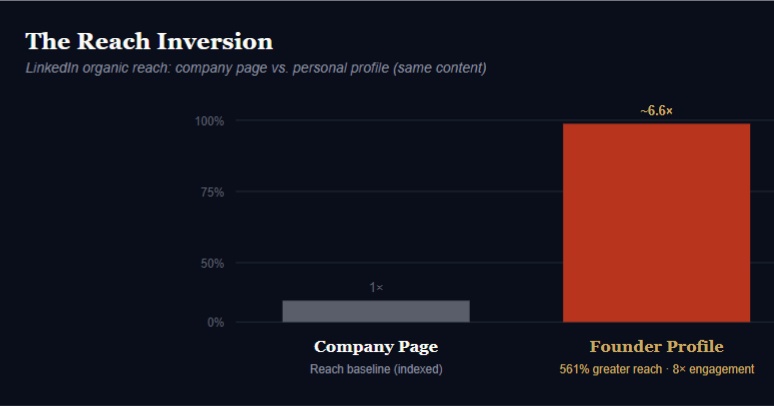
The most overlooked development in B2B distribution between 2024 and 2026 is the quiet collapse of LinkedIn company-page reach. Most marketing teams have noticed the symptom — their company posts get fewer impressions than they used to — without diagnosing the structural shift behind it. LinkedIn's algorithm now systematically deprioritizes brand-handle content in favor of content from named individuals, and the gap is not subtle. Company-page reach has dropped sixty to sixty-six percent since 2024. Personal profiles, posting the same content, now generate more than five times the reach.
This is not a quirk to be fixed by better company-page content. It is the result of LinkedIn explicitly tuning its algorithm to favor what it considers more trustworthy: posts from identified humans with verifiable backgrounds and reciprocal social graphs. Brand handles, by design, lack those properties. The platform is rewarding what the platform's users actually engage with — and what they engage with is people.
The consequence for B2B marketing is operationally consequential. The most valuable distribution asset most B2B brands have in 2026 is not their website, not their company page, and not their email list. It is the personal profile of their founder.
561%
greater LinkedIn reach for personal profiles vs company pages posting identical content
63%
of buyers consider a CEO more credible than the company's communications department
80%
of B2B social-sourced leads come through LinkedIn in 2026
Why the Algorithm Favors People
LinkedIn's algorithm in 2026 is built around three signals: peer-to-peer engagement velocity, network density, and content authenticity. Brand handles fail on all three by design. They have no peers; they have followers. Their network is unidirectional. Their content is parsed by the algorithm as more likely to carry a commercial agenda. None of this is a punishment. It is a structural truth about how the platform now ranks distribution.
The same content posted from a founder's profile flips every one of those signals. Peer-to-peer engagement is the dominant input — comments from other identified humans inside the first sixty minutes determine reach amplification. Network density is reciprocal, with mutual connections multiplying second-degree distribution. Content from named individuals carries the algorithmic trust premium that brand handles structurally cannot.
The Founder as Distribution Infrastructure
The strategically correct framing is not that founders should occasionally post on LinkedIn. It is that the founder's personal brand has become distribution infrastructure for the company — a published, persistent, algorithmically-favored channel through which earned media, product news, hiring announcements, and category commentary all reach buyers and partners more effectively than through the company channel.
For most B2B companies under $50 million in revenue, this is the largest underused distribution asset on the balance sheet. Building it is a sequencing problem more than a creative one. The founder needs a consistent voice, a defined set of content pillars, a publishing cadence of three to five posts per week, and a feedback loop that connects content output to pipeline.
ChannelReach / Conversion in 2026Best Used ForFounder Profile5–8× engagement vs company page; 2–5% MQL conversion of engaged readersThought leadership, category POV, recruitment, earned media amplificationExecutive Profiles3–6× engagement vs company page; subject-matter authority compoundsFunctional expertise, customer trust, expansion of authority surfaceEmployee Advocacy10× aggregate reach of company page; 7× lead conversionRecruiting amplification, customer-success stories, culture signalCompany PageBaseline; ~60-66% reach decline since 2024Paid campaigns, hiring, brand credibility check, official announcements
Why Earned Media Is the Force Multiplier
The most underused move in founder-led marketing is the deliberate use of earned media as content for the founder's personal channel. The mechanics are straightforward: a publisher names the founder in an editorial article, the founder shares that article from their personal profile with substantive commentary, and the post is consumed by an audience that already trusts the founder — with the publisher's third-party validation attached.
This sequence produces three effects at once. The founder's audience sees external validation that confirms their existing trust. The publisher's audience encounters the founder via the publisher's authority. The algorithm reads the engagement as high-quality, high-trust content and extends its reach materially beyond either input alone.
What Founder Channels Actually Need to Work
Cadence floor of two to three substantive posts per week. Below this rate the algorithm does not maintain the network warmth that drives reach. Posting more than once a day suppresses per-post reach for most accounts. The sweet spot for most B2B founders is three to five posts per week with consistent timing.
Three to four content pillars at the intersection of founder expertise and audience interest. Founder lessons and failures. Category POV and contrarian takes. Behind-the-scenes operating insight. Customer outcomes. Rotating through these pillars maintains coherence while producing variety.
Engagement velocity in the first sixty minutes. The LinkedIn algorithm tests every post against early engagement — likes per minute, comments per impression, response speed from the author. A coordinated team of five engaged readers in the first hour materially changes the post's distribution outcome.
Native formats over external links. Posts with external links receive 40% less initial reach. The right move is native text or carousel content with the link in the first comment, where it produces traffic without suppressing the post.
Why CMOs Should Build This Channel This Year
Personal brand authority compounds on a six-to-twelve-month curve. A founder profile that starts producing content in May 2026 will be a measurably more powerful distribution asset by November than the same profile started in November will be by May 2027. The window for compounding is real, and it is bounded — competitors are running the same playbook, and category share-of-voice on personal profiles is increasingly contested.
The cost of building the channel is small. The cost of not building it, in a market where personal profiles now outperform company pages by orders of magnitude, is the slow loss of distribution leverage relative to category competitors who do.
Further Reading · Curated by the DropPR Editorial Desk
Earn Media. Amplify Through the Founder.
Editorial placements that name your founder — amplified through their personal channel for compounding reach.
DropPR places your founder inside the editorial conversation, then provides the LinkedIn amplification kit that converts each placement into measurable distribution through the highest-leverage owned channel you have.
Founder Authority Stack
Editorial placement naming your founder as quoted expert ($1,200 value)
LinkedIn amplification kit: post template, comment plan, video script ($400 value)
Engagement orchestration brief for first-60-minute velocity ($250 value)
30-day follower-growth and pipeline-attribution dashboard ($300 value)
Bonus: 10-post founder content calendar in your category ($350 value)
Stack value: $2,500 Charter pricing from $99.
For founders, CEOs, and executive teams building category authority through LinkedIn.
Data Sources Referenced
Ordinal (Jan 2026) · LinkedIn company-page reach down 60–66% since 2024; personal profiles 561% greater reach.
Refine Labs · Employee posts 2.75× impressions, 5× engagement vs company page despite 46% fewer followers.
Hey Sid · 2024 B2B Marketing Benchmark Report citing 8× engagement gap between personal and company.
Edelman Trust Barometer · 63% of buyers find CEO more credible than communications department.
Workflows.io (May 2026) · Founder-led marketing as primary B2B GTM motion; compounding curve.
Heropost (April 2026) · Personal posts receive 5–7× more organic reach than company-page posts.
Hayden Hollis
Head of Growth Marketing · DropPR.ai
Hayden Hollis writes about content distribution, digital PR, SEO, AI search, and creator marketing. His work focuses on how brands and creators can extend the reach of their content beyond social media and improve visibility across search engines, news publishers, and AI-powered discovery platforms. He regularly covers strategies related to earned media, audience growth, authority building, and the evolving role of AI in online discovery.