Video as a Primary Source: Turning Short-Form Content Into Citable Editorial
Video content is invisible to AI citation systems. The same expert insight that earns zero citations as a YouTube video can earn consistent AI citation share as an editorial article on a trusted publisher. A six-step end-to-end workflow — source video selection, insight extraction, editorial structuring, publisher-standard writing, placement, and LinkedIn amplification — for converting any substantive video into a compounding citation asset.
By Hayden Hollis
There is a content format that B2B brands and creators are producing at scale, that their buyers consume at scale, and that AI engines almost entirely ignore as a citation source. That format is video. A founder's thirty-minute YouTube breakdown of their industry's biggest problem. A TikTok series walking through a workflow step by step. A podcast episode where a subject-matter expert makes a genuinely novel argument about category dynamics. These are substantive, credible, expert-produced pieces of content — and because they live in a video format, they are functionally invisible to the retrieval systems that determine AI citation share.
The gap is structural, not permanent. Video content is not inherently uncitable — it is uncitable in its native format. The audio and visual information inside a video cannot be retrieved by a text-based RAG system. But that information, converted into a well-structured editorial article and placed on a publisher AI engines already trust, becomes citable immediately. The insight is the same. The expert is the same. The only thing that changed is the format.
This article describes the end-to-end workflow for converting video content — YouTube, TikTok, Instagram, podcast — into citable editorial articles. It is the core workflow DropPR was built to operate, and it is the fastest path most brands and creators have to building citation share from content they are already producing.
$234B
global creator economy producing video content that is largely uncitable by AI engines in its native format
~25%
of AI tool citations come from editorial sources — the format video content must be converted into to earn citation
3–10
days: typical cycle time from video upload to published editorial article on a trusted publisher
Why Video Is Invisible to AI Citation Systems
Retrieval-augmented generation works by searching a corpus of text passages. The retrieval system uses vector similarity — comparing the semantic meaning of a query against indexed text — to find relevant passages and incorporate them into a synthesized answer. It does not process audio. It does not interpret video frames. It does not transcribe YouTube content at retrieval time.
This means a video that contains genuinely novel expert insight — the kind of content AI engines would cite if they could read it — is simply absent from the retrieval corpus. The insight exists. The expert is credentialed. The content is substantive. But from the perspective of every AI engine your buyers use, the video might as well not exist.
The conversion workflow closes this gap. It takes the insight from the video, structures it for passage-level extraction, attributes it to the named expert, places it on a publisher the model already trusts, and submits it for indexing. The same insight that was invisible in video format becomes a citable editorial source within days.
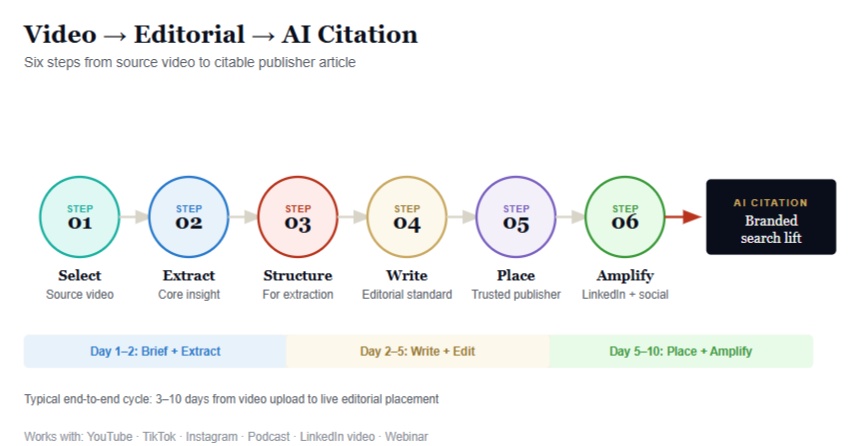
The Video-to-Editorial Workflow: Six Steps
Step 1 — Select the right source video. Not every video converts equally. The highest-value source videos share three properties: they contain a named expert (founder, CEO, subject-matter specialist) making substantive, specific claims about a category problem or solution; they run at least eight to ten minutes, providing enough substance for a 600–1,000 word editorial article; and they address a topic directly connected to the queries your buyers ask AI engines. Shorter brand-promotional videos, product demos, and event recaps rarely contain enough substantive expert content to produce a credible editorial article. Longer thought-leadership content — founder essays, category analysis, customer-problem breakdowns — converts best.
Step 2 — Extract and transcribe the core insight. The goal of this step is to identify the two to four central claims the expert makes in the video — the specific, attributable, evidence-backed arguments that make the content worth citing. These are not the anecdotes, the asides, or the production framing. They are the claims that, if extracted and placed in a trusted editorial article, would give an AI engine something specific and corroborated to cite when a buyer asks about this topic. For a 20-minute video, the extractable core insight is typically 400–600 words of substantive content — the rest is context, illustration, and conversation.
Step 3 — Structure the article for extraction. The extracted insight must be restructured for editorial publication and passage-level retrieval. This means: opening with a definitional or thesis sentence that states the article's central claim directly; organizing the body into clearly-labeled sections, each addressing a sub-claim or supporting argument; using the expert's name and credentials in proximity to each key claim; and closing with a clear, standalone summary of the argument. The article should be structured so that any 100–200 word section can stand alone as a citable passage — because that is how retrieval systems will use it.
Step 4 — Write to publisher editorial standard. The article must read as editorial content, not as a video transcript or a marketing document. This means removing the verbal filler and conversational register of spoken content; adding editorial context (statistics, external references, category framing) that the video may have assumed rather than stated; and ensuring that all claims are attributed, sourced, or clearly framed as the expert's stated position. A publication that accepts the article for placement is staking its editorial reputation on its accuracy and quality — the writing must meet that standard.
Step 5 — Place on a publisher the AI engine trusts. The conversion from video insight to AI citation only completes when the article is placed on a property already in the model's retrieval corpus as a trusted source. A self-published Medium post, a brand blog, or a low-authority aggregator does not close the circuit — the model does not retrieve from these with the same confidence as it retrieves from established editorial properties. The placement must be on a domain with established editorial credibility in the relevant category. This is the step that produces the citation — everything before it is preparation.
Step 6 — Amplify through the video's original channel. Once the editorial article is live, the loop closes by returning the content to the video's original distribution channel. The creator or founder shares the article from their personal LinkedIn or social profile with a brief commentary linking the original video to the published piece. This produces three simultaneous effects: the LinkedIn post reaches the creator's existing audience with third-party editorial validation attached; the outbound link from LinkedIn to the publisher builds additional authority signal; and the branded search that follows the combined exposure reinforces the entity-category association in the knowledge graph. The article references the video; the video drives traffic to the article; both reinforce the same expert-brand association.
What Makes a Good Source Video: A Checklist
Named expert on camera or on mic. Anonymous or brand-voiced video does not produce the person-entity association that strengthens AI citation. The expert must be identified by name and title in the video and in the resulting article.
Specific, attributable claims. "AI is changing marketing" is not citable. "AI Overviews now appear on 48% of search result pages and are eliminating referral traffic for informational queries in software and professional services categories" is citable. The video must contain specific, attributable, evidence-backed claims — not generic category commentary.
Category-relevant topic with documented buyer demand. The topic must correspond to a query your buyers actually ask AI engines. If the video addresses a topic that does not appear in your prompt-to-citation query map, the resulting article will earn citation for queries that do not drive your pipeline. Source video selection should be driven by citation gap analysis, not by which videos performed best on social.
Minimum eight to ten minutes of substantive content. Shorter videos rarely contain enough extractable substance for a credible 600–800 word editorial article. A 60-second TikTok with a single insight can contribute a quote or a supporting data point to a larger article, but typically cannot anchor one on its own.
The Compounding Value of a Single Video Placement
A well-executed video-to-editorial conversion produces citation value that compounds well beyond the single article. The editorial article on the publisher generates ongoing retrieval events every time the topic is queried. The LinkedIn amplification drives branded search that reinforces the entity-category association. The expert's credibility compounds across the knowledge graph — each new article attributed to them strengthens their person entity, which strengthens the brand entity through the worksFor relationship.
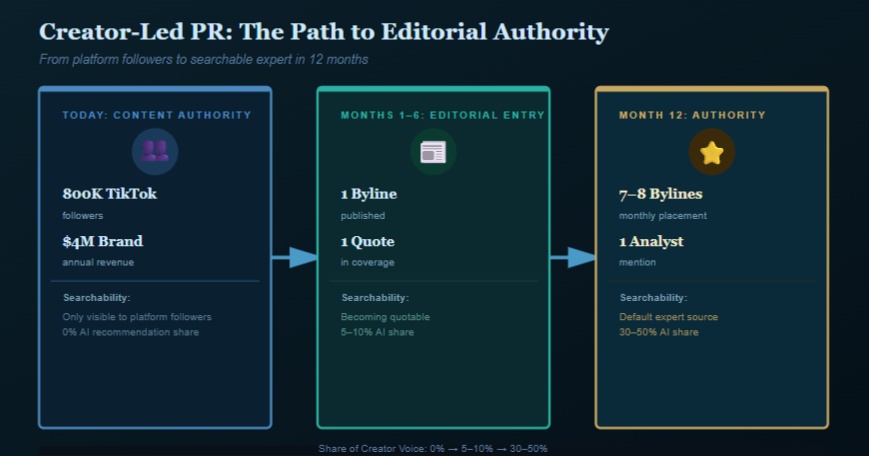
For brands already producing regular video content — weekly YouTube essays, daily TikToks, biweekly podcast episodes — the workflow above means that every substantive video already produced represents an unrealized citation asset. A 90-day retrospective of a brand's best expert video content, converted into editorial articles and placed on trusted publishers, typically produces more citation share improvement than any equivalent investment in new owned content creation.
The content already exists. The workflow converts it into the format AI engines can read, trust, and cite.
Further Reading · Curated by the DropPR Editorial Desk
U.S. Creator Marketing Spending To Surpass $21B As Brands Move Beyond SocialNet Influencer / EMARKETER
The 2026 State of Influencer MarketingJem Social
Turn Your Video Into a Citation
Upload a video. Get an editorial article. Earn AI citation share.
DropPR runs the complete six-step video-to-editorial workflow: insight extraction, editorial structuring, publisher-standard writing, placement on a trusted AI-cited property, and LinkedIn amplification kit. One upload — one citation asset that compounds.
Video-to-Editorial Conversion Stack
Insight extraction and editorial structuring from your video ($600 value)
Publisher-standard editorial article (600–1,000 words) ($800 value)
Placement on a trusted AI-cited publisher ($800 value)
LinkedIn amplification kit for the expert/founder ($300 value)
30-day citation share lift tracking post-placement ($400 value)
Total stack value: $2,900 Charter pricing from $99.
For brands, agencies, and creators. No subscription. Pay per placement.
Data Sources Referenced
Jem Social · State of Influencer Marketing 2026 · $234B global creator economy; creator-to-press conversion flywheel.
Muck Rack (via PR.co, Dec 2025) · ~25% of AI tool citations from editorial/journalistic sources.
Net Influencer / EMARKETER (Feb 2026) · Creator marketing spending and video content production at scale.
Frase (2026) · GEO Playbook; passage-level retrieval and extractable content structure requirements.
LLMrefs (2026) · Retrieval-augmented generation; text-only retrieval corpus and video invisibility.
Later (2026) · Creator budget allocation and video-to-editorial content repurposing trends.
Hayden Hollis
Head of Growth Marketing · DropPR.ai
Hayden Hollis writes about content distribution, digital PR, SEO, AI search, and creator marketing. His work focuses on how brands and creators can extend the reach of their content beyond social media and improve visibility across search engines, news publishers, and AI-powered discovery platforms. He regularly covers strategies related to earned media, audience growth, authority building, and the evolving role of AI in online discovery.